This was the year that the CEB began existence and it saw an array of world-changing events. We take a tour of some of the goings-on in this momentous year.
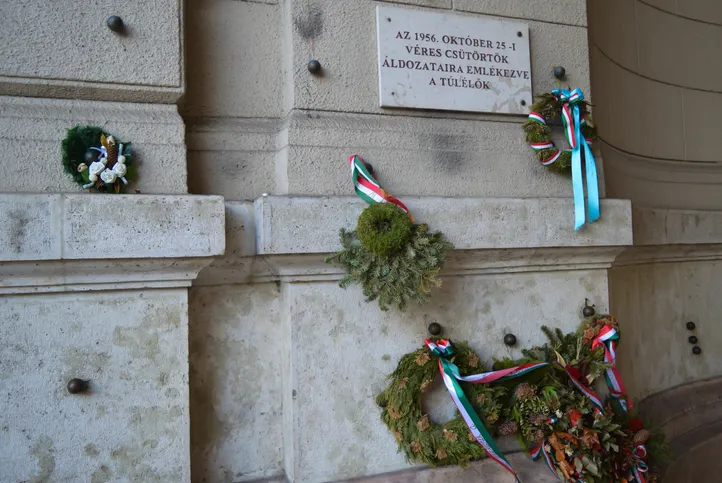
Hungarian Revolution of 1956 Memorial in front of Hungarian Parliament Building in BudapestPOLITICS
If you’d opened the New
York Times on 1 January 1956 you might have seen an article which included
the prophetic sentence, ‘We can say this year more than ever before that the
future depends on the courage, the resolution and the energy of democratic
man.’ In fact, few people could have anticipated quite how dramatic the
events of the next 12 months would be. And how far-reaching their
consequences.
---
In the USSR, in a supposedly secret speech at the
20th congress of the Communist party, President Nikita Khrushchev
denounces his predecessor, Josef Stalin, for his failure of leadership. The
speech, entitled ‘On the cult of personality and its consequences’, signals
the beginning of the destalinisation of the USSR. Its content rocks the Eastern
Bloc, with protesters in Georgia and Poland seizing the opportunity to push
for freedom from their Soviet leaders. Their protests are crushed by Soviet
forces.
In Poznań, Poland, unarmed
workers bitterly resentful of high prices and low wages take to the streets
carrying placards reading ‘we want to eat’ and chanting ‘bread, bread,
bread’. They are fired on by the Soviet-run army and security forces. Scores
of people are killed and many more are injured.
In Hungary, it looks as
though the forces of freedom may win out as rebels win the first phase of the
Hungarian Uprising. Imre Nagy becomes premier, declares Hungarian neutrality
and agrees to establish a multiparty system. However the revolution is
short-lived. Invading Soviet forces brutally crush protests. Nagy is
executed, some 2,500 Hungarians are killed, along with 700 Soviet troops, and
hundreds of thousands flee.
In Egypt, an attempt by England and France to take back
control of the Suez Canal after it is nationalised by President Nasser draws
strong condemnation from the US and USSR. The Anglo-French forces withdraw
but hostilities between the US and USSR bring them to the brink of nuclear
confrontation.
In the USA, in Montgomery, Alabama, the home of
Martin Luther King is bombed. His wife and baby daughter are home at the time
but are unharmed. King had taken a leading role in the recent Montgomery bus
boycott, when African Americans refused to ride on the city’s buses to
protest against segregated seating and the arrest of Rosa Parks for her
refusal to give up her seat for a white passenger. No one is ever prosecuted
for the bombing.
In South Africa, 20,000 women of all races protest in
Pretoria against the introduction of the Apartheid pass laws, which were used
to separate black South Africans from the rest of the population and limit
their movement. Initially the pass laws largely apply to African men, but
attempts to apply it to women lead to marches like this one. Pass laws were
one of the dominant features of the apartheid system, and the pass book, or
dompas, becomes a reviled symbol of apartheid.
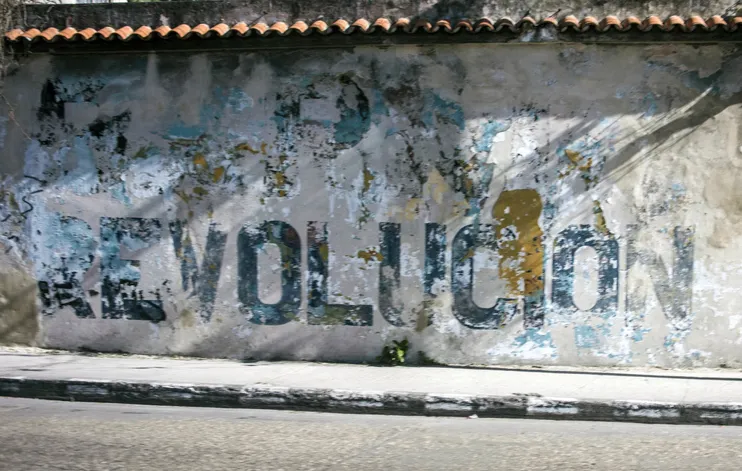
In Cuba, revolutionary forces of the 26th
of July Movement, led by Fidel Castro and Che Guevara, land on Cuba intent on
overthrowing the military dictatorship of President Fulgencio Batista. The
revolution actually begins in 1953 and Batista is finally ousted at the end
of 1958. The Cuban Revolution transforms Cuba’s relations with the US.
Cuban revolution grafitti
HEALTH & TECHNOLOGY
IBM
releases the first computer with a hard drive, the IBM 305 RAMAC. The computer weighs around a ton and
needs to be moved by forklift. The hard drive can store about 5 megabytes of
data and allows users to retrieve data without the use of punch cards. The
development kick starts the development of the computer systems we use today. Britain
passes the Clean Air Act. The Act aimed to
tackle the air pollution and smog in London, caused by the industry and the
burning of coal. In 1952 the ‘great smog’ in the capital led to over 4,000
additional deaths.
The first transatlantic
telephone cable goes into operation.
Named TAT-1, it initially carries 36 telephone channels. In its first 24
hours of service there are 588 London to US calls and 119 calls from London
to Canada. The cable is upgraded over the years and is retired in 1978.
CULTURE
The first Eurovision
Song Contest is held.
Seven countries from across Europe enter the competition with singers singing
two original songs each. The songs are judged by panels from the other
nations. The inaugural competition is won by Lys Assia from Switzerland. The Eurovision
has continued every year since 1956, and now as many as 43 countries take
part.
Elvis Presley releases
Heartbreak Hotel. The
song tops various charts in the US and internationally for many weeks. It’s
Presley’s first million-seller and one of the best-selling singles of 1956.
In 2004 Rolling Stone magazine names it one of the 500 greatest songs of all
time.
‘My
Fair Lady’ debuts on Broadway. The musical, created by Lerner and Loewe, is
based on George Bernard Shaw's 1913 play ‘Pygmalion’ and stars Rex Harrison
and Julie Andrews. The show is nominated for ten Tony Awards and wins six. It
runs until September 1962, making it the longest running musical at that
time.
***
The CEB was established in 1956
by eight member states of the Council of Europe on the basis of a partial
agreement in order to bring solutions to the problems of refugees. Read more
aboutour history.