Insights on the joint CEB-OECD Conference on the Local Integration of Refugees
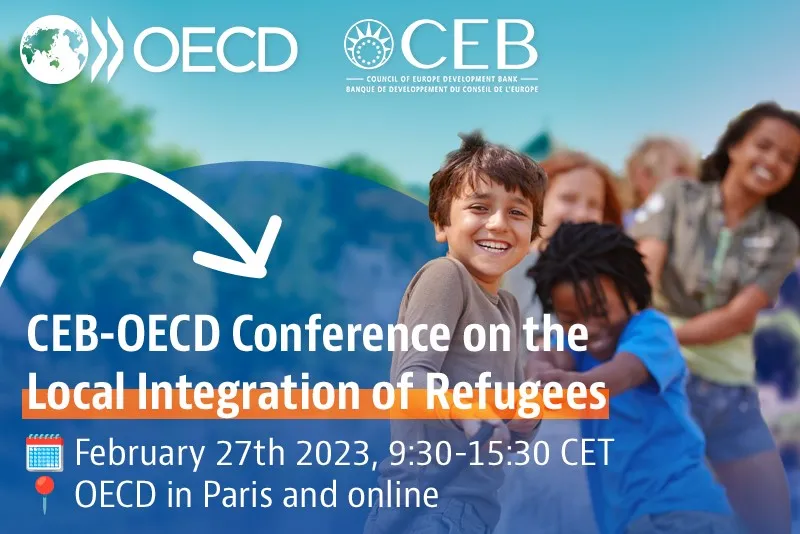
One year after Russia’s aggression against Ukraine, the CEB and the OECD Centre for Entrepreneurship, SMEs, Regions and Cities (CFE) jointly organised an expert-level conference to reflect and reassess how well European reception and integration systems function at the local level during "refugee shocks". Based on the CEB and the OECD research as well as experience from practitioners, the conference aimed at highlighting the key role played by sub-national authorities in the integration of refugees. The panel debates focused on identifying policy and financing challenges and opportunities for all stakeholders involved.
 The event benefitted
from the insights of seventeen high-level speakers from non-governmental
organisations, regional and local authorities, international organisations, and
the research sector. Opening statements
were delivered by the CEB’s Vice Governor in charge of Social Development,
Johannes Böhmer, and by the OECD’s Deputy Director of the CFE, Nadim Ahmad.
Over 150 people joined the event, both remotely and in person.
The event benefitted
from the insights of seventeen high-level speakers from non-governmental
organisations, regional and local authorities, international organisations, and
the research sector. Opening statements
were delivered by the CEB’s Vice Governor in charge of Social Development,
Johannes Böhmer, and by the OECD’s Deputy Director of the CFE, Nadim Ahmad.
Over 150 people joined the event, both remotely and in person.
The CEB and the OECD are confident that the conversations and ideas exchanged during this conference will contribute to shaping resilient and responsive refugee integration practices in an uncertain future.
As outlined by Dorothée Allain Dupré, Head of the OECD’s Regional Development and Multi-level Governance Division, the conference enabled the identification of eight main take-aways to strengthen refugee support and integration systems.
- In light of an
increased politicisation of integration policies, providing evidence and data
is fundamental.
- Sharing inspiring
examples of successful integration initiatives from different parts of the
world is essential for regions, cities and governments to continue improve
their integration policies.
- Multi-sector
and multi-level governance are an imperative in the management of the refugee
crisis, as a lack of coordination across these different layers affects the
delivery of critical public services.
- Developing place-based
approaches is necessary to ensure the integration of refugees. A one-size-fits-all
approach will not = work.
- Ensuring a
more geographically balanced contribution of migrants to regional development
is a key challenge, which depends on creating the right coordination mechanisms
across levels of government.
- NGOs play a
critical role in supporting refugees, both in terms of providing direct
assistance and creating opportunities for employment and social interaction.
- Sub-national
governments need financial and administrative support to make the most of
existing funding sources.
- The “dual-intent” approach to integration should be promoted. That consists of = making sure that the skills of refugees continue to be built and their integration facilitated, while at the same time not hampering their return home once the situation allows.
Learn more:
- about the event, find on this page the detailed agenda of the event
- about the OECD work on the local integration of migrants
See also the presentations of our speakers and the full concluding remarks:
- Edo Omic’s (CEB) presentation
- Ave Lauren’s (OECD) presentation
- Margaux Tharaux’s (OECD) presentation
- Dorothée Allain-Dupré’s (OECD) conclusions