The intersection of housing and inequalities in the Western Balkans
Housing is unquestionably a fundamental necessity for all people, and in the Western Balkans severe shortfalls, costs, and quality of housing are making life harder for many.
 In fact, the high
cost and low quality of housing in many Western Balkans countries are
reinforcing socioeconomic inequalities and limiting the potential for human
capital growth in the region. Roughly 55% of the region’s households report
problems with high rates of overcrowding, with a quarter of such households
also suffering from poor
insulation, or severe degradation of their home (leaks, mold, etc.)- problems that
are all the more prevalent in low-income households.
In fact, the high
cost and low quality of housing in many Western Balkans countries are
reinforcing socioeconomic inequalities and limiting the potential for human
capital growth in the region. Roughly 55% of the region’s households report
problems with high rates of overcrowding, with a quarter of such households
also suffering from poor
insulation, or severe degradation of their home (leaks, mold, etc.)- problems that
are all the more prevalent in low-income households.
The low quality of homes can have negative consequences on the physical health of those living within them (for example via the development of respiratory diseases) and the educational outcomes of children that are not provided with adequate space for schoolwork. Furthermore, the poor quality of houses often makes them less energy efficient, which contributes to the high rate of energy poverty in the region (32% of those living in relative poverty were unable to keep their homes adequately warm in 2019 [1], 2).
The Housing Market in the Western Balkans
In the 1990s the privatisation process helped drive up current high ownership rates. People were given an opportunity to acquire their previously state-provided homes at a heavily discounted price. According to Eurostat data, today the majority of households in the region own their home (without a mortgage), ranging from a low of 84% of households in Serbia to 96% in Albania.
However, after the wave of housing privatisation, these new homeowners often faced an evolving political and economic environment that at times resulted in subdued employment and wage growth opportunities, limiting their capacity to invest in home maintenance and improvements. Adding to these challenges, housing-related costs, such as utility prices, have been gradually increasing, while real wage growth has been relatively low.
Housing issues aggravate inequalities in the region
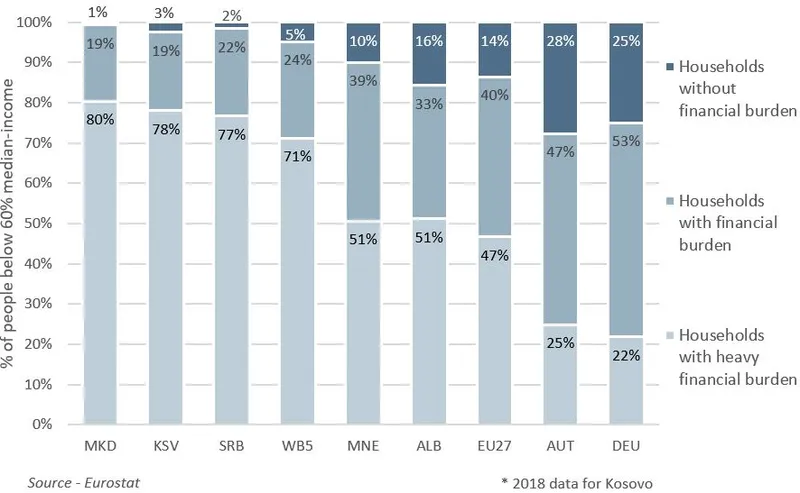
Many households struggle with high housing costs, energy poverty, overcrowded homes and material and social deprivation. The relative financial burden of housing is significantly higher in the Western Balkans compared to the EU, particularly for those living in relative poverty [2] (see figure 1).
Cost pressures are exacerbated by high energy costs, 51% of those in relative poverty reported being behind in their utility payments in 2019. Furthermore, 55% of homes in the region were overcrowded in 2019 [3] (compared to the EU rate of 17%), with 27% of overcrowded homes also suffering from leaking roofs, no indoor toilet/shower or insufficient indoor lighting. Issues like these aggravate existing socioeconomic differences, hinder efficient human capital formation, and affects the perceived quality of life of occupants.
Housing issues may influence the decision to emigrate abroad
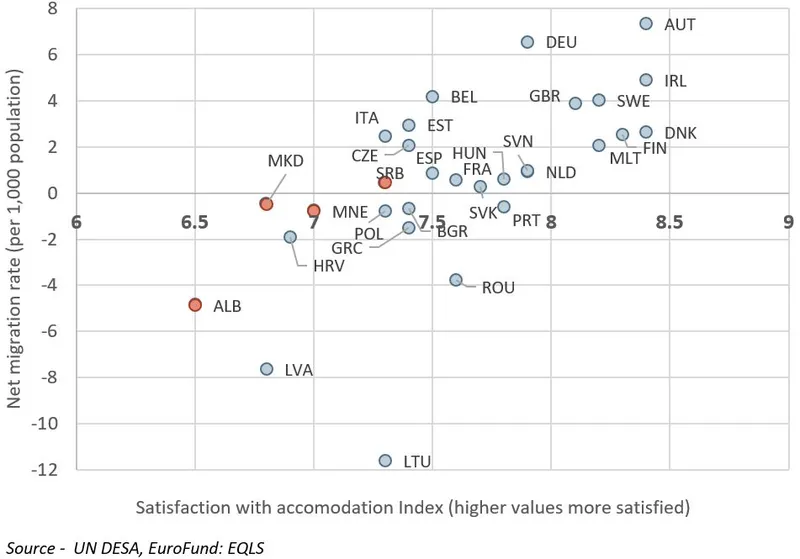
Although the factors influencing the decision to move abroad vary greatly between any individual’s unique circumstances [4], difficulties to find and afford quality housing has become an increasingly cited rationale for choosing to leave the region.
Housing inequalities often echo the wider socioeconomic difficulties of a region. While only a correlation, figure 2 shows that countries with lower housing satisfaction rates generally tend to have increased negative net-migration figures. Housing has for some become an additional obstacle that prevents them from improving the quality of life for themselves and their families, further motivating the decision to emigrate.
Increased attention needed for housing investments
The region needs more inclusive housing policies to help improve the wellbeing of households; such as supporting healthy living conditions not deteriorating them or to provide children with a safe space to learn and play. More investment in housing is clearly needed to develop new housing and modernize existing stocks - which will go a long way to help alleviate the high financial burdens and energy poverty associated with the region’s current housing market.
Read more on housing issues and why more robust and resilient social infrastructure is an important aspect to achieve economic prosperity and inclusive growth in the region in the CEBs latest report: Social infrastructure in the Western Balkans: Increasing the region’s economic resilience, enhancing human capital and counteracting the effects of Brain Drain.
Post published: April 2022
Authors: Edo Omic, Economist and Cecilia Handeland, Research Assistant, CEB
[1] Population weighted average.
[2] Defined as those earning below 60% of the median income.
[3] Population-weighted regional average, Eurostat data.
[4] The decision could be based on a number of different factors, including but not limited to economic, governance and/or social sector factors, as well as individual reasons such as having family abroad or being a victim of discrimination.
Related publications
-
Social Infrastructure in the Western Balkans
Increasing the region’s economic resilience, enhancing human capital and counteracting the effects of outward migration on skills and … Published: November 2021 Read