News
Administrative Council members visit CEB Cyprus projects
21 September 2015
 PARIS - This year’s annual visits by Administrative Council members
to CEB-financed project sites took place in Cyprus on 16 and 17 September. The
project visits in Nicosia and Limassol partly coincided with the official visit
of CEB Governor Rolf Wenzel to Cyprus.
PARIS - This year’s annual visits by Administrative Council members
to CEB-financed project sites took place in Cyprus on 16 and 17 September. The
project visits in Nicosia and Limassol partly coincided with the official visit
of CEB Governor Rolf Wenzel to Cyprus.
The delegation of the Administrative Council consisted of the following six CEB member state representatives: Gino Alzetta (Belgium), Gergana Beremska (Bulgaria), Endre Török (Hungary), Ólafur Sigurđsson (Iceland), Artur Radziwiłł (Poland), and Iveta Lukáčová (Slovak Republic). The Chairman of the Administrative Council, Joseph Licari, also joined the visits.
The projects which the delegation visited cover several areas, which reflects the diverse and cross-cutting character of the CEB’s lending activity: education, urban modernisation, rehabilitation of public infrastructure, and protection of the environment.
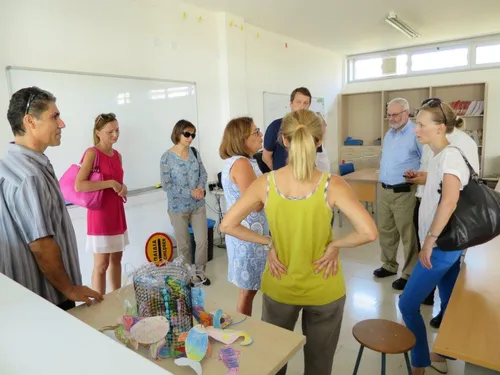
On 16 September, the Administrative Council representatives visited the University of Cyprus, the country’s largest academic institution and a growing establishment. The first phase of construction of the University’s new campus in the outskirts of Nicosia was co-financed by the Bank.
The delegation also visited the Makarios III Lyceum in Nicosia and the 10th Primary School - Chalkoutsa in Limassol, Cyprus’ second largest city. Both schools are part of an ongoing project which, in its current phase, is co-financed by the CEB in the amount of €95 million. The project foresees the construction of 71 new schools, the rehabilitation of 54 school buildings and expansion work in 116 institutions.
In urban modernisation, Administrative Council members visited a project of the Municipality of Nicosia aiming to rehabilitate the areas close to the buffer zone. Since the partition of the island in 1974, the buffer zone is located in the middle of Nicosia. The rehabilitation of these areas includes attracting private investment, sustaining economic activity, improving basic infrastructure, and protecting the city’s cultural heritage.
On 17 September, the delegation visited a project which involves the construction, operation and maintenance of the sewerage and drainage system in the Greater Limassol area. The project is in line with EU requirements for waste water collection, treatment and management, and will help to reduce pollution in the area. The CEB has been involved in the development of Limassol’s sanitary sewer network since the early 1980s.Set up in 1956, the CEB (Council of Europe Development Bank) has 41 member states. Twenty-two Central, Eastern and South Eastern European countries, forming the Bank's target countries, are listed among the member states. As a major instrument of the policy of solidarity in Europe, the Bank finances social projects by making available resources raised in conditions reflecting the quality of its rating (Aa1 with Moody's, outlook stable, AA+ with Standard & Poor's, outlook stable and AA+ with Fitch Ratings, outlook stable). It thus grants loans to its member states, and to financial institutions and local authorities in its member states for the financing of projects in the social sector, in accordance with its Articles of Agreement.