News
Albania: CEB pledges more than €100 million to support post-earthquake reconstruction
17 February 2020
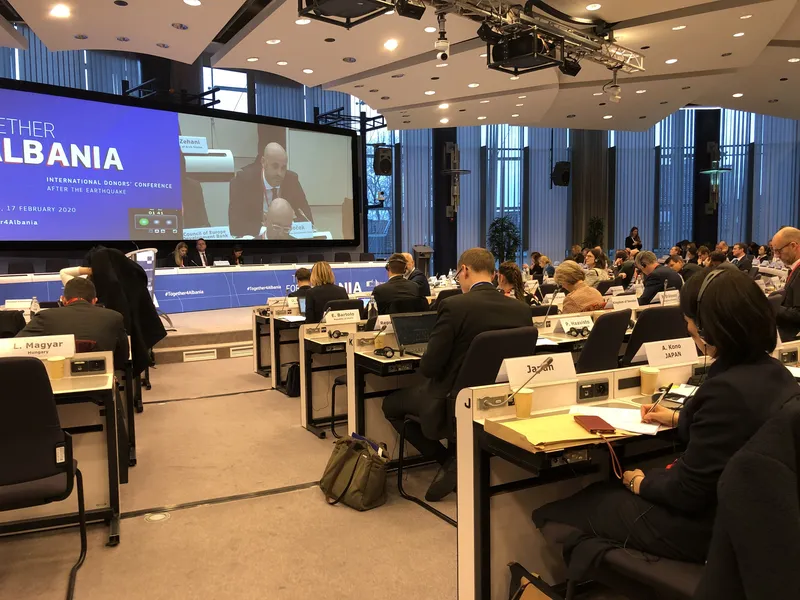
Brussels – The Council of Europe Development Bank (CEB) has pledged more than €100 million in grant and loan financing for post-earthquake reconstruction efforts in Albania.
The 6.4 Richter magnitude earthquake that hit Albania on 26 November 2019, and the more than 1,000 aftershocks that followed, have left 51 people dead and thousands injured. The towns of Durrës, Lezhë, Laç as well as the capital Tirana and the village of Kodër-Thumanë were severely damaged. Post-earthquake reconstruction efforts have been estimated at close to €1 billion and the European Commission has called for an international donors’ conference on 17 February in Brussels to mobilise a part of the funding required.

***
Albania joined the Council of Europe Development Bank in June 1999. Since then, the Bank has provided €164 million in funding for investments in social housing, health, education, rural and urban regeneration, and sustainable tourism.
The Social Dividend Account (SDA) is funded mainly with earmarks from the CEB’s annual results decided by member states. It is used to support high social impact projects, located mainly in the Bank's target countries. This support can take the form of technical assistance, loan guarantees, interest-rate subsidies and investment grants. Moreover, on an exceptional basis and for purposes related to its mandate, the CEB can mobilise SDA grants in the framework of emergency situations.
The Albanian Development Fund (ADF) was established in 1993, based on an agreement between the Albanian Government and the World Bank. Its mission is to encourage a sustainable, balanced and cohesive socio-economic development at local and regional level. The CEB has been working with the ADF on rural and urban infrastructure development throughout Albania since 2001.
[1] CEB loans are approved by the Bank’s Administrative Council.
Set up in 1956, the CEB (Council of Europe Development Bank) has 41 member states. Twenty-two Central, Eastern and South Eastern European countries, forming the Bank's target countries, are listed among the member states. As a major instrument of the policy of solidarity in Europe, the Bank finances social projects by making available resources raised in conditions reflecting the quality of its rating (AA+ with Fitch Ratings, outlook positive, AAA with Standard & Poor's, outlook stable and Aa1 with Moody's, outlook stable). It thus grants loans to its member states, and to financial institutions and local authorities in its member states for the financing of projects in the social sector, in accordance with its Articles of Agreement.