News
At its annual Joint Meeting in Warsaw, CEB approves eleven loans totalling close to €800 million
16 March 2026
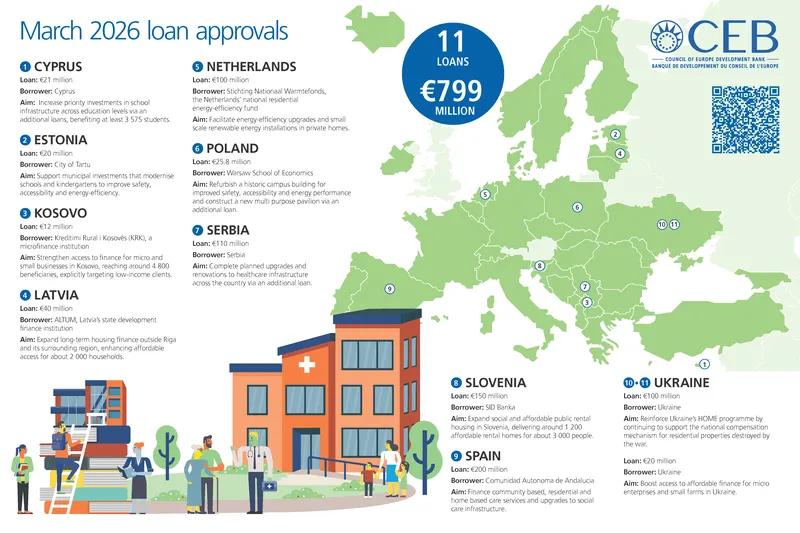
Warsaw – The CEB has approved eleven loans totalling €799 million, with around two‑thirds of the volume directed to the Bank’s Target Group Countries and a strong focus on education, health, social care and affordable housing. Reflecting the CEB’s sustained commitment to Ukraine’s recovery, two loans were approved for the country, bringing the total approvals for Ukraine to €673 million since its accession to the Bank in June 2023.
CYPRUS: An additional €21 million loan to expand priority investments in education infrastructure across all schooling level. Building on a €65.5 million loan approved in 2021 that benefited around 25 000 students, the project addresses growing needs linked to rising numbers of foreign‑born students and improves safety, capacity, energy performance and seismic resilience. The additional financing will support at least 3 575 more students from diverse socio‑economic backgrounds, including vulnerable children with special needs. By expanding access to free pre‑primary education, the project is also contributing to gender equality by removing disincentives for mothers who may otherwise not participate in the labour market.
ESTONIA: A €20 million loan to the City of Tartu will support priority municipal investments that strengthen social inclusion, improve the living environment and advance climate‑neutral urban development. The financing will focus on modernising schools and kindergartens to improve safety, accessibility and energy efficiency, benefiting children, families and education staff. The CEB loan will also finance sustainable urban mobility, including cycling and pedestrian infrastructure, urban amenities and the rehabilitation of the Sõpruse Bridge. With more than 60% of investments contributing to climate mitigation, the project will benefit residents relying on safe and accessible mobility infrastructure. Indirect benefits will extend to the wider Tartu County population of around 163 000 people.
KOSOVO: A €12 million loan to Kreditimi Rural i Kosovës (KRK), Kosovo’s third‑largest microfinance institution, will bolster access to finance for micro and small businesses in the country. The financing will enable KRK to extend tailored microloans to low‑income clients in urban and rural areas, including small farms and informal entrepreneurs. The loan will co‑finance up to 50% of a €24 million microloan portfolio, expected to reach around 4 800 beneficiaries, targeting low-income clients and supporting productive investment and working capital across agriculture, services, trade and small‑scale production. The project promotes women‑led businesses and provides Just Transition co‑benefits by supporting microenterprises in regions affected by Kosovo’s gradual coal phase‑out.
LATVIA: A €40 million loan to ALTUM, Latvia’s state development finance institution, will expand access to long‑term housing finance in municipalities outside Riga and its surroundings. The financing will support a €60 million portfolio of housing loans for the acquisition, construction or renovation of primary residences, addressing limited access to affordable housing finance. The programme is expected to benefit close to 2 000 households, improve housing affordability through longer maturities and lower monthly repayments, and support regional economic development by easing labour shortages linked to housing constraints.
NETHERLANDS: A €100 million loan to the Stichting Nationaal Warmtefonds, the Netherlands’ national residential energy efficiency fund, will support energy-efficiency upgrades and small‑scale renewable energy installations in private homes. Part of an investment programme of at least €200 million, the CEB loan will help low‑ and middle‑income households and homeowners’ associations to invest in insulation, heat pumps, solar panels and other energy‑saving measures. Differentiated loan conditions, combined with Dutch state support schemes, are designed to improve affordability for households most exposed to energy poverty. The programme targets the intersection of climate action and social inclusion by improving affordability, reducing household energy consumption and lowering CO₂ emissions, and is expected to benefit around 14 000 households.
POLAND: A €25.8 million additional loan to the Warsaw School of Economics (WSE) will support Phase II of its campus development programme. Building on the successful completion of the first phase, which delivered the Hub of Innovation, the additional financing will support the refurbishment of a historic campus building to improve safety, accessibility and energy performance, as well as the construction of a new multi‑purpose pavilion for academic, cultural and student activities. The project will strengthen access to high‑quality university education to a larger number of diverse students and create better teaching, working and studying conditions for students, as well as university staff.
SERBIA: An additional €110 million loan will support the continued modernisation of healthcare infrastructure across the country. The financing will enable the completion of planned upgrades and renovations addressing longstanding structural and functional gaps, with the aim of improving clinical outcomes, reducing reliance on treatment abroad and strengthening staff retention and wellbeing. Since its approval in 2019, the initial loan has been a key government instrument for addressing persistent gaps in Serbia’s health and social care infrastructure, particularly for vulnerable groups outside of major urban centres.
SLOVENIA: A €150 million loan to SID Banka will support the expansion of social and affordable public rental housing in Slovenia, addressing persistent housing affordability pressures affecting low‑income households and vulnerable groups. CEB financing will support a housing programme of at least €300 million, providing long‑term funding to municipalities, public housing funds and non‑profit providers. The programme is expected to deliver around 1 200 affordable rental homes, benefiting approximately 3 000 people through income‑linked rents set below market levels. Building on a strong partnership with Slovenia and complemented by additional financing from the European Investment Bank, the operation will strengthen social inclusion and expand access to decent housing in high‑demand areas.
SPAIN: A €200 million loan to the Autonomous Community of Andalusia will support the provision of inclusive health and social care services in Andalusia, responding to rising needs linked to population ageing, chronic diseases and socio‑economic vulnerability. CEB financing will cover community‑based, residential and home‑based care services, including tele‑assistance, as well as upgrades to social care infrastructure. The programme targets structural gaps in access to care and will primarily benefit vulnerable groups, including older persons and people with disabilities. With services tailored to women’s needs, the project is categorised as gender mainstreaming. The operation builds on a long‑standing partnership with Andalusia and follows three previous CEB‑supported programmes.
UKRAINE: An additional €100 million loan for the HOME programme in Ukraine will continue supporting the national compensation mechanism for residential properties destroyed by the war. The programme enables eligible homeowners to receive housing certificates to purchase or build replacement homes and has established the CEB as a key partner in addressing Ukraine’s urgent housing needs. To date, nearly 3 800 dwellings have been acquired, benefiting more than 13 000 vulnerable people, and the existing financing has been fully utilised. Housing remains one of the most pressing problems in Ukraine. The additional loan will allow the programme to scale up further in line with government priorities for 2026, supporting continued recovery and durable housing solutions.
Additionally, a €20 million loan to Ukraine will support access to affordable finance for micro‑enterprises and small farms in Ukraine, operating in the exceptionally challenging context of Russia’s full‑scale invasion. The programme will expand lending to vulnerable and war‑affected businesses through Ukraine’s National Development Institution, helping overcome high borrowing costs, limited collateral and administrative barriers. Blended with EU support under the Ukraine Investment Framework and complemented by CEB grant financing, the operation will improve affordability and stability for final beneficiaries – namely, internally displaced persons, veterans, returnees and enterprises facing long‑standing exclusion from finance. The project supports job creation, economic resilience and financial inclusion as part of Ukraine’s recovery and social stability.
The Council of Europe Development Bank (CEB) is a multilateral development bank with an exclusively social mandate from its 43 member countries. The CEB finances investment projects and provides technical assistance in social sectors such as education, health and affordable housing, while focusing on the needs of vulnerable people, as well as on the social dimensions of climate change and the environment. Borrowers include governments, local and regional authorities, public and private banks, non-profit organisations and others. The CEB, which has a triple-A credit rating, funds itself through international capital markets. In addition, the CEB receives funds from donors to complement its activities.