News
CEB and EBRD sign agreement to streamline co-financing and boost impact
30 June 2025
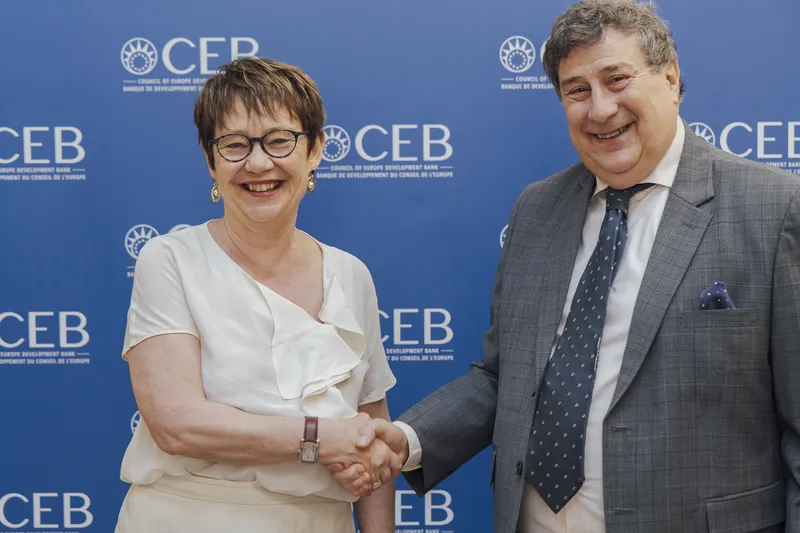
Paris – The Council of Europe Development Bank (CEB) and the European Bank for Reconstruction and Development (EBRD) signed a Mutual Reliance Agreement to strengthen joint efforts on public sector projects outside the European Union.The agreement is a concrete step in delivering on the G20 Roadmap towards Better, Bigger and More Effective Multilateral Development Banks (MDBs), which calls for system-wide cooperation among MDBs for enhanced efficiency and greater development impact.
The Mutual Reliance Agreement sets out a framework for collaboration in procurement, specifically for public sector projects co-financed by the CEB and EBRD outside the EU. It allows for the designation of a Lead Financier—responsible for procurement oversight—based on mutual recognition of each institution’s policies and procedures. This reduces duplication, simplifies project implementation, and increases operational efficiency.
“As Chair of the Heads of MDBs group for 2025, the CEB is committed to advancing practical solutions that help MDBs work better and more effectively together. Today’s agreement delivers on that ambition—concretely, pragmatically, and with impact,” said Carlo Monticelli, Governor of the Council of Europe Development Bank.
“Streamlining and simplifying our procurement in this way will bring major benefits to our clients and partners, as well our two banks,” said Odile Renaud-Basso, the EBRD’s President. “This agreement reflects our mutual trust and joint ambition to deliver results efficiently and responsibly.”
The Mutual Reliance Agreement is the result of close collaboration between the procurement and integrity teams of CEB and EBRD, grounded in shared values and a long-standing partnership. It reinforces the institutions’ ability to respond to the complex needs of their member countries, ensuring that joint financing operations are not only faster and more efficient, but also more impactful.
The CEB and EBRD have a strong track record of collaboration, including as co-founders of the Western Balkans Investment Framework (WBIF) and joint contributors to the Eastern Europe Energy Efficiency and Environment Partnership (E5P).
A recent example of this cooperation is the Just Transition Platform for North Macedonia, launched at COP28 by EBRD and supported by the CEB and other MDB partners. The platform aims to help coal-dependent regions shift to clean energy in a socially inclusive way, by supporting works, communities and businesses to ensure no one is left behind in the transition.
Media contact
Jelica Vesic, Senior Communications Officer at CEB, +33 6 03 12 57 80, Jelica.vesic@coebank.org
The Council of Europe Development Bank (CEB) is a multilateral development bank with an exclusively social mandate from its 43 member countries. The CEB finances investment and provides technical assistance in social sectors such as education, health and affordable housing, while focusing on the needs of vulnerable people, as well as on the social dimensions of climate change and the environment. Borrowers include governments, local and regional authorities, public and private banks, non-profit organisations and others. The CEB, which has a triple-A credit rating, funds itself through international capital markets. In addition, the CEB receives funds from donors to complement its activities.