News
CEB approves eight new loans totalling €902 million
20 November 2025
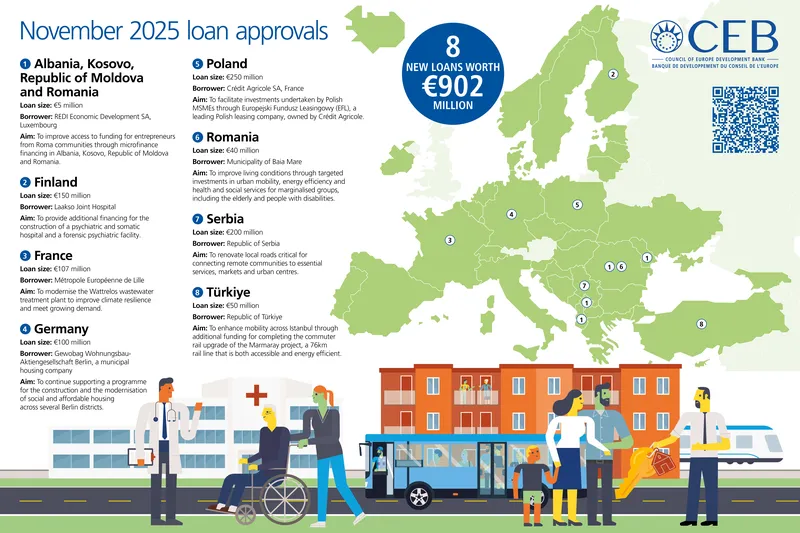
Paris - The Council of Europe Development Bank (CEB) has approved eight new loans totalling €902 million. The projects cover a wide range of sectors: health and social care; social and affordable housing; MSME financing and microfinance; urban, rural and regional development and environmental protection.
ALBANIA, KOSOVO, REPUBLIC OF MOLDOVA AND ROMANIA: A €5 million loan to REDI Economic Development SA, based in Luxembourg, aiming to expand access to affordable credit to Roma entrepreneurs. REDI Luxembourg, will on-lend the funds exclusively to partner microfinance institutions in Albania, Kosovo, the Republic of Moldova and Romania, which will finance operations that are expected to sustain or create an estimated 2 000 local jobs. The programme aims to help curb the widespread unemployment and financial exclusion in Roma communities in these countries, while also promoting gender inclusion as at least 30% of the loan is expected to be allocated to women entrepreneurs. To maximise social impact, micro-lending will be complemented by tailored technical assistance, financial literacy training and business development services delivered through REDI’s non-profit shareholder, REDI NGO.
FINLAND: An additional €150 million loan to Laakso Joint Hospital Real Estate Company will support the second phase of investments for the modernisation and centralisation of psychiatric and somatic care for around 1.7 million residents of the Helsinki metropolitan area. The project will improve accessibility and the continuity of care, explicitly targeting service provision to vulnerable populations, such as women with anxiety and depression, people with substance abuse disorders and socio-economically disadvantaged individuals with chronic depression.
FRANCE: A €107 million loan to Métropole Européenne de Lille will partially finance the modernisation of the wastewater treatment plant in the Wattrelos area, located northeast of the city. The project will upgrade wastewater and stormwater treatment capacity to deliver cleaner, more energy-efficient and environmentally-friendly sanitation services. By protecting aquatic ecosystems and cutting greenhouse gas emissions, the project will bring major environmental benefits while ensuring fair and sustainable water services for residents of this densely populated urban area. Located in a region still recovering from the decline of heavy industry, the project also helps support just transition as communities move toward a greener, more resilient future.
GERMANY: A €100 million additional loan to Berlin’s municipal housing company, Gewobag Wohnungsbau-Aktiengesellschaft, will partially finance the continuation of a programme for the construction and modernisation of social and affordable housing in the city, ensuring the long-term financial sustainability of the scheme. The CEB’s initial €100 million loan approved in 2020 has delivered housing units for 4 500 beneficiaries, of which 60% – or around 2 700 people – belong to particularly vulnerable groups, including more than 350 refugees. The additional loan adds 12 new, socially focused projects that will deliver 304 new and 1 575 refurbished social and affordable rental homes across Berlin for vulnerable groups, as well as for low- and middle-income families.
POLAND: A €250 million loan to Crédit Agricole SA, France, will support new investments, business growth, and job creation through Europejski Fundusz Leasingowy (EFL), a leading Polish leasing company owned by Crédit Agricole. The loan will finance operations in Poland, exclusively benefitting local micro, small and medium enterprises (MSMEs). While providing funding for essential equipment and assets, the loan will focus on businesses in economically lagging regions and on helping vulnerable groups access financing opportunities. Earmarking about 30% of financing for women-owned or women-led businesses, the loan will also promote female entrepreneurship. In addition, around 5% of CEB loan proceeds will be allocated to ‘green assets’. Expected to benefit around 12 500 Polish MSMEs, the loan builds on a long-lasting relationship with the borrower and its leasing company in Poland.
ROMANIA: A €40 million loan to Baia Mare Municipality aims to improve living conditions as the city transitions from its mining and metalworking past to a more diverse economy based on manufacturing and services. The loan will co-finance the municipality’s development programme, supporting projects such as road upgrades, housing renovation, new education facilities and a hospital, as well as facilities for the elderly and people with disabilities, and a community centre. While benefitting all Baia Mare’s inhabitants, the investments will focus on the most vulnerable – including the Roma community – thus helping the city tackle demographic changes and social inequalities in its most disadvantaged neighbourhoods. The CEB funding will complement a €51 million EU grant.
SERBIA: A €200 million loan to Serbia will co-finance the renovation of local roads to improve connectivity and access to essential services, markets and urban centres for remote communities suffering from acute infrastructure deficits and connectivity barriers. Works will include asphalt resurfacing, drainage system upgrades and measures to ensure year-round accessibility and climate resilience. Through a methodology developed jointly with the borrower, the CEB loan proceeds will support the municipalities most in need. In total, the loan is expected to improve everyday life for about 1.5 million people, including half a million residents in 29 of the country’s least developed municipalities.
TÜRKIYE: A €50 million additional loan to Türkiye will enable the completion of the commuter rail upgrade of the Marmaray Commuter Rail Project, a major urban mass-transit infrastructure project connecting the Asian and European greater metropolitan areas of İstanbul through a 76 km rail line, co-financed with the Japanese International Cooperation Agency (JICA) and European Investment Bank (EIB). Initiated in 2006, the Marmaray system first began operating in 2013 and has since transported over 1.3 billion passengers, currently serving approximately 660 000 commutes per day. The project mitigates critical urban infrastructure gaps and also reduces socio-economic disparities in peripheral areas. The additional loan will finance the completion of Haydarpaşa Railway Station, a strategic terminal station on the Asian side of İstanbul. The station will enhance passenger services while showcasing and preserving, through an integrated exhibition, one of the most important archaeological findings on this side of İstanbul.
The Council of Europe Development Bank (CEB) is a multilateral development bank with an exclusively social mandate from its 43 member countries. The CEB finances investment and provides technical assistance in social sectors such as education, health and affordable housing, while focusing on the needs of vulnerable people, as well as on the social dimensions of climate change and the environment. Borrowers include governments, local and regional authorities, public and private banks, non-profit organisations and others. The CEB, which has a triple-A credit rating, funds itself through international capital markets. In addition, the CEB receives funds from donors to complement its activities.