News
CEB approves nine new loans totalling €878 million
13 June 2025
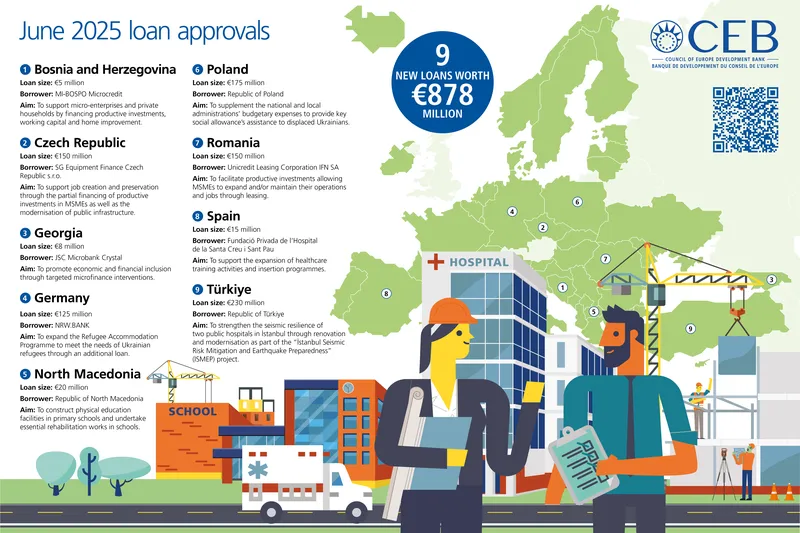
PARIS - The Council of Europe Development Bank (CEB) has approved nine new loans totalling €878 million to support a broad range of social infrastructure projects across its member countries. These include investments in temporary accommodation for refugees, healthcare and education facilities, as well as microfinance and MSME financing. Of the total, €300 million will go to projects that support the integration of Ukrainians displaced across Europe in their host countries. The approvals also feature a significant contribution to Türkiye’s ongoing İstanbul Seismic Risk Mitigation and Emergency Preparedness Project (ISMEP).
BOSNIA AND HERZEGOVINA: A €5 million loan to MI-BOSPO Microcredit Foundation will support micro-enterprises to promote income-generating activities and the start-up or expansion of micro-businesses, primarily targeting women entrepreneurs. The loan will also finance home improvement works to foster better living conditions for underserved populations throughout the country. This third CEB loan with MI-BOSPO will be enhanced by a guarantee from the CEB’s Social Impact Account (SIA). By targeting structurally disadvantaged regions and addressing barriers to finance in rural areas, the project will support economic inclusion and help rural populations sustain their livelihoods, contributing to reduced migration to urban centres or abroad. In all, the loan is expected to meet the financing needs of 6 250 microenterprises, farms and households.
CZECH REPUBLIC: A €150 million loan to SG Equipment Finance Czech Republic (SGEF CZ) will finance productive investments in micro-, small-, and medium-sized enterprises (MSMEs) across the Czech Republic and the Slovak Republic. Targeting smaller businesses in less developed regions, the project aims to address long-standing financial barriers while directly promoting job creation and economic inclusion. The loan will also co-finance the modernisation of public infrastructure, including investments in public transport and essential healthcare services. These investments, led by local authorities and service providers, will promote balanced territorial development, support Just Transition regions and reduce pressure on public budgets. SGEF CZ’s financial obligations will be fully guaranteed by its parent company, Société Générale S.A., France.
GEORGIA: An €8 million loan to JSC Microbank Crystal (Crystal) will help promote economic and financial inclusion through microfinance interventions targeting underserved microentrepreneurs and smallholder farmers, particularly women. Providing crucial financial resources to self-employed individuals and microenterprises that form the backbone of Georgia’s rural economy and its social fabric, the loan will enable financing for approximately 11 000 microenterprises and farms. Women entrepreneurs are expected to represent 60 per cent of beneficiaries. Highlighting the project's deep grassroots impact, the loan targets individuals with limited formal education, low productivity and constrained access to capital, many of whom turn to self-employment out of necessity. The loan is backed by CEB’s SIA loan guarantee.
GERMANY: An additional loan of €125 million to NRW.BANK, the promotional bank of the German state of North Rhine-Westphalia, will continue to co-finance municipal investments in the acquisition, construction and modernisation of temporary refugee accommodation. Building on the effective use of the initial loan approved in 2022, this additional financing envelope will increase the total loan amount to €325 million, translating to a co-financing total investments of at least €650 million. The project will substantially contribute to addressing critical gaps in refugee accommodation infrastructure across the region, which has welcomed substantial flows of Ukrainian refugees and asylum seekers between 2022 and 2024. To date, the CEB’s co-financing has contributed to the construction and modernisation of accommodation for over 16 300 refugees. The additional loan amount is expected to enable the accommodation of at least an additional 9 000 highly vulnerable refugees and their families in safe and modern temporary housing.
NORTH MACEDONIA: An additional €20 million loan to North Macedonia will support the construction of physical education facilities in 30 additional primary schools and the refurbishment and energy efficiency upgrades of selected schools nationwide. The project is part of a broader national programme to improve student outcomes, promote health and expand access to quality physical education. Under the initial €30 million loan, 70 new physical education facilities were built and 90 schools renovated, benefiting over 66 000 students. The project has also benefitted from over €6 million in grant funding through two Western Balkans Investment Framework (WBIF) grants and the CEB’s Green Social Investment Fund, helping to reduce the financial burden on municipalities, extend investment to under-resourced schools and promote energy efficiency measures.
POLAND: The additional €175 million loan will support Poland’s Aid Fund for Ukrainian citizens under temporary protection. This second loan addresses ongoing needs among vulnerable groups – such as single mothers, the elderly and families with dependent children – who have arrived without support networks. This funding will increase the CEB loan from €565 million to €740 million, sustaining key social and family allowances, providing minimum access to essential services and aiding social inclusion and cohesion. From the outset, this programme has ensured basic conditions for refugee integration, addressing key social needs in education, health, housing and employment.
ROMANIA: A €150 million loan to Unicredit Leasing Corporation IFN SA (UCL) will finance productive investments in MSMEs across the country, with particular efforts deployed to reach enterprises in lagging regions as well as youth-led or women-owned businesses. Improving the productivity and resilience of MSMEs through targeted support, such as leasing solutions and regionally earmarked funding, is essential to boost employment and innovation, support economic convergence with the EU and advance Romania’s green and digital transitions. This is CEB’s third loan to UCL, providing funding to around 3 000 MSMEs and contributing to creating and maintaining approximately 50 000 jobs.
SPAIN: A €15 million loan to Fundació Privada de l’Hospital de la Santa Creu i Sant Pau (Fundació Sant Pau) in Barcelona will support the refurbishment and equipment of medical education facilities, transforming them into modern training centres to expand healthcare education programmes. Spain faces a critical shortage of healthcare professionals due to its ageing population and the rising prevalence of chronic illnesses—challenges that threaten the long-term sustainability of the national healthcare system. Fundació Sant Pau, which plays a key role in regional and national medical education and research, has launched an initiative to expand healthcare training in partnership with the Barcelona Education Consortium. Primary beneficiaries of the project will include medical students, healthcare professionals seeking upskilling and unemployed individuals in career transition. The project, backed by the InvestEU partial loan guarantee, will also strengthen the wider healthcare system by improving workforce capacity, patient care and social inclusion in Catalonia.
TÜRKIYE: A €230 million loan to Türkiye is part of the ongoing İstanbul Seismic Risk Mitigation and Emergency Preparedness Project (ISMEP). Its goal is to enhance İstanbul’s resilience to major earthquakes through comprehensive mitigation and disaster management measures. The project will focus on improving the seismic resilience of two major public hospitals – one each on the European and Asian sides of the Bosphorus, respectively – by financing their reconstruction and modernisation. These facilities will be designed to remain operational during and after major earthquakes, ensuring continued access to essential medical services for millions, especially the most vulnerable groups. The investment is expected to directly benefit around 20 000 patients per day, significantly enhancing the safety, capacity and quality of healthcare in İstanbul. This is the fifth CEB loan under the ISMEP framework, adding to the €930 million in financing that the Bank has already invested in this unique programme of priority public infrastructure.
The Council of Europe Development Bank (CEB) is a multilateral development bank with an exclusively social mandate from its 43 member countries. The CEB finances investment and provides technical assistance in social sectors such as education, health and affordable housing, while focusing on the needs of vulnerable people, as well as on the social dimensions of climate change and the environment. Borrowers include governments, local and regional authorities, public and private banks, non-profit organisations and others. The CEB, which has a triple-A credit rating, funds itself through international capital markets. In addition, the CEB receives funds from donors to complement its activities.