News
CEB at Economy Ministers Meeting in Vienna, as part of 2018 Berlin Process Western Balkans Summit
05 July 2018
VIENNA - The CEB attended the Economy Ministers Meeting in Vienna, as part of the Western Balkans Summit under the Berlin Process.
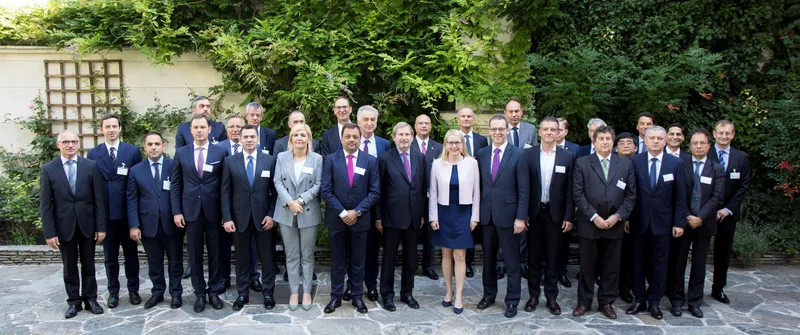 The meeting
of Economy Ministers, co-hosted by the British and the Austrian governments in
Vienna, kicked off the 2018 Berlin Process Western Balkans Summit, to continue
next week in London with Interior Ministers and Foreign Ministers meeting on 9
July and leaders meeting on 10 July.
The meeting
of Economy Ministers, co-hosted by the British and the Austrian governments in
Vienna, kicked off the 2018 Berlin Process Western Balkans Summit, to continue
next week in London with Interior Ministers and Foreign Ministers meeting on 9
July and leaders meeting on 10 July.
The Berlin Process encourages cooperation between the Western Balkans six – Albania, Bosnia and Herzegovina, Kosovo, Montenegro, Serbia and "the former Yugoslav Republic of Macedonia" – and likeminded European nations; Austria, Croatia, France, Germany, Italy, Poland, Slovenia and the United Kingdom, with Bulgaria joining this year.
The Economy Ministers
meeting brought together European and Western Balkans Ministers and
representatives, the European Commission, international financial institutions
as well as regional and international organisations. Discussions
in Vienna focused on how the Berlin Process could best support economic growth
in the region, with Vice-Governor Carlo Monticelli introducing the CEB’s activities in support
of small and medium-sized businesses (SMEs) in the Western Balkans, thus
demonstrating the CEB’s commitment to supporting its member states in the region.
Set up in 1956, the CEB (Council of Europe Development Bank) has 41 member states. Twenty-two Central, Eastern and South Eastern European countries, forming the Bank's target countries, are listed among the member states. As a major instrument of the policy of solidarity in Europe, the Bank finances social projects by making available resources raised in conditions reflecting the quality of its rating (Aa1 with Moody's, outlook stable, AA+ with Standard & Poor's, outlook positive and AA+ with Fitch Ratings, outlook stable). It thus grants loans to its member states, and to financial institutions and local authorities in its member states for the financing of projects in the social sector, in accordance with its Articles of Agreement.