News
CEB Governor and Serbian Prime Minister discuss ongoing social investments
11 February 2022
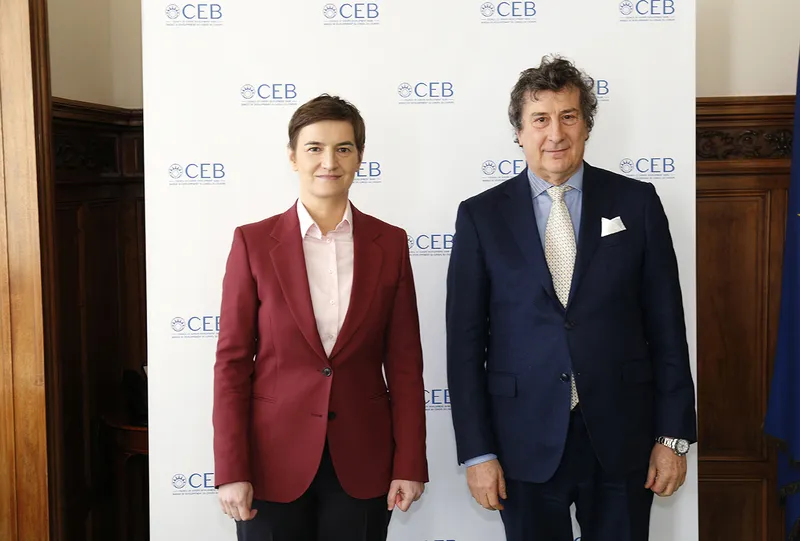
The two officials stressed the importance of partnership with the CEB, especially in the field of healthcare, education, environmental protection, and energy efficiency. Since it joined the CEB in 2004, Serbia has benefitted from more than € 1 billion in investments from the Bank.
“I am very pleased and honoured to welcome Prime Minister Brnabić,” said CEB Governor Carlo Monticelli. “Our meeting provided the opportunity to review the very broad scope of our cooperation which led to the realisation of so many valuable projects over the years, and to discuss avenues for further strengthening of our relations”.
In the past three years, the CEB approved loans worth more than € 650 million to the Government of Serbia to improve healthcare infrastructure and social care services across the country, and as part of response to the Covid-19 pandemic. In addition, the Bank is cooperating with the Western Balkans Investment Framework (WBIF), which recently approved a grant of € 35.7 million to partially finance the construction of a new children’s hospital in Belgrade (Tirsova).
When it comes to education infrastructure, in the past ten years the CEB approved € 177 million in loans to finance the construction, renovation and modernisation of secondary and tertiary educational facilities, student dormitories, and training of teachers.
Earlier this year, the CEB approved a € 30 million loan to reduce overcrowding and improve living conditions and rehabilitation opportunities for prisoners. The project will deliver modern equipment and amenities for the training, education and recreation of inmates.
The Serbian authorities have also received significant support to aid refugees and migrants through the Regional Housing Programme (RHP) and the Migrant and Refugee Fund (MRF). A total of 6 150 refugee families in Serbia received new homes by the end of 2021, while the funding approved through the RHP amounted to € 134 million.
Since 2015, the CEB has supported Serbian authorities with MRF grants for emergency assistance to the migrants transiting through Serbia. In total € 4.4 million has been used to provide shelter, food, health care, and legal advice to migrants and refugees.
Set up in 1956, the CEB (Council of Europe Development Bank) has 42 member states. Twenty-two Central, Eastern and South Eastern European countries, forming the Bank's target countries, are listed among the member states. As a major instrument of the policy of solidarity in Europe, the Bank finances social projects by making available resources raised in conditions reflecting the quality of its rating (Aa1 with Moody's, outlook stable, AAA with Standard & Poor's, outlook stable, AA+ with Fitch Ratings, outlook positive and AAA* with Scope Ratings, outlook stable). It thus grants loans to its member states, and to financial institutions and local authorities in its member states for the financing of projects in the social sector, in accordance with its Articles of Agreement.
*unsolicited