News
Governor Monticelli joins EC President von der Leyen in Regional Housing Programme ceremony
01 November 2023
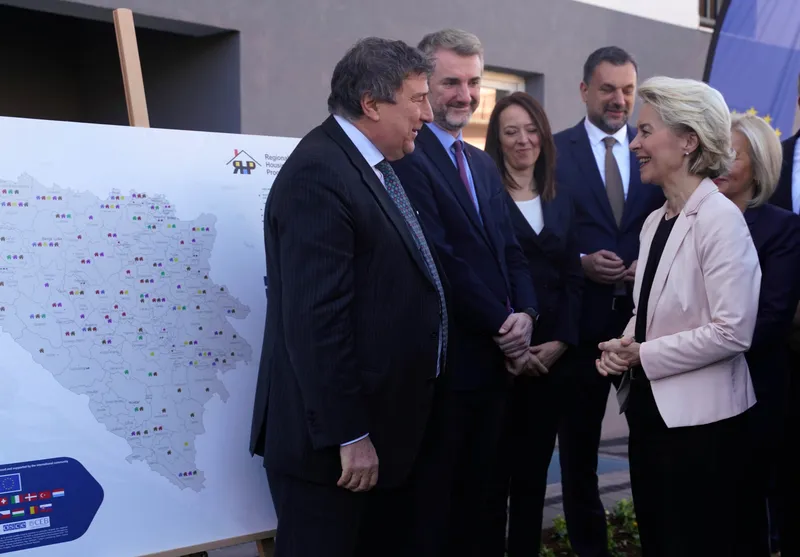
Vogošća, Bosnia and Herzegovina - Council of Europe Development Bank (CEB) Governor Carlo Monticelli joined today European Commission President Ursula von der Leyen and Chairwoman of the Council of Ministers of Bosnia and Herzegovina (BiH) Borjana Krišto, in a ceremony in the municipality of Vogošća, near Sarajevo, to deliver keys to a new Regional Housing Programme (RHP) apartment building to 27 most vulnerable families.
The Federal Minister of Displaced Persons and Refugees, Nerin Dizdar, the Mayor of Vogošća, Migdad Hasanović and Ambassador of the European Union to Bosnia and Herzegovina, Johann Sattler, also attended, in addition to other representatives from the RHP donor countries. As the Programme is coming to an end in December after 11 years, the gathering also provided an occasion to celebrate the many achievements of this landmark initiative.
The RHP – a joint initiative of Bosnia and Herzegovina, Croatia, Montenegro and Serbia – was launched in 2012 to provide secure homes to the most-vulnerable refugees and internally-displaced persons in these four countries following the conflicts in the former Yugoslavia in the 1990s. As such, the RHP was the first joint post-conflict initiative between these countries in the region.
Following the ceremony, Governor Monticelli said: “The CEB is proud to have played a key role in the RHP over the last decade, in close partnership with the European Union, the other donors, as well as UNHCR and the OSCE, and Partner Countries. The RHP has proven to be a highly successful initiative in providing homes to those most in need. Indeed, it can serve as a valuable model for future regional co-operation in other post-conflict or reconstruction contexts.”
In line with its core mandate to support refugees and displaced people, and leveraging its extensive knowledge of social housing, the CEB has accompanied the Partner Countries in the implementation of housing projects by providing oversight and capacity building, while managing close to €300 million in donor funds.
The RHP is financed mainly by the international community, with the European Union being by far the largest donor, having contributed over 80% of its funding. Other donors include USA, Germany, Norway, Switzerland, Italy, Denmark, Türkiye and Luxembourg. UNHCR and the OSCE have been partner institutions, ensuring a stringent beneficiary selection process.
As the RHP approaches its end, approximately 11 300 families – or close to 36 000 persons – have received secure homes across the Western Balkans, after almost three decades of displacement. In Bosnia and Herzegovina specifically, a total of almost 2 800 housing units have been delivered to approximately 9 000 most-vulnerable persons.
In addition to providing safe and durable homes, the RHP has brought numerous other benefits to the region, including improved capacity to implement projects, and strengthened cooperation and partnerships among Partner Countries, thus contributing to the reconciliation process across the Western Balkans. The closure of the RHP will be celebrated at a Conference in Sarajevo, Bosnia and Herzegovina, on 29 November 2023.
More on the RHP
RHP | Structure and Management (regionalhousingprogramme.org)
Provide housing to displaced persons in the Balkans | CEB (coebank.org)
The Council of Europe Development Bank (CEB) is a multilateral development bank, whose unique mission is to promote social cohesion in its 43 member states across Europe. The CEB finances investment in social sectors, including education, health and affordable housing, with a focus on the needs of vulnerable people. Borrowers include governments, local and regional authorities, public and private banks, non-profit organisations and others. As a multilateral bank with an excellent credit rating, the CEB funds itself on the international capital markets. It approves projects according to strict social, environmental and governance criteria, and provides technical assistance. In addition, the CEB receives funds from donors to complement its activities.