News
CEB holds annual Joint Meeting in Strasbourg, marks 60th anniversary
17 June 2016
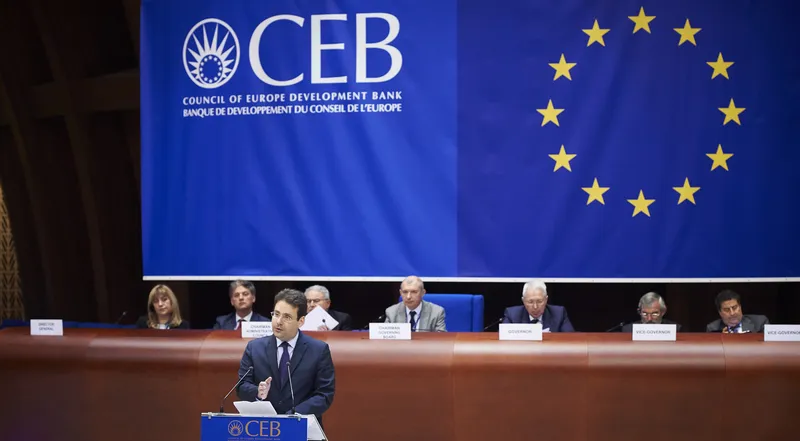 Strasbourg – The 51st Joint Meeting of the
Council of Europe Development Bank (CEB) was held on 17 June in Strasbourg at
the invitation of the French government. As in previous years, the meeting
brought together the members of the Bank’s Governing Board, Administrative
Council and senior management.
Strasbourg – The 51st Joint Meeting of the
Council of Europe Development Bank (CEB) was held on 17 June in Strasbourg at
the invitation of the French government. As in previous years, the meeting
brought together the members of the Bank’s Governing Board, Administrative
Council and senior management.
Representing the host country France at the meeting was Matthias Fekl, Minister of State for Foreign Trade, the Promotion of Tourism and French Nationals Abroad. Also speaking at the meeting were Thorbjørn Jagland, Secretary General of the Council of Europe; Dominique Lamiot, Chairman of the CEB’s Governing Board; Joseph Licari, Chairman of the CEB’s Administrative Council; and Rolf Wenzel, Governor of the CEB.
In his address, Thorbjørn Jagland commended the CEB on helping its member countries to manage the migrant and refugee crisis, and expressed his gratitude for the solid partnership between the Bank and the Council of Europe.
Chairman Lamiot noted with satisfaction that interaction between the Bank and its member states had further intensified. Chairman Licari said that the Bank’s excellent results were due to the commitment shown by the CEB’s Governor and staff.
Matthias Fekl underlined that European cooperation was not only an imperative necessity but also an obligation in the face of challenges, welcomed the CEB’s responsiveness to the migrant and refugee crisis, and commended the Bank on the quality of its projects.
Rolf Wenzel said that the Bank was determined to continue supporting all its members in tackling the migrant and refugee crisis, fighting the root causes of radicalisation, including high unemployment and marginalisation, and managing effectively climate change.
Following the Joint Meeting, Governor Wenzel officially opened a photo exhibition to mark the Bank’s 60th anniversary. The exhibition, which showcases the multi-faceted, pan-European character of the Bank’s work, is hosted by the Council of Europe in the lobby of its Assembly Chamber.
In the afternoon, the CEB’s 298th Administrative Council meeting and 214th Governing Board meeting were held. The Governing Board appointed Rosa María Sánchez-Yebra Alonso to the post of Vice-Governor for Social Development Strategy and Hakan Tokaç to the post of Vice-Governor for Target Group Countries. Their five-year term in office will begin on 16 August for Mr Tokaç and on 18 December for Ms Sánchez-Yebra Alonso.
The Administrative Council approved twelve new social projects worth a total of € 1.15 billion and discussed strategic and policy issues. It also approved the CEB’s new Financial and Risk Policy. The new policy maintains the prudent approach which has long characterised the CEB’s operations and has proved to be efficient. It introduces a balance sheet management approach to optimise the use of the Bank’s financial resources, and allows greater flexibility in interest risk management, while maintaining a strong liquidity position. New indicators allowing for the enhanced monitoring of liquidity and interest rate risk have been added to the CEB’s prudential framework.
The Governing Board and the Administrative Council welcomed the Bank’s prompt response to the migrant and refugee crisis, including the new challenges related to the integration of migrants and refugees in member countries.
The organs of the Bank
supported the general directions of the proposed new Development Plan, including
a significant increase in new project approvals and the periodic assessment of
the financial resources framework in line with best practices of peer
institutions. They asked the CEB’s management to prepare for approval in
December 2016 the new Development Plan documents, to become effective on 1st
January 2017.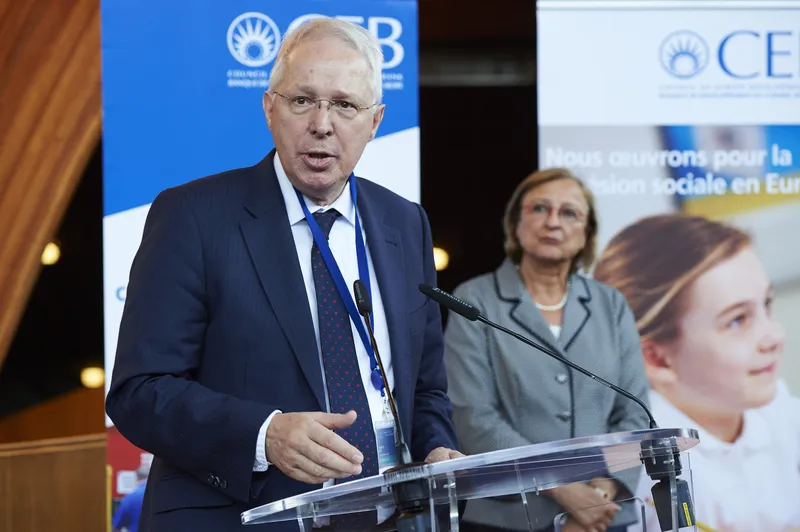
Set up in 1956, the CEB (Council of Europe Development Bank) has 41 member states. Twenty-two Central, Eastern and South Eastern European countries, forming the Bank's target countries, are listed among the member states. As a major instrument of the policy of solidarity in Europe, the Bank finances social projects by making available resources raised in conditions reflecting the quality of its rating (Aa1 with Moody's, outlook stable, AA+ with Standard & Poor's, outlook stable and AA+ with Fitch Ratings, outlook stable). It thus grants loans to its member states, and to financial institutions and local authorities in its member states for the financing of projects in the social sector, in accordance with its Articles of Agreement.