News
CEB’s Joint Meeting in Montenegro reinforces commitment to education and social investment
04 April 2025
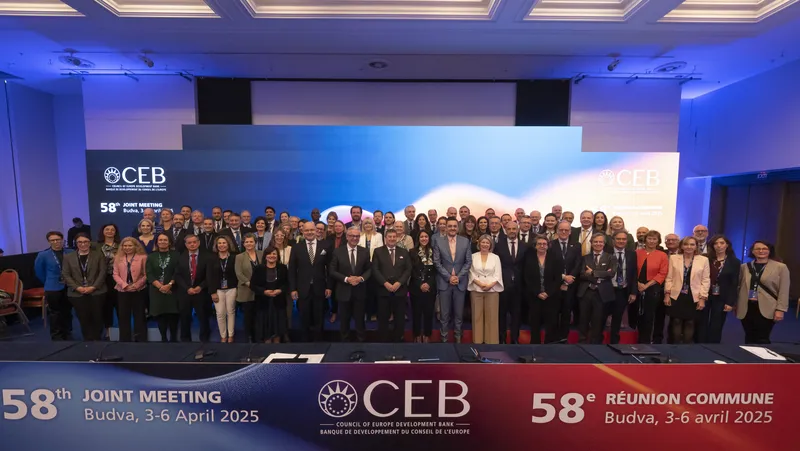
Budva, Montenegro – The annual Joint Meeting of the Council of Europe Development Bank (CEB) took place today in Budva, Montenegro, bringing together the CEB’s Governing Board, Administrative Council, and senior management. Hosted by Montenegro for the first time, with the support of the Ministry of Finance and the Ministry of Foreign Affairs, the Joint Meeting was an opportunity for the country to reaffirm its commitment to advancing social development and strengthening the partnership with the Bank.
In Montenegro, a member country since 2007, the CEB has approved 11 social projects to date, with total financing of €213 million, in the sectors of affordable housing, education and employment support.
Governor Monticelli underscored in his opening remarks that: “Montenegro is a European Union (EU) candidate country, a nation striving forward, embracing the ideals we all seek, of an inclusive, innovative and thriving society. The CEB is proud to support this process, by financing social development projects in key areas, including education.”
Opening the Joint Meeting, Minister of Finance of Montenegro, Novica Vuković said: “I extend my sincere gratitude to CEB for its continuous support and strong partnership. I am confident that we will continue to work together on projects that have a lasting and positive impact on our society. We are witnessing rapid progress in fulfilling the requirements for EU membership, alongside intensive reform processes that include investments in key sectors—education being at the very core. Montenegro has recognised that education is the most valuable resource of a modern society—an investment that brings multiple positive effects, both for economic growth and for social cohesion and sustainable development.”
The CEB’s approach in the education sector
This year’s Joint Meeting closed session focused on the CEB’s approach in supporting the education sector across its member countries, with a discussion on the importance of securing investment in this critical sector. Underinvestment in education across Europe is threatening social cohesion by limiting social mobility, deepening inequalities, and reducing opportunities for economic growth. The Minister of Education, Science and Innovation of Montenegro, Prof. Dr Andjela Jaksic-Stojanovic, participated as a guest.
In her intervention, Minister Jaksic-Stojanovic said: “The Ministry of Education, Science, and Innovation continues investing in educational infrastructure, reaffirming its commitment to improving learning conditions and child development across Montenegro. The growth plan includes 48 projects worth over 240 million euros, relying on both our team’s expertise and strong partnerships with international institutions, notably the CEB. This 12-year cooperation has already benefited thousands of young children by enhancing preschool education. With further investments and new projects, even more educational facilities across Montenegro will offer children a safe, modern, and stimulating learning environment. These partnerships remain crucial to the Ministry’s vision—an education system that meets modern society’s needs and gives children the best foundation for a successful future.”
Over the years, the CEB has been a key partner in strengthening Montenegro’s education sector with €20 million in loans with ongoing activities focused on improving access to quality preschool facilities through the construction of four new kindergartens in Bar, Berane, Podgorica and Ulcinj. This initiative builds on a previous project that delivered five new kindergartens and renovated 28 preschool facilities between 2015 and 2021, further improving the country’s early education infrastructure.
As part of the Joint Meeting, the CEB delegates – accompanied by Minister Jaksic-Stojanovic – will visit the Dragan Radulović Kindergarten in Podgorica, one of the facilities supported by the CEB, to see first-hand the impact of this early childhood education investment project.
Recognising the importance of securing education funding, the CEB will continue to propose innovative financing solutions and implementation mechanisms for education to remain a priority on the social agenda in all of its member countries.
The CEB’s Joint Meeting will continue with closed-door sessions tomorrow, with the Bank’s Administrative Council reviewing new loans for approval, including for key projects in healthcare and financial inclusion in Montenegro.
The Council of Europe Development Bank (CEB) is a multilateral development bank, whose unique mission is to promote social cohesion in its 43 member states across Europe. The CEB finances investment in social sectors, including education, health and affordable housing, with a focus on the needs of vulnerable people. Borrowers include governments, local and regional authorities, public and private banks, non-profit organisations and others. As a multilateral bank with an excellent credit rating, the CEB funds itself on the international capital markets. It approves projects according to strict social, environmental and governance criteria, and provides technical assistance. In addition, the CEB receives funds from donors to complement its activities.