News
CEB releases 2022 solid financial and operational results while continuing to support Europe’s social cohesion
31 January 2023
PARIS – The Council of Europe Development Bank (CEB) fulfilled the principal objectives set out in its Development Plan 2020-2022. With a solid financial and operational performance in 2022, the CEB continued to support social cohesion in Europe amid overlapping crises.
On the heels of the COVID-19 pandemic, the Russian aggression against Ukraine in February 2022 heightened geopolitical tensions, exacerbated economic disruptions and triggered a refugee crisis. In this context, the CEB’s social mandate proved to be more relevant and more urgent than ever. The Bank fulfilled its principal strategic objectives set out in its Development Plan 2020-2022 by stepping up its support to the member countries in meeting their social investment needs and in bolstering inclusiveness and resilience.
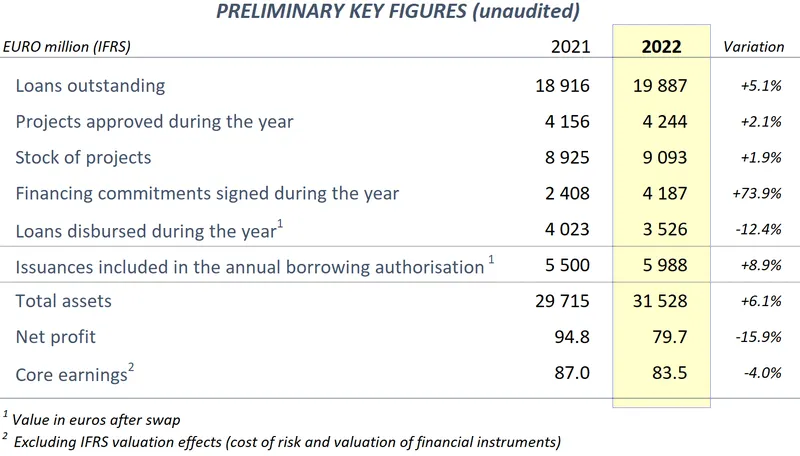
Lending approvals reached €4.2 billion, broadly stable compared to 2021 (+2.1%), of which 31% were dedicated to member countries affected by the war in Ukraine and 15% to the COVID-19 pandemic.
The CEB’s preliminary unaudited results for the financial year 2022 show a net financial profit of €79.7 million, compared to €94.8 million in 2021 (-15.9%), reflecting mainly the impact of International Financial Reporting Standard (IFRS) 9 on both credit provisioning (cost of risk) and valuation of financial instruments.
Excluding IFRS 9 impact, core earnings amounted to €83.5 million for the year 2022, compared to €87.0 million in 2021 (-4.0%), mainly driven by lower revenues in debt securities at amortized cost portfolio. As in the past, no credit risk event was recorded in the financial year 2022.
On the funding side, the CEB further enhanced its presence in the Social Inclusion Bond market with two additional issuances worth €2.0 billion, whose proceeds are targeted to be used to bolster the Bank’s response to the refugee crises caused by the war in Ukraine and help assist its member states.
The CEB’s ratings continued to reflect its strong financial profile and the support of its member countries, underlined by its AAA rating reaffirmed by Standard & Poor’s (12 September 2022) and Scope Ratings (24 June 2022, unsolicited) with a stable outlook; Moody’s Aa1 rating placed on review for upgrade (16 December 2022), showing an instant response from the rating agency further to the approval of the CEB’s 7th capital increase and new Strategic Framework; and Fitch’s AA+ rating with a positive outlook (22 July 2022).
The Financial Statements for the year ended 31 December 2022 will be submitted to the CEB’s Governing Board for approval in March 2023.
Set up in 1956, the CEB (Council of Europe Development Bank) has 42 member states. Twenty-two Central, Eastern and South Eastern European countries, forming the Bank's target countries, are listed among the member states. As a major instrument of the policy of solidarity in Europe, the Bank finances social projects by making available resources raised in conditions reflecting the quality of its rating (Aa1 with Moody's, on review for upgrade, AAA with Standard & Poor's, outlook stable, AA+ with Fitch Ratings, outlook positive and AAA* with Scope Ratings, outlook stable). It thus grants loans to its member states, and to financial institutions and local authorities in its member states for the financing of projects in the social sector, in accordance with its Articles of Agreement.
*unsolicited
Related publications
-

Strategic Framework 2023-2027
Explore the Council of Europe Development Bank's (CEB) Strategic Framework for 2023-2027, designed to promote social cohesion across … Published: January 2023 Read