News
Governor Wenzel addresses Business Forum on Western Balkans on the occasion of “Paris Balkans 2016”
04 July 2016
 PARIS
- The Governor of the Council of Europe Development Bank (CEB) Rolf Wenzel
participated in the Business Forum on the Western Balkans at the Conference
Centre “Pierre Mendès France” today. The Forum was part of the Summit “Paris
Balkans 2016”.
PARIS
- The Governor of the Council of Europe Development Bank (CEB) Rolf Wenzel
participated in the Business Forum on the Western Balkans at the Conference
Centre “Pierre Mendès France” today. The Forum was part of the Summit “Paris
Balkans 2016”.
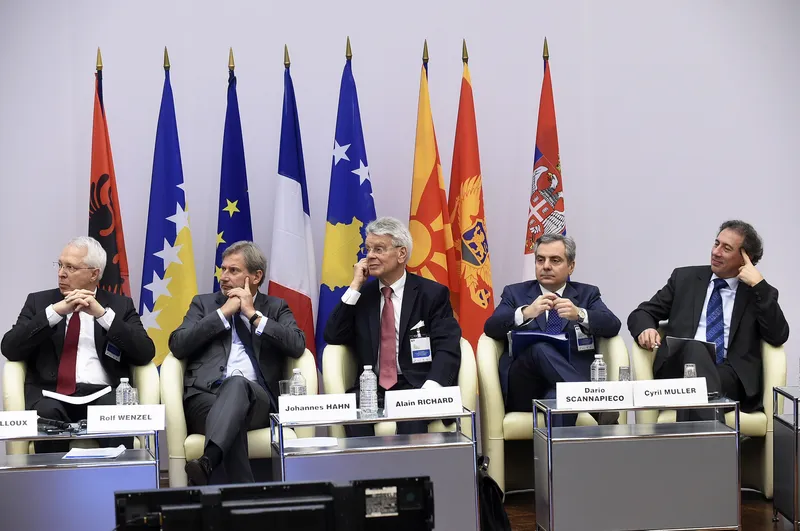
Governor Wenzel addressed the plenary session, which was opened by Michel Sapin, Minister of Finance, and chaired by Alain Richard, Special Representative for Economic Diplomacy in the Balkans. The theme of the session was “Financing projects in the Western Balkans – Implementation of reforms for business climate”. The six Western Balkan countries* were represented at the Forum by their respective Ministers of Economy.
In his speech, Governor Wenzel welcomed the
economic reforms that the countries of the Western Balkans had implemented in
recent years. He said that the CEB was active in the region, as a founding
member of the Western Balkans Investment Framework (WBIF) and the main
implementation partner of the Regional Housing Programme (RHP), as well as through
the Migrant and Refugee Fund (MRF) and other social projects.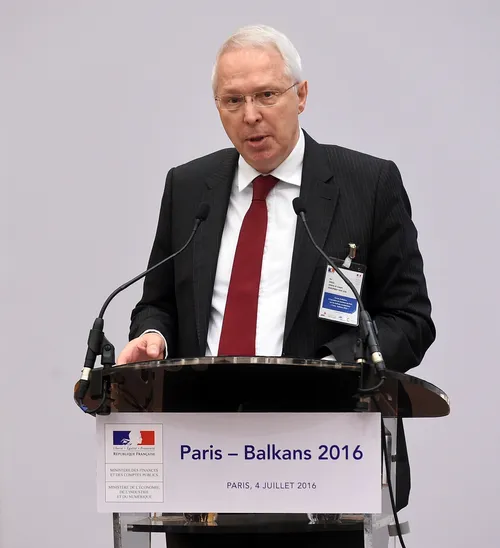
“The CEB is determined to continue to create sustainable growth in the region through social development,” he stressed, and called for increased cooperation to help the Western Balkan countries on the path to prosperity and European integration.
Closing the conference, Emmanuel Macron, Minister of the Economy, Industry and Digital Affairs, highlighted the progress achieved by Western Balkan countries since the last Summit in Berlin in 2014.________
*Albania, Bosnia and Herzegovina, Kosovo, Montenegro, Serbia and "the former Yugoslav Republic of Macedonia"
Set up in 1956, the CEB (Council of Europe Development Bank) has 41 member states. Twenty-two Central, Eastern and South Eastern European countries, forming the Bank's target countries, are listed among the member states. As a major instrument of the policy of solidarity in Europe, the Bank finances social projects by making available resources raised in conditions reflecting the quality of its rating (Aa1 with Moody's, outlook stable, AA+ with Standard & Poor's, outlook stable and AA+ with Fitch Ratings, outlook stable). It thus grants loans to its member states, and to financial institutions and local authorities in its member states for the financing of projects in the social sector, in accordance with its Articles of Agreement.