News
Governor Wenzel addresses international conference on environment and human rights
28 February 2020
Strasbourg – The Governor of the Council of Europe Development Bank (CEB), Rolf Wenzel, spoke yesterday at the high-level conference on “Environmental Protection and Human Rights” organised at the Council of Europe under the aegis of the Georgian Presidency of the Committee of Ministers of the Council of Europe.
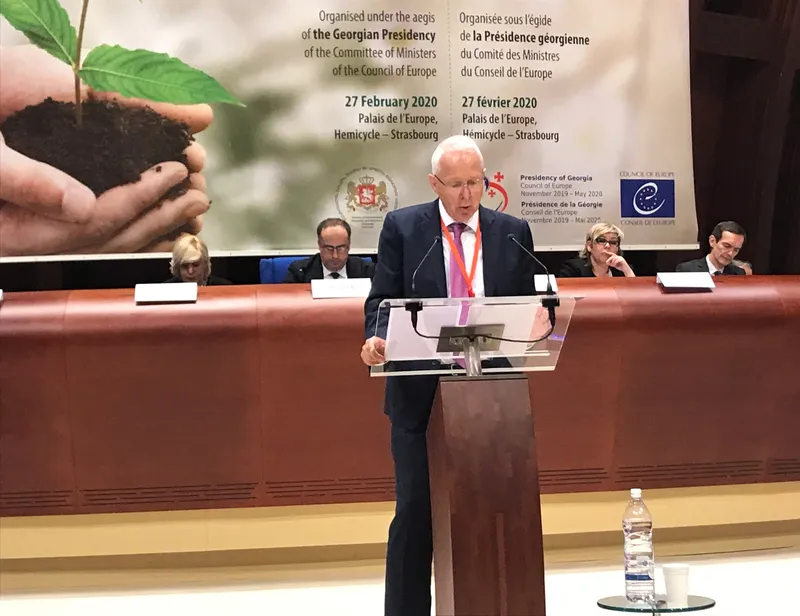 The conference, which was attended by
ministers, academic experts, ambassadors and other representatives of the
Council of Europe’s members countries, looked at the interrelation between the
protection of the environment and the promotion and protection of human rights.
Against the background of serious environmental challenges and pressing threats
to biodiversity, the conference considered ways of tackling the climate crisis.
The conference, which was attended by
ministers, academic experts, ambassadors and other representatives of the
Council of Europe’s members countries, looked at the interrelation between the
protection of the environment and the promotion and protection of human rights.
Against the background of serious environmental challenges and pressing threats
to biodiversity, the conference considered ways of tackling the climate crisis.
In its declaration at the end of the conference, the Presidency of the Committee of Ministers, expressing the broad consensus reached during the conference, said that “the primary responsibility for protecting the environment and human rights rests with member states. In developing their legislations, policies, strategies and actions, member states could build upon and implement the related legal instruments and activities of the Council of Europe.”
In his speech, Governor Wenzel stressed that protecting the environment and those most vulnerable to climate change was “protecting the most fundamental of human rights: the right to life itself”, and stressed that international financial institutions also had an important role to play in this.
The CEB Governor underlined that the CEB’s Development Plan for the Period 2020-2022 paid special attention to environmental screening of projects, and outlined the ways in which the Bank was actively contributing to climate action through the financing of projects which supported environmental protection both directly and indirectly.
Concerning the Sustainable Development Goals (SDGs), Mr Wenzel said that the CEB had stepped up efforts to support the national SDG policy frameworks of its member countries and was doing its utmost to help them mobilise the necessary funds in order to achieve their SDG targets.Set up in 1956, the CEB (Council of Europe Development Bank) has 41 member states. Twenty-two Central, Eastern and South Eastern European countries, forming the Bank's target countries, are listed among the member states. As a major instrument of the policy of solidarity in Europe, the Bank finances social projects by making available resources raised in conditions reflecting the quality of its rating (AA+ with Fitch Ratings, outlook positive, AAA with Standard & Poor's, outlook stable and Aa1 with Moody's, outlook stable). It thus grants loans to its member states, and to financial institutions and local authorities in its member states for the financing of projects in the social sector, in accordance with its Articles of Agreement.