News
Governor Wenzel in New York for United Nations High-Level Summit on Refugees and Migrants
20 September 2016
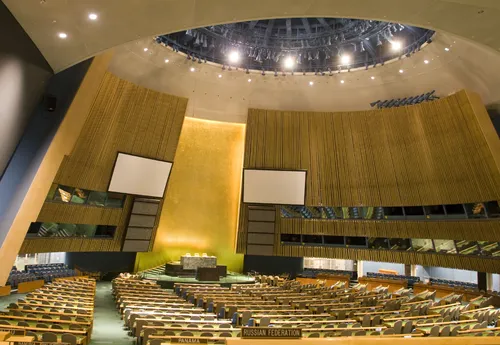 PARIS
- The Governor of the Council of Europe Development Bank (CEB) Rolf Wenzel
attended the high-level Summit hosted by the United Nations General Assembly in
New York to address the issue of large movements of refugees and migrants.
PARIS
- The Governor of the Council of Europe Development Bank (CEB) Rolf Wenzel
attended the high-level Summit hosted by the United Nations General Assembly in
New York to address the issue of large movements of refugees and migrants.
Governor Wenzel was invited to attend a round table on the theme “Global compact for responsibility-sharing for refugees; respect for international law”. Commenting on the outcome of the Summit, he welcomed the adoption by the United Nations General Assembly of the New York Declaration for Refugees and Migrants and said: “The international community has made an important step towards taking concrete and coordinated measures to protect the rights of migrants and refugees in accordance with international law.”
“The CEB warmly welcomes the adoption of the Comprehensive Refugee Response Framework (Annex I to the Declaration), to be developed by the United Nations High Commissioner for Refugees in cooperation with international organisations and other partners,” Governor Wenzel added. “As a social development bank established 60 years ago to tackle the problems of refugees and displaced persons in Europe, the CEB is fully committed to the Comprehensive Refugee Response Framework and stands ready to contribute to its development, based on the principles of international cooperation and responsibility-sharing.”
The Governor recalled that in October 2015 the CEB established the Migrant and Refugee Fund (MRF) to help its member states cope with migrant and refugee flows. The Bank has so far approved over € 18 million in grants for a total of 15 refugee projects, mainly in the Balkan region.
Set up in 1956, the CEB (Council of Europe Development Bank) has 41 member states. Twenty-two Central, Eastern and South Eastern European countries, forming the Bank's target countries, are listed among the member states. As a major instrument of the policy of solidarity in Europe, the Bank finances social projects by making available resources raised in conditions reflecting the quality of its rating (Aa1 with Moody's, outlook stable, AA+ with Standard & Poor's, outlook stable and AA+ with Fitch Ratings, outlook stable). It thus grants loans to its member states, and to financial institutions and local authorities in its member states for the financing of projects in the social sector, in accordance with its Articles of Agreement.