News
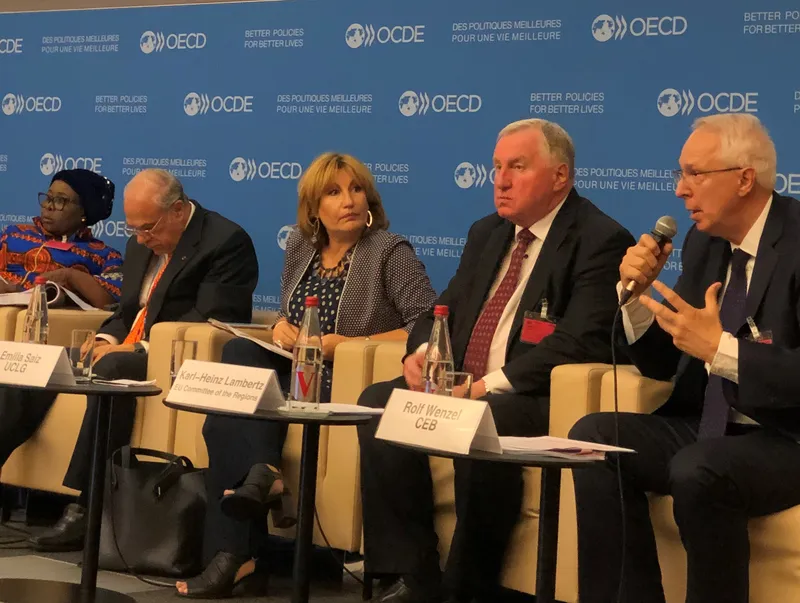
Governor Wenzel in OECD Conference on Subnational Government Finance and Investment
17 June 2019
PARIS - The Governor of the Council of Europe Development Bank (CEB) Rolf Wenzel participated today in the first Conference of the World Observatory on Subnational Governance Finance and Investment, which took place in the headquarters of the Organisation for Economic Cooperation and Development (OECD) in Paris.
 The
World Observatory on Subnational Governance Finance and Investment is an
initiative led by the OECD and the United Cities and Local Governments (UCLG)
and financially supported, among others, by the CEB. It is aimed at promoting
dialogue and partnership between national and subnational governments, and also
international institutions, with a view to enhancing subnational government
finance.
The
World Observatory on Subnational Governance Finance and Investment is an
initiative led by the OECD and the United Cities and Local Governments (UCLG)
and financially supported, among others, by the CEB. It is aimed at promoting
dialogue and partnership between national and subnational governments, and also
international institutions, with a view to enhancing subnational government
finance.
The Observatory, which collected data on subnational finance and territorial organisation from over 120 countries, published its key findings in an extensive first report launched during the conference. The information and data of the Observatory, including its online database, will be regularly updated and even expanded to cover additional areas.
The Secretary General of the OECD Angel Gurría opened the high-level segment of the conference, which marked the launch of the 2019 World Observatory Report. In his speech, he stressed the importance of subnational governments in today’s political reality, highlighted the need for reliable data on local government finance and said that the World Observatory Report and database were “all about building our collective capacity (…) so we can work together for better outcomes.”
Participating in a panel discussion during the high-level segment of the conference, Governor Wenzel commended the OECD and the UCLG on their joint initiative and reiterated the CEB’s commitment to supporting the project, which, he said would be a useful tool for CEB operations.
Mr Wenzel outlined the main challenges facing
subnational governments seeking financing for their social investments, such as
public expenditure cuts following the recent financial crisis, and a limited
borrowing capacity due to legal constraints, missing requirements in terms of
credit ratings, etc. He also talked about the CEB’s experience working with
local and regional governments and explained what the Bank was doing to help them
overcome obstacles and support their social policies.
Set up in 1956, the CEB (Council of Europe Development Bank) has 41 member states. Twenty-two Central, Eastern and South Eastern European countries, forming the Bank's target countries, are listed among the member states. As a major instrument of the policy of solidarity in Europe, the Bank finances social projects by making available resources raised in conditions reflecting the quality of its rating (AAA with Standard & Poor's, outlook stable, AA+ with Fitch Ratings, outlook stable and Aa1 with Moody's, outlook stable). It thus grants loans to its member states, and to financial institutions and local authorities in its member states for the financing of projects in the social sector, in accordance with its Articles of Agreement.