News
Governor Wenzel opens Novo Brdo housing complex in Ljubljana together with Slovenia’s Environment Minister Andrej Vizjak
26 October 2021
Ljubljana - During their visit to Slovenia, the Governor of the Council of Europe Development Bank (CEB), Rolf Wenzel and Vice-Governor Tomáš Boček, attended the opening ceremony for the Novo Brdo housing project in Ljubljana, Slovenia, which is partially financed through a CEB loan worth €50 million approved in 2018 to the Housing Fund of the Republic of Slovenia (HFRS).
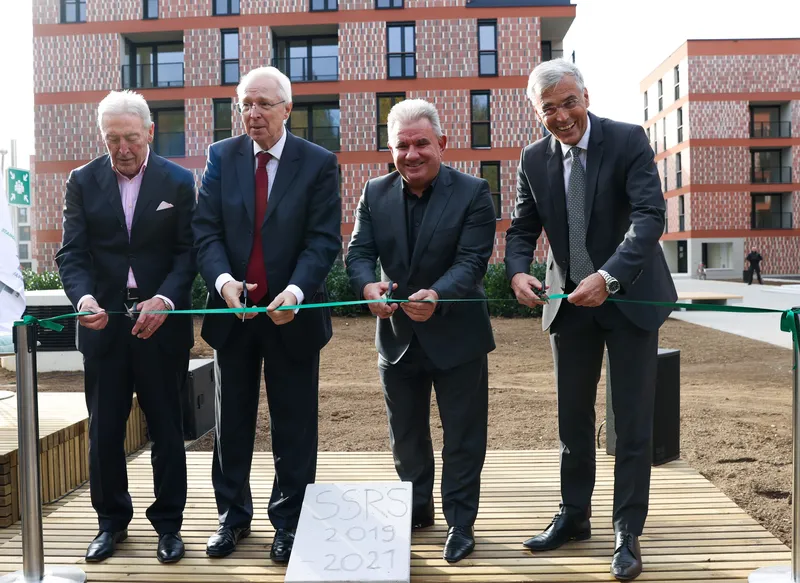
Governor Wenzel and Vice-Governor Boček attended the ceremony together with the Minister of the Environment and Spatial Planning, Andrej Vizjak, Deputy Mayor of Ljubljana Aleš Čerin, and Director of the Housing Fund of the Republic of Slovenia, Črtomir Remec.
Addressing the guests at the ceremony, Governor Wenzel underlined that the Novo Brdo housing complex will provide approximately 500 rental housing units for low- and middle-income families who are increasingly priced out of the market, in particular for young people under the age of 29 and the elderly.
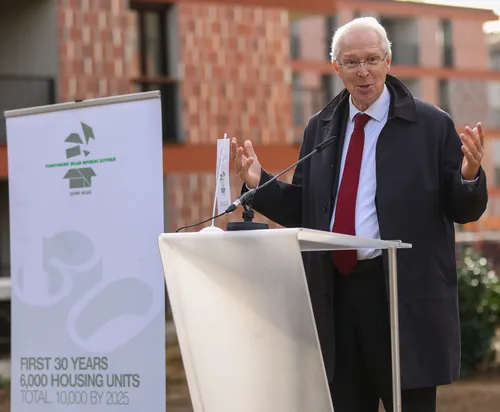
“The CEB loan extended to one of our most dynamic partners, the Housing Fund of the Republic of Slovenia, will make an important contribution to Slovenia’s rental housing stock,” Governor Wenzel said. “I am happy to announce that we are continuing our partnership with the Fund and that we are currently working on a second loan worth €70 million, which is expected to have larger regional outreach and respond to the housing needs of seven regions in Slovenia with additional 900 rental housing units.”
In addition to the 500 housing units constructed at Novo Brdo, the current CEB loan to the HFRS co-finances the construction of 210 housing units of the Pod Pekrsko Gorco urban development project in Maribor, as well as 110 student housing units for the University of Ljubljana in the Gerbičeva street, which was inaugurated earlier this year.
“An apartment or a home is an asset, the value of which is certainly best understood by those who do not have it,” Minister Vizjak noted. “Most often, these are young people and young families who are solving their housing issue for the first time. The unsolved housing issue is not only a problem for young people or those who are left without a roof over their heads due to various circumstances, but also a challenge that is more or less successfully dealt with by all governments and countries around the world. I am pleased that the Novo Brdo residential neighbourhood also addresses the problems of different generations of people and time.”
Aleš Čerin, Deputy Mayor of the City of Ljubljana, added: “The city of Ljubljana is making sure that the Novo Brdo neighbourhood is very pleasant for the residents. We recently opened a new kindergarten unit in the technology park in the vicinity of the neighbourhood. At the same time, we expanded the Vrhovci primary school and we will build a new primary school in the vicinity if needed.”
The Novo Brdo housing complex is the largest project of the Housing Fund of the Republic of Slovenia, which this year celebrates 30 years of existence.
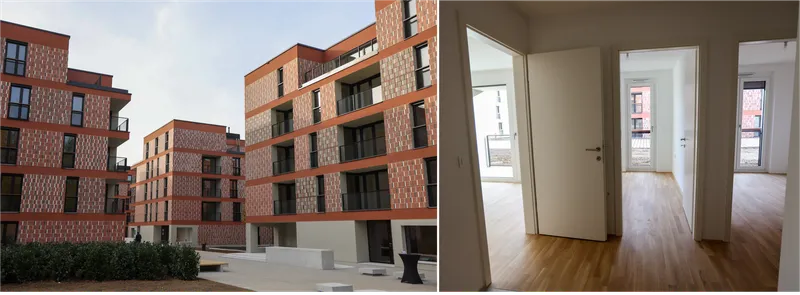
“We have successfully completed the largest housing construction in independent Slovenia,” noted HFRS Director Črtomir Remec. “Diverse apartments in 18 apartment buildings will provide a safe and warm home to 498 vulnerable families and individuals, of which 25 will be sheltered residences for persons above the age of 65.”
Slovenia
Slovenia became a CEB member country in 1994. In the past 15 years the CEB supported inclusive growth in Slovenia with €170 million in investments across different sectors, such as social and affordable housing, environment, education, and municipal infrastructure.
Set up in 1956, the CEB (Council of Europe Development Bank) has 42 member states. Twenty-two Central, Eastern and South Eastern European countries, forming the Bank's target countries, are listed among the member states. As a major instrument of the policy of solidarity in Europe, the Bank finances social projects by making available resources raised in conditions reflecting the quality of its rating (Aa1 with Moody's, outlook stable, AAA with Standard & Poor's, outlook stable, AA+ with Fitch Ratings, outlook positive and AAA* with Scope Ratings, outlook stable). It thus grants loans to its member states, and to financial institutions and local authorities in its member states for the financing of projects in the social sector, in accordance with its Articles of Agreement.
*unsolicited