News
Governor Wenzel visits renovation site of CEB-financed Adoma project
21 March 2016
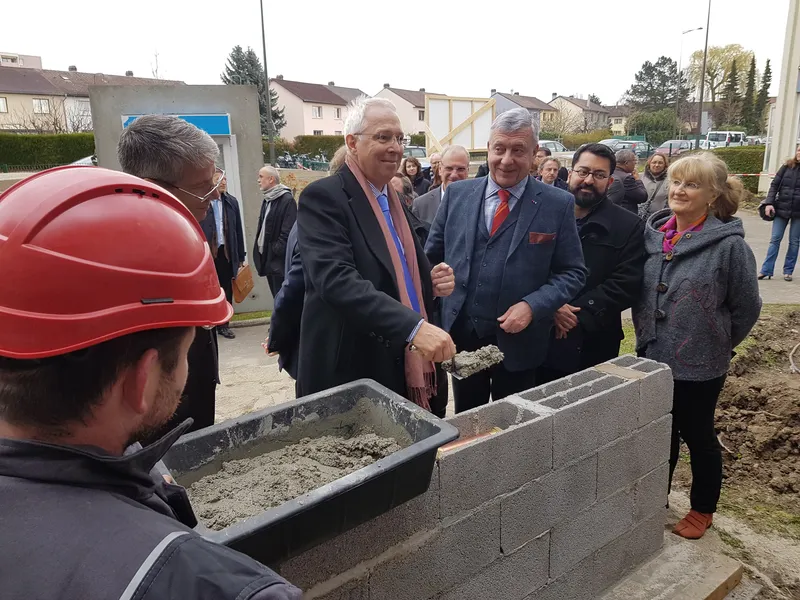 The Governor of the Council of Europe Development Bank, Rolf Wenzel, visited today the Adoma residential building “Le Ried” in Hoenheim, where substantial renovation work is being carried out to the building’s 235 rooms, with emphasis on improving energy efficiency.
This €1.8 million renovation project is part of a broader programme by Adoma, formerly known as Sonacotra and part of the Group SNI, aiming to provide housing solutions to persons who have difficulty securing accommodation, such as migrant workers, asylum-seekers and refugees. The CEB is supporting this programme with a €100 million credit line to Adoma.
Also visiting the renovation site were the Chair of the Board of Directors of the Group SNI, André Yché; the Director General of Adoma, Jean-Paul Clément; the Permanent Representative of France to the Council of Europe, Ambassador Jocelyne Caballero; the Mayor of Hoenheim, Vincent Debes; and the Mayor of Bischheim, Jean-Louis Hoerle.
Commenting on the visit, Governor Wenzel said: “Today we are moving from words to action and our visit here reflects our determination to proceed with this important social project. I am pleased that the CEB is joining forces with SNI/Adoma in order to help vulnerable groups in France such as migrant workers, asylum-seekers and refugees, in accordance with the CEB’s social mandate.”
André Yché said: “Nothing is more symbolic than launching here in Strasbourg, home to the Council of Europe, the partnership between the Council of Europe Development Bank and Adoma, whose mission is to provide shelter to persons experiencing severe social hardship. This demonstrates the importance at the European level of providing decent accommodation and emergency shelter to refugees.”
Set up in 1956, the CEB (Council of Europe Development Bank) has 41 member states. Twenty-two Central, Eastern and South Eastern European countries, forming the Bank's target countries, are listed among the member states. As a major instrument of the policy of solidarity in Europe, the Bank finances social projects by making available resources raised in conditions reflecting the quality of its rating (Aa1 with Moody's, outlook stable, AA+ with Standard & Poor's, outlook stable and AA+ with Fitch Ratings, outlook stable). It thus grants loans to its member states, and to financial institutions and local authorities in its member states for the financing of projects in the social sector, in accordance with its Articles of Agreement.