News
Greece: €160 million EIB and CEB financing for vital water irrigation investment helps protect key farming area in Crete
16 February 2024
- New water irrigation investment aims to shield against droughts in the Platys agricultural area and boost the island’s farming sector
- EIB and CEB are financing a €160 million project, which includes construction of a 21 million cubic meter capacity reservoir
The European Investment Bank (EIB) and the Council of Europe Development Bank (CEB) have each committed €80 million to support a significant new investment in Crete, which will shield vital agricultural lands in the Platys region from droughts by upgrading the water irrigation network in the area, while at the same time also protecting it against potential flooding.
The project will finance the construction of the new 21 million cubic meter capacity reservoir and an irrigation network of up to 4,350 hectares in the surroundings of the Platys region in Reythmno prefecture to secure and improve irrigated agriculture and protect the surrounding area from drought and floods. The project also includes financing for the construction of an 18.6-kilometer transfer line from the reservoir to the currently overexploited aquifer in the Messara agricultural plain of the Greek island.
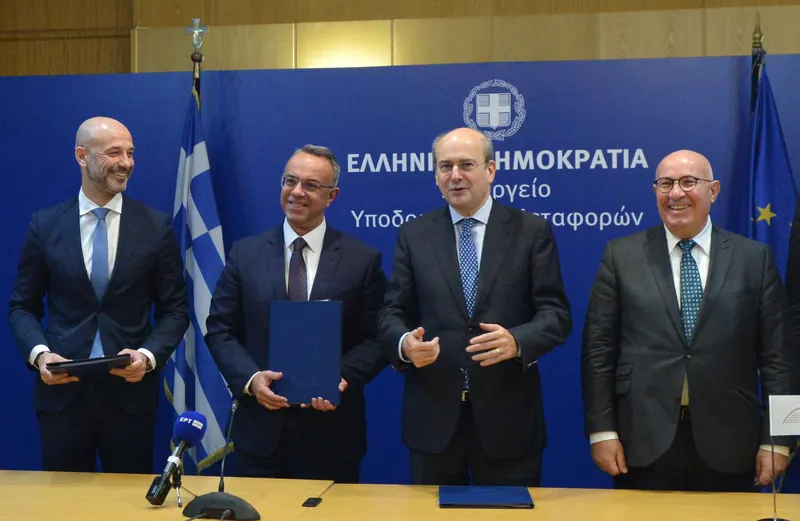
EIB Vice President Kyriacos Kakouris and Minister of Infrastructure and Transport of Greece Christos Staikouras, and Greece’s Minister of Finance Kostis Hatzidakis signed the EIB loan contract in Athens on February 16th, 2024. Tomáš Boček, CEB Vice Governor for Target Group Countries, also signed the CEB’s loan, along with Ministers Staikouras and Hatzidakis.
“Climate action and sustainability are at the forefront of the EIB’s strategy in the agricultural sector, and this investment focuses on food quality and security, as well as sustainable and inclusive rural development. These important works will also help to boost the value of agricultural production in Crete, since they will reduce water costs for farming needs, and are an important step to mitigating the adverse impacts of climate change in the region,” said Kyriacos Kakouris, EIB Vice President.
“The Ministry of Infrastructure and Transport highlights rational management of water resources as a top set of policies in response to the escalating climate crisis. At the same time, it ensures support for the primary sector and the coverage of both current and future water supply needs of the population. The construction of the Platys River Dam in Rethymno, Crete, is an emblematic project that will secure the water supply of Rethymno and irrigate 45 square kilometers in Messara, Heraklion, which is the heart of the island's agricultural production. We are creating infrastructure that promotes sustainable development, boosts economic activity, and enhances social cohesion,” said Christos Staikouras, Minister of Infrastructure and Transport.
“Climate-related risks can cause heavy disruption to economic performance and social welfare. We welcome the support offered by the European Investment Bank and the Council of Europe Development Bank (CEB) for the implementation of new investments that will limit the potential damage and costs related to such risks. I am particularly happy that this project is taking place in the region where I was born, Rethymno,” said Kostis Chatzidakis, Minister of Finance.
“We welcome this opportunity to partner with the Government of Greece and the EIB to facilitate access to funding to address the social dimensions of climate change, focusing on vulnerable groups and tackling depopulation trends in the Platys region,” said Tomáš Boček, CEB Vice Governor for Target Group Countries.
In addition to protecting against potential droughts and flooding, the new investment will help reduce greenhouse gas emissions, mainly through an increase in the biomass and soil retention of olive trees and savings in water pumping needs. The project will also boost the value of agricultural production, since it will reduce water costs for farming needs, representing an important step to mitigating the adverse impacts of climate change in the region.
Additionally, the project will generate environmental benefits by increasing the water kept in the aquifer to a sustainable level, while helping improve social cohesion by creating new, permanent jobs both in the infrastructure operation and at the on-farm level in an area suffering from a declining population.
A holistic approach to supporting targeted investment across Greece
The respective technical approaches to the project by the EIB and CEB will assure holistic and integrated water management, contributing substantially to environmental sustainability and socio-economic viability. The project will also support less developed and transition areas in Crete, thus bringing new investment in a region where per-capita income is lower than EU average, affirming both banks’ commitment to equitable growth and the convergence of living standards.
The new financing is also part of EIB Group’s objectives to focus on targeted investment in climate action and environmental sustainability, including adaptation to a warming planet, which is expected to result into more frequent and extreme droughts and torrential flooding.
Similarly, the CEB sees addressing the social dimensions of climate change as a key, cross-cutting objective of its Strategic Framework 2023-2027, given that climate hazards deepen inequality and keep vulnerable people in a cycle of underdevelopment.
Press contacts
CEB:
Communications Division, info@coebank.org, Tel.: +33(0)1 47 55 55 00
EIB:
Graham Wood, g.wood@ext.eib.org, Tel.: +30 69 72 12 23 50
Nikos Chrysoloras, n.chrysoloras@eib.org, Tel: +32 473 13 47 60
Website: www.eib.org/press – Press Office: +352 4379 21000 – press@eib.org
Background information
CEB: The Council of Europe Development Bank (CEB) is a multilateral development bank, whose unique mission is to promote social cohesion in its 43 member states across Europe. The CEB finances investment in social sectors, including education, health and affordable housing, with a focus on the needs of vulnerable people. Borrowers include governments, local and regional authorities, public and private banks, non-profit organisations and others. As a multilateral bank with an excellent credit rating, the CEB funds itself on the international capital markets. It approves projects according to strict social, environmental and governance criteria, and provides technical assistance. In addition, the CEB receives funds from donors to complement its activities.
EIB: The European Investment Bank (ElB) is the long-term lending institution of the European Union, owned by its Member States. It finances sound investments that contribute to EU policy objectives. EIB projects bolster competitiveness, drive innovation, promote sustainable development, enhance social and territorial cohesion, and support a just and swift transition to climate neutrality.