News
Improving social infrastructure boosts the economic resilience of Western Balkans: New CEB study and expert seminar conclude
10 November 2021
PARIS – A new research paper from the Council of Europe Development Bank (CEB) explores the potential of social infrastructure investments, especially in the sectors of education, health and housing, to help the Western Balkan region achieve economic resilience, develop human capital and counteract the effects of brain drain.
The report argues that improving the region’s social infrastructure can boost the human capital and societal foundations necessary to achieve long-term economic growth, resilience, and competitiveness as the countries transition to higher-value added and knowledge-based economies. Moreover, this may counteract the effects of brain drain.
The topic was also discussed in an expert seminar entitled “Western Balkans: Jobs, People, and Opportunities – What’s the Future?”, which took place on 9 November and included speakers from the European Commission, the Slovenian Presidency of the Council of the EU, the European Bank for Reconstruction and Development, the Regional Cooperation Council, and Vienna Institute for International Economic Studies.
“The CEB attaches great importance to the Western Balkan region,” said CEB Governor Rolf Wenzel. “This is demonstrated not only by the Bank being one of the largest lenders for the financing of social infrastructure projects but also by our constant support for strategic reflection and engagement with policy-makers, social sector specialists and researchers on the region’s potential for sustainable development. The study and the follow-up seminar are one example of the latter and we are pleased with the interest shown by our regional and European partners.”
You can read the full paper here. The seminar agenda is available here. For more details, contact Edo Omic, Economist at edo.omic[at]coebank.orgSet up in 1956, the CEB (Council of Europe Development Bank) has 42 member states. Twenty-two Central, Eastern and South Eastern European countries, forming the Bank's target countries, are listed among the member states. As a major instrument of the policy of solidarity in Europe, the Bank finances social projects by making available resources raised in conditions reflecting the quality of its rating (Aa1 with Moody's, outlook stable, AAA with Standard & Poor's, outlook stable, AA+ with Fitch Ratings, outlook positive and AAA* with Scope Ratings, outlook stable). It thus grants loans to its member states, and to financial institutions and local authorities in its member states for the financing of projects in the social sector, in accordance with its Articles of Agreement.
*unsolicited
Contact
- Edo OMIC Economist
Related publications
-
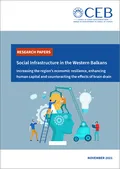
Social Infrastructure in the Western Balkans
Increasing the region’s economic resilience, enhancing human capital and counteracting the effects of outward migration on skills and … Published: November 2021 Read