News
Lisbon conference on investment for social inclusion
04 July 2019
LISBON – A high-level conference on investment for social inclusion, organised by the CEB and hosted by the Calouste Gulbenkian Foundation, took place on 4 July, on the margins of the CEB’s annual Joint Meeting. The conference brought together a dozen top-notch speakers from across Europe.
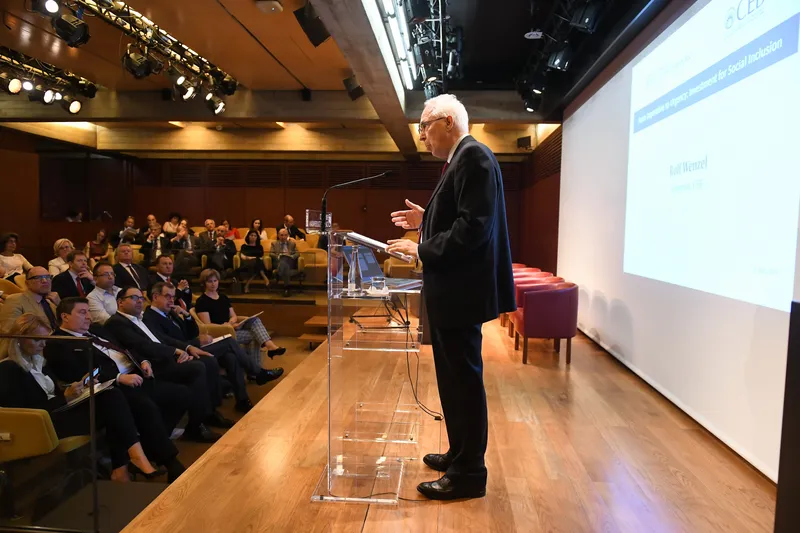


Governor Wenzel also emphasised the similarities between the Bank and the Foundation. Not only were the two institutions established at the same moment in time but they also share the same commitment to promoting social cohesion in Europe. Governor Wenzel maintained: “We do share the commitment to creating sustainable societies that provide equal opportunities for all and a better place to live in. And today, more than six decades later, it is fair to say that we have the same priorities to guide our activities: social cohesion, integration, sustainability.”
The discussions were rounded off by Carlos da Silva Costa, Governor of Banco de Portugal, who emphasised the important role of the CEB in supporting social cohesion in Europe. He also argued in favour of policy-making at the national level, focused on three sectors that are conducive to inclusive growth - education, labour market, and the business environment. Such national policies should ensure that the three sectors are flexible, able to respond efficiently to future environmental, technological, and socio-cultural shocks. Most importantly, these policies should restore agency to those at the peril of being socially excluded and allow them to contribute to sustainable growth.
Set up in 1956, the CEB (Council of Europe Development Bank) has 41 member states. Twenty-two Central, Eastern and South Eastern European countries, forming the Bank's target countries, are listed among the member states. As a major instrument of the policy of solidarity in Europe, the Bank finances social projects by making available resources raised in conditions reflecting the quality of its rating (AAA with Standard & Poor's, outlook stable, AA+ with Fitch Ratings, outlook stable and Aa1 with Moody's, outlook stable). It thus grants loans to its member states, and to financial institutions and local authorities in its member states for the financing of projects in the social sector, in accordance with its Articles of Agreement.