News
Poland: CEB Governor meets with Polish representatives
10 March 2020
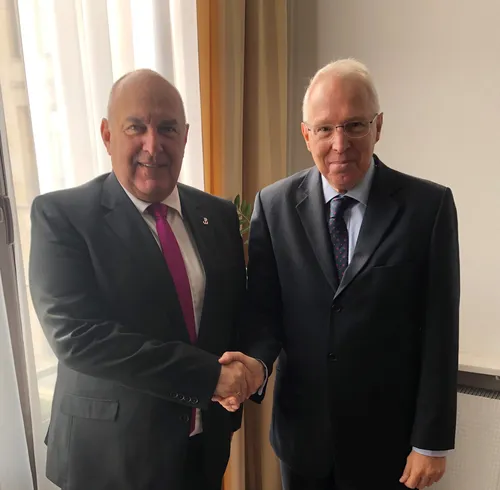
Mr Wenzel had an exchange of views with the Minister of Finance Tadeusz Kościński on the cooperation between Poland and the CEB. The Governor underlined the progress of CEB operations in Poland in a range of sectors. Minister Kościński and Governor Wenzel reviewed prospects for future cooperation.
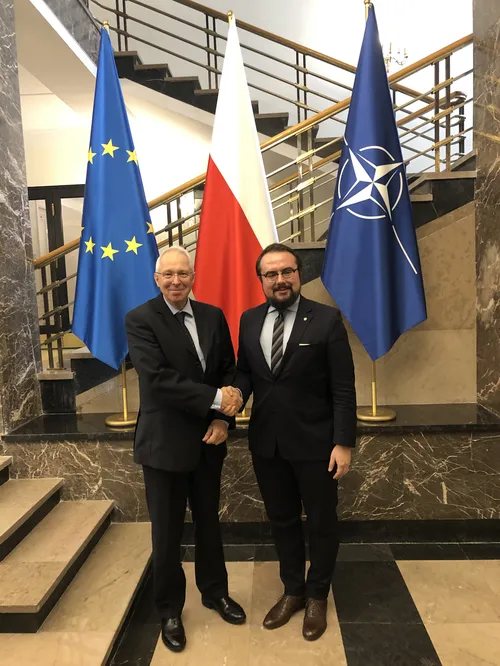
The Governor also met with Paweł Jabłoński, Poland’s Deputy Minister of Foreign Affairs, with whom he discussed the excellent cooperation between Poland and the Bank, also with regard to the Green Social Investment Fund, as well as possible ways of expanding further this cooperation.
While in Warsaw, the Governor also held a meeting with Szymon Kamiński, CEO of Pekao leasing, which is a long-standing partner of the CEB. Between 2015 and 2019 the CEB approved five consecutive programme loans to Pekao Bank and its subsidiary Pekao Leasing for a total amount of € 500 million in order to support job creation and preservation through the financing of micro-, small and medium-sized enterprises (MSMEs) across the country.
At the end of the visit, Governor Wenzel said: “I am pleased with the cooperation between Poland and the CEB in important areas of social development, such as urban and rural modernisation, prevention of natural disasters, protection of the environment, health, and MSME financing. These lines of action are at the heart of the CEB’s social mandate and are also central to the objectives set by the CEB Development Plan for the period 2020-2022.”
Since becoming a CEB member in 1998, Poland has had well above € 5 billion in financing approved by the Bank and is the largest beneficiary of CEB lending. The sectors which have benefited the most are job creation and preservation and the modernisation of urban and rural areas, including works in the area of flood protection. Projects in the areas of health and the protection of the physical and cultural environment have also received CEB financing.Set up in 1956, the CEB (Council of Europe Development Bank) has 41 member states. Twenty-two Central, Eastern and South Eastern European countries, forming the Bank's target countries, are listed among the member states. As a major instrument of the policy of solidarity in Europe, the Bank finances social projects by making available resources raised in conditions reflecting the quality of its rating (AA+ with Fitch Ratings, outlook positive, AAA with Standard & Poor's, outlook stable and Aa1 with Moody's, outlook stable). It thus grants loans to its member states, and to financial institutions and local authorities in its member states for the financing of projects in the social sector, in accordance with its Articles of Agreement.