Statement
Statement by Carlo Monticelli at Committee of Ministers of the Council of Europe
07 February 2024
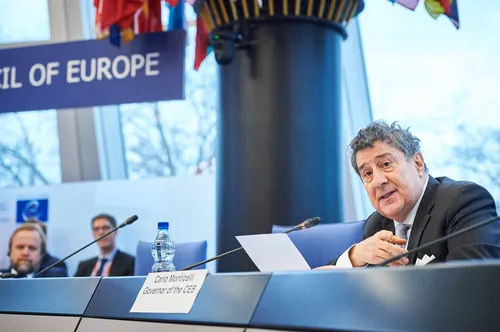
As prepared for delivery
Strasbourg, 7 February 2024
Dear Secretary General, Dear Ambassadors,
It is a great pleasure to be with you today.
This annual exchange is important to me. It allows me to update you on the Bank’s activities over the past year, give you a look at what’s ahead, and, most importantly hear from you.
Before looking back on 2023, let me share with you the excellent news that we received 2 days ago. I am very happy to confirm that we have reached the threshold to allow the capital increase, approved little more than year ago, to become effective. It is a historic moment for the Bank and we are grateful to our Members for making this happen. The subscription period is still open and I encourage Member States who have not yet done so, to subscribe.
This excellent news comes after an exceptional year for our Bank – and this is not an exaggeration.
First, it marked the start of CEB’s engagement with Ukraine in Ukraine. When we last met, Ukraine was in the process of becoming the CEB’s 43rd member. That accession process was completed in June.
From that moment, the CEB accelerated its action.
In August, the Bank’s teams undertook a first operational mission to the country. Our staff met with different Ukrainian Ministries and development partners, made contacts on the ground and forged the basis for future collaboration.
In September, the CEB signed its first €2 million grant for financing critical home repairs benefitting over 500 vulnerable households.
Then in November, the first direct loan to Ukraine was approved by the CEB’s Administrative Council.
This loan, totalling €100 million, will provide instrumental financing for urgent healthcare services to vulnerable populations, and repairs to damaged healthcare infrastructure. The loan is co-financed within the World Bank’s “Health Enhancement and Lifesaving” framework operation and has 10 million targeted to mental health care.
The CEB’s action in Ukraine is a direct response to the Reykjavik Declaration’s call to support the reconstruction of Ukraine.
Let me also mention that, since the onset of the war, the CEB had been providing support to refugees from Ukraine, hosted in CEB member countries.
Another landmark for 2023 is that it is the year the CEB returned to the full Triple A rating. This happened in July, after more than a decade since the 2012 downgrade. You may know that regaining the full Triple A rating has been one of my key objectives for the CEB since I became Governor of the Bank. Here’s why:
The full Triple A rating strengthens the CEB’s ability to deliver on its mandate by broadening the Bank’s access to capital markets and allowing the CEB to raise funds at even more favourable terms, which we can pass on to the benefit of our borrowers.
The full Triple A rating also gives a very important signal. It confirms the CEB’s excellent credit-worthiness, resulting from sound financial and risk management and strong shareholder support. Regaining this status has already led to concrete benefits in both market access and cost of borrowing.
2023 was also a record year for the CEB’s successful Social Inclusion Bond brand. The CEB’s significance as a leading issuer of sustainable bonds was confirmed by awards and the expansion into three new currencies. The leadership of the CEB in the issuance of Social Inclusion Bonds is a further testimony to the breadth of the scope of the Bank’s activity in carrying out its social mandate.
2023 saw a rise in approved loan operations, as well. The Bank approved 48 loan operations last year, compared to 36 in 2022. More approved loans mean more social projects throughout Europe.
The overall volume of loan approvals amounted to €4.1 billion, 50% of which went to target group countries. This falls in line with the goals of the CEB’s Strategic Framework and is on par with the results of the previous year (€4.2 billion). Disbursements totalled €3.7 billion.
In 2023 the CEB proved once more its capacity to react quickly to respond to new needs of its members countries. For example, shortly after the devastating earthquakes hit Türkiye and Syria last February, the CEB called for an exceptional Administrative Council and approved a €250 million loan to Türkiye to support the recovery and reconstruction of the country’s critical health services and infrastructure.
In addition, in 2023, the Bank celebrated the completion of the Regional Housing Programme (RHP). Many of you are familiar with this programme. For those who are not, the RHP was launched in 2012 to provide housing solutions to internally-displaced persons following the conflicts in former Yugoslavia.
The RHP proved truly remarkable in terms of both impact, delivering 11 300 homes for close to 36 000 people, and support it gave to the reconciliation between the participating countries. Indeed, this is at the heart of the CEB’s conception: fostering cohesion in Europe.
In 2023, the CEB also widened its reach through renewed and deepened collaboration with international institutions and actors as well as with other multilateral development banks.
It solidified its longstanding relationship with the EU and kickstarted investments in highly social projects worth €370 million, enabled by the InvestEU Garantee Agreement of 2022.
For example: The CEB provided a €100 million loan to the Institut Catala de Finances in the Spanish region of Catalonia for the development of social and affordable housing. The housing will serve more than 4 000 vulnerable people, including migrants, the homeless and victims of domestic and gender-based violence. Without the guarantee, the CEB would not have been able to approve such a high loan amount because of the high level of risk.
In parallel, the CEB intensified its efforts to enhance collaboration with other multilateral development banks. The Bank was among the signatories of a joint statement of the Heads of MDBs, in which MDB’s committed to “do more, and better together”.
2023, perhaps like no other before, underscored the growing threat of the climate emergency and the urgent need for climate action.
Indeed, the Reykjavik Declaration specifically mentions the CEB’s role in the social implications of the current climate crisis.
I am proud to report that in 2023, almost 50% of CEB projects approved had climate benefits in addition to their social impact.
Looking at 2024, the CEB has started the year on a strong footing, both on the financial and the operational fronts.
2024 will be a year of consolidation as we pursue with the implementation of the Strategic Framework and strive to build on the progress achieved so far.
This includes stepping up our activity in Ukraine in line with the directions of the Strategic Framework.
CEB teams are already preparing additional projects in Ukraine in the social sector in coordination with local authorities to respond to their priorities.
To further support our operations on the ground, the CEB is planning to open a small liaison office on the premises of the Council of Europe offices in Kyiv. The Kyiv office will improve coordination, enable the CEB to leverage synergies with the CoE and its Action Plan for Ukraine, and facilitate information exchanges between our institutions.
Europe faces a number of challenges in 2024. We already observe growing pressures on social cohesion. With ongoing conflicts, a challenging economic environment, intensifying geopolitical tensions, and an increasing risk of adverse climate events, those pressures are likely to mount.
A recent survey by the World Economic Forum of nearly 1 500 leaders in business, academia, civil society and government identified involuntary migration, a lack of economic opportunity, and societal polariSation among the top 10 global risks in the near term.
This confirms once more that our unique social mandate remains as relevant as ever. The “permacrises” of recent years have shown just how vulnerable social cohesion is and how vital social investments are.
The CEB remains committed to consolidating its role as the social development bank of choice for Europe, helping its members address persisting and newly emerging social-development and inclusion challenges.
The Council of Europe Development Bank (CEB) is a multilateral development bank, whose unique mission is to promote social cohesion in its 43 member states across Europe. The CEB finances investment in social sectors, including education, health and affordable housing, with a focus on the needs of vulnerable people. Borrowers include governments, local and regional authorities, public and private banks, non-profit organisations and others. As a multilateral bank with an excellent credit rating, the CEB funds itself on the international capital markets. It approves projects according to strict social, environmental and governance criteria, and provides technical assistance. In addition, the CEB receives funds from donors to complement its activities.
Related publications
-

Strategic Framework 2023-2027
Explore the Council of Europe Development Bank's (CEB) Strategic Framework for 2023-2027, designed to promote social cohesion across … Published: January 2023 Read