Statement
Statement by Governor Monticelli at G20 Leaders’ Summit (Johannesburg, 22 November 2025)
22 November 2025
As prepared for delivery
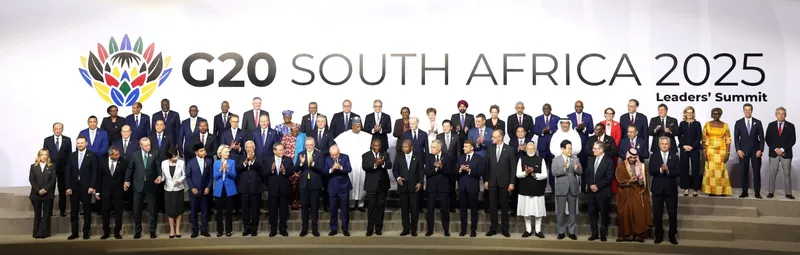
Your Excellencies, Leaders of the G20,
Let me start by congratulating South Africa for its successful Presidency of the G20 and its extensive engagement with Multilateral Development Banks – in short MDBs.
MDBs are longstanding development partners for their member countries and, building on shareholders’ guidance and G20 leadership, are pursuing reforms to achieve greater impact and scale.
In 2025, MDBs have worked closely together to translate into concrete action the G20 Roadmap for towards Better, Bigger and More Effective MDBs that you approved last year. Our results are illustrated in the inaugural Implementation Report which, for the first time, provides a comprehensive account both at individual and joint level of the progress achieved across the ten major MDBs.
Let me recall some of the key actions: implementation of financial measures that will allow MDB to scale-up lending in the coming years; signing of new agreements that facilitate MDB co-financing; providing stronger support for country platforms and regional initiatives; and intensifying efforts to develop solutions to mobilize more private capital for development.
While much remains to be done, these achievements reflect the growing momentum of collaboration in the Heads of MDBs Group – an informal forum that brings together the leaders of the ten main MDBs – which the Council of Europe Development Bank, or CEB, had the honour of chairing this year.
As the only MDB with an exclusively social mandate, in this role the CEB also fostered a greater focus on social infrastructure within the Group. We published a joint report and initiated a reflection on how to mobilize more private capital in particular for health and education - strategic sectors that drive job creation and inclusive growth.
Looking ahead to 2026, MDBs stand ready to continue pursuing a proactive reform agenda to advance global sustainable development for the benefit of communities today and for future generations to come.
The Council of Europe Development Bank (CEB) is a multilateral development bank with an exclusively social mandate from its 43 member countries. The CEB finances investment and provides technical assistance in social sectors such as education, health and affordable housing, while focusing on the needs of vulnerable people, as well as on the social dimensions of climate change and the environment. Borrowers include governments, local and regional authorities, public and private banks, non-profit organisations and others. The CEB, which has a triple-A credit rating, funds itself through international capital markets. In addition, the CEB receives funds from donors to complement its activities.