News
Turkey: EU welcomes progress achieved in construction of new hospital in Kilis
23 January 2020
KILIS, TURKEY – On 22 January 2020, H.E. Christian Berger, EU Ambassador to Turkey, visited the construction site of the future hospital in Kilis – a project managed by the CEB, implemented by the Turkish Ministry of Health, and funded by the EU Facility for Refugees in Turkey (FRiT).
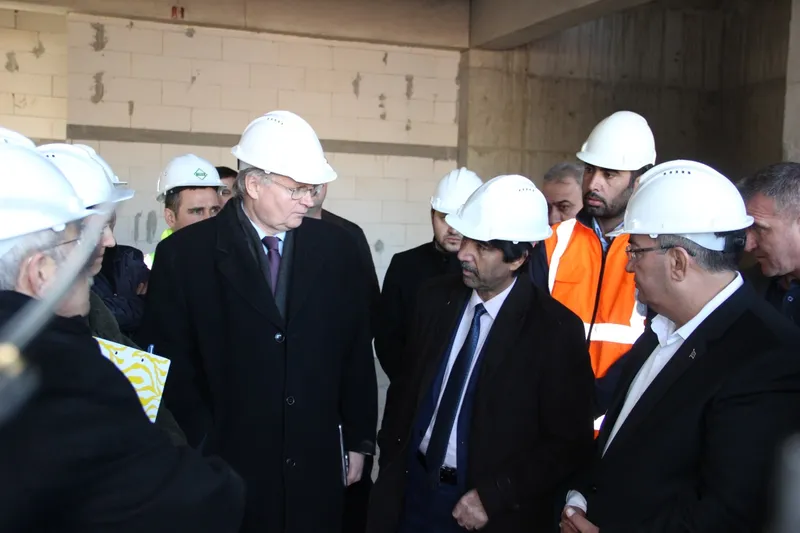
Ambassador Berger and his colleagues from the EU Delegation met representatives from the Ministry of Health, Kilis Municipality, and the CEB at the construction site of the new Kilis Hospital. While visiting the site, the Ambassador welcomed the progress achieved to date and thanked everyone involved, including the Ministry of Health, Kilis Municipality and the EU’s partner, the Council of Europe Development Bank, for making the visit possible very quickly.
Kilis, located near the Turkish border with Syria, is one of the regions that have been seriously impacted by the influx of Syrian refugees. The EU, in cooperation with Turkey and the CEB, has sought to alleviate the pressure exerted on public infrastructure caused by a dramatic increase in the demand for healthcare services, by funding the construction of a new state 300-bed hospital that will provide access to quality health services for the host community and the Syrian refugees alike.
Construction works commenced in earnest in 2019 and they are scheduled for completion by the end of March 2021. The project will also support the social and economic development of Kilis by creating jobs and new services that go beyond the construction period.
***
The EU Facility for Refugees in Turkey
The EU Facility for Refugees in Turkey (FRiT) is the answer to the EU Member States’ call for significant additional funding to support refugees in the country, and manages a total of €6 billion, to be mobilised in two tranches. The first tranche serves to fund projects that run until mid-2021 latest. The second tranche serves to fund projects which run until mid-2025 latest. The main focus areas are humanitarian assistance, education, health, municipal infrastructure, and socio-economic support.
CEB support for migrant and refugees
The Council of Europe Bank (CEB) was established in the aftermath of World War II with a specific mandate to help find adequate solutions for hundreds of thousands of refugees and displaced persons, located at that time in Europe. The CEB has continued to provide support to its member countries with addressing migrant and refugee emergency accommodation and / or integration needs ever since, with more than €4.4 billion in financing approved to date. This financing complements the migrant and refugee-related grant support mobilised and / or managed in response to the 2015 migrant crisis, which currently exceeds €70 million.
Set up in 1956, the CEB (Council of Europe Development Bank) has 41 member states. Twenty-two Central, Eastern and South Eastern European countries, forming the Bank's target countries, are listed among the member states. As a major instrument of the policy of solidarity in Europe, the Bank finances social projects by making available resources raised in conditions reflecting the quality of its rating (AA+ with Fitch Ratings, outlook positive, AAA with Standard & Poor's, outlook stable and Aa1 with Moody's, outlook stable). It thus grants loans to its member states, and to financial institutions and local authorities in its member states for the financing of projects in the social sector, in accordance with its Articles of Agreement.