News
Governor Wenzel, Chairman Lamiot address Committee on Migration, Refugees and Displaced Persons of the Parliamentary Assembly of the Council of Europe
09 September 2015
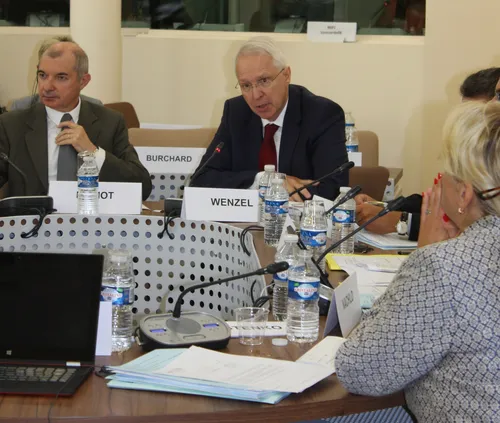 PARIS - The Governor of the Council of Europe Development Bank (CEB) Rolf Wenzel and the Chairman of the Bank’s Governing Board Dominique Lamiot addressed this morning the Committee on Migration, Refugees and Displaced Persons of the Parliamentary Assembly of the Council of Europe. The session, which was held in Paris, was chaired by Thierry Mariani, Member of the French National Assembly.
In his address, Governor Wenzel introduced the CEB and its work and highlighted the Bank’s social mandate. He stressed that financing social projects which promoted the integration of migrants, asylum seekers and other vulnerable groups was central to the CEB’s activities, and presented three such projects: the Regional Housing Programme; a recently approved €100 million loan to leading French social housing provider Adoma in favour of migrant workers and asylum seekers; and the financing of open accommodation centres for asylum seekers on the island of Lesbos in Greece.
With regard to the current refugee and migrant crisis in particular, Governor Wenzel outlined the steps taken by the Bank and said that the CEB was setting up a “Migrant and Refugee Fund” for which it was providing seed money. CEB members were urged to contribute to this Fund, which aimed to provide emergency assistance to countries receiving large numbers of refugees. “The CEB stands ready actively to support its members in the implementation of the strategies they put in place not only for dealing with this emergency situation but also in order to provide long-term solutions regarding the settlement and integration of migrants”, said Governor Wenzel.
In his turn, the Chair of the CEB’s Governing Board Dominique Lamiot underlined that the loan activity of the CEB supported the values of the Council of Europe. Regarding the migrant and refugee crisis, he pointed out that the emergency aid provided by the Bank in an immediate response to the crisis was the first step to dealing with a complex issue and could be used to leverage additional funds. In order to help its members deal with related issues in a long-term perspective, the CEB was ready to take complementary action by providing loans. “We are also looking at tightening cooperation on this matter with other multilateral organisations such as the EIB”, said Chairman Lamiot.
Thierry Mariani, Chairperson of the Committee on Migration, Refugees and Displaced Persons, welcomed the useful exchange of views on the subject and acknowledged that the initiatives taken by the CEB in the area of migration were significant.
Set up in 1956, the CEB (Council of Europe Development Bank) has 41 member states. Twenty-two Central, Eastern and South Eastern European countries, forming the Bank's target countries, are listed among the member states. As a major instrument of the policy of solidarity in Europe, the Bank finances social projects by making available resources raised in conditions reflecting the quality of its rating (Aa1 with Moody's, outlook stable, AA+ with Standard & Poor's, outlook stable and AA+ with Fitch Ratings, outlook stable). It thus grants loans to its member states, and to financial institutions and local authorities in its member states for the financing of projects in the social sector, in accordance with its Articles of Agreement.