Empowering women through business
MI-BOSPO is a Bosnian microfinance institution that works mainly with micro and small enterprises owned by women – who often have no stable income. A CEB programme loan is helping MI-BOSPO to address women’s economic empowerment and inclusion, and improve their living conditions.
 The CEB programme loan of €2 million, which was approved in September 2018, will be channelled through by MI-BOSPO in the form of micro-loans limited to amounts up to €5,100 (equivalent to 10,000 Bosnian Convertible Marks, or BAM). This is the legal limit for non-profit microcredit foundations, and will mean that a minimum of 800 households and microenterprises could benefit from the programme.
This CEB loan is the first to serve mostly low-income women entrepreneurs with limited or no access to bank loans.
"MI-BOSPO has created special favourable credit products from the CEB funds. By strengthening women’s entrepreneurship, it strengthens women’s position in society and helps to reduce poverty in general," Safet Husić, MI-BOSPO Director
The challenge of unemployment
Bosnia and Herzegovina has one of the highest levels of unemployment in Eastern Europe. In March 2018 its registered unemployment rate was 37%, with 466,330 people unemployed. According to data from the statistics office, only 794,505 people were in formal employment out of a population of 3.5 million. The country is still suffering from the consequences of the 1992-1995 war, which affected all the larger companies in the country. Ongoing political and economic uncertainty continues to deter foreign investors who could create vital new jobs.
The issue for women
Women in Bosnia and Herzegovina have lower employment rates and are economically less active compared to men. Women make up 45% of the unemployed population, and are 62% of the inactive labour force, since many are homemakers or unpaid family carers. The International Labour Organization estimates male and female labour force participation at 55% and 33.5%, respectively.
A host of other factors also contribute to gender imbalances, including:
- Insufficient childcare facilities
- An education system that reinforces the traditional roles of men and women
- Gendered labour roles
- A lack of financial resources for the self-employed.
A driving ambition
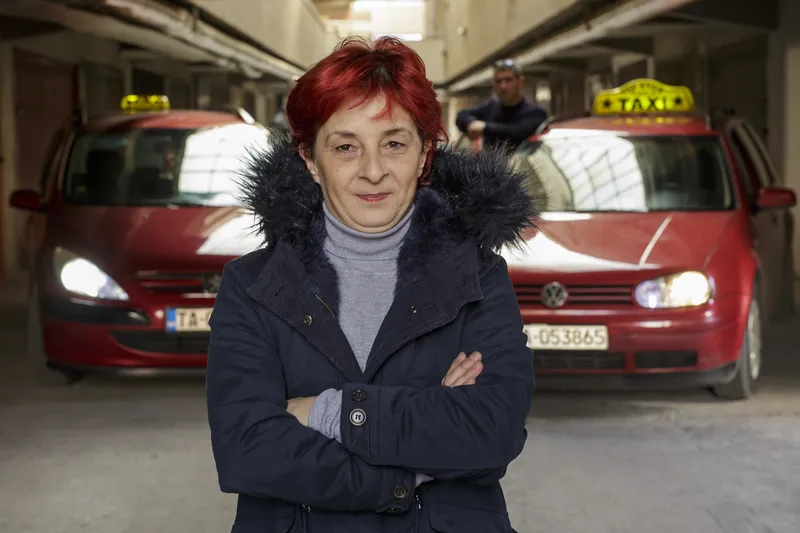 Tuzla is the economic, cultural, educational and tourist centre of north east Bosnia. It’s a busy place, with plenty going on. Mersija Begovic´, who comes from the city, used her first MI-BOSPO loan to found a taxi company with her husband. That was in 1998, when the couple began the business with one old rented car.
Today Mersija has just received her twentieth loan from MI-BOSPO, and her taxi company owns four cars and a van, and has three employees.
Mersija has stepped back to enable her son to manage the day-to-day running of the business (she’s mindful of how hard it is for young people to find work in Bosnia and Herzegovina). However, she still keeps an eye on business – she’s in charge of administration.
📷 Amel EmricRelated publications
-
Technical brief - Supporting inclusion in Europe through microfinance
This technical brief reviews microfinance activities in Europe and highlights three key areas of intervention for international finance … Published: May 2019 Read