Constructing education: How the Finns do it
Here’s how they are using cutting edge school design to address learning challenges, and the lessons it holds for other countries.
Author: Janel Siemplenski Lefort
It’s been raining off and on all morning in Järvenpää, a small city north of Helsinki. The streets are wet and the sidewalks muddy, but the floors in Harjula School’s entrance are gleaming.
The entrance is filled with hooks and cubby holes where schoolchildren hang their coats and take off their shoes. Students and teachers walk around in stockinged feet or in “house shoes,” slippers to keep the muck out when the weather is bad.
Down the hall from the entry, the building opens up to a bright atrium with tables and chairs, which also serves as a cafeteria. Floor to ceiling windows let the light pour in even on a gloomy day and provide a view onto the outside play area, a huge pine tree (which is decorated at Christmas) and a neighbouring residential area, with brick houses and bright, almost fluorescent green lawns.
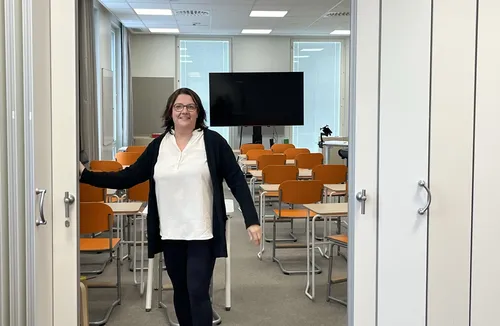
At the back of the atrium is a raised stage, blocked off by a retractable wall that opens to a larger, space used for big gatherings, sports events and theatre productions. Throughout the building, thick, accordion-style walls can be opened or closed to enable teachers and children to come together in big groups, or be whittled down into smaller, more intimate gatherings. It’s a kaleidoscope of spaces that twist and turn as needs change.
The innovatively designed school is the brainchild of Tarja Edry, the principal of Harjula School, and Jan Mikkonen, pedagogical facility development manager for Järvenpää. In many ways, Harjula’s design represents the next step in Finnish education, a country already known for cutting-edge, highly effective schooling. “We had a vision, together with Tarja, about what we planned to do,” Mikkonen says.
That vision was to deconstruct the traditional school, with its long hallways and closed classrooms, and rebuild it as a more open, more flexible space that could support different kinds of instruction, such as team teaching, where instructors work in groups or share classes, collaborative projects that encourage students to communicate and solve problems together and creative exercises that let children express their own personalities and talents.
Because all the rooms are multifunctional, teachers move from one area to another or share classrooms with another teacher. They no longer have dedicated classrooms. Edry hoped that changing the space would push teachers out of their comfort zones and force them to rethink how children learned.
The somewhat radical approach caused conflict, however. Some teachers left. “Those who didn’t want to stay started searching for another school, because they didn’t want to change their pedagogy,” she says. The old school building was more traditional, with classrooms for each teacher. The new building is “totally different,” she says. “Everybody had to get used to it.”
“Education has always been a way to upgrade socially. But education isn’t so easily the way to jump up the social ladder anymore.”
Merja Narvo-Akkola – Chief of education services for Järvenpää
Finland’s educational system is among the best in the world, according to the Programme for International Students Assessment (PISA). But the country is grappling with the same issues as everyone else – the shortened attention span of children raised in a digital world, learning losses accumulated during the pandemic, rising absenteeism and overburdened parents who struggle to set limits and, more importantly, spend time with their children. “Children are feeling a bit insecure,” Edry says. “We can see it. They really want to be with adults.”
Finland is up against other challenges as well. It is historically a homogeneous country, but that is changing. By 2030, immigrants are expected to account for 25% of school children in major cities like Espoo and Helsinki, and they are struggling to learn the language and to read at the same level as their peers. More generally, the gap between strong students and weaker ones has widened, and boys in particular are falling behind. Finland is even starting to see signs of childhood poverty, a new phenomenon in the country.
“Education has always been a way to upgrade socially,” says Merja Narvo-Akkola, chief of education services for Järvenpää. Finnish education is highly decentralised, and municipalities are responsible for planning, building and running schools. “But education isn’t so easily the way to jump up the social ladder anymore.”
Read how Innovative financing for a Milan school is sparking change in education
Why buildings matter
When Principal Edry and educators like her try to rethink education infrastructure, they need support. Providing that support is central to the Constructing Education framework, a new approach to financing education infrastructure being promoted by the Council of Europe Development Bank and the European Investment Bank. EU members spend billions of euros on education infrastructure each year, and the money needs to be deployed in a way that best supports learning and prepares children for the future.
For example, the framework recommends providing funds to develop teachers’ competencies, helping them find the best ways to use the new, snazzy spaces, which hopefully avoids the pitfall of moving into an innovative building and teaching the same old way.
“I think what brought the Constructing Education framework about is the realisation that you are putting up so much money to invest in these very innovative buildings and then you see that the teaching staff is not ready to use it,” says Yael Duthilleul, who works on the Constructing Education framework for the Council of Europe Development Bank. “You think, ‘We’re wasting our investments.’ For us as financiers, it’s an issue because we’re mobilising money for these projects, but the impact that you expect, which is on students’ learning outcomes, is not guaranteed.”
The Constructing Education framework tries to address teachers’ professional development and coaching, planning sessions, consultations with parents and students – things that all take time and resources, which are almost never included in the total budget of new educational facilities.
“In Finland, we can’t put that into the investment budget. We have to find that money from somewhere else,” says Narvo-Akkola, chief of education at Järvenpää. At Harjula school, Edry was forced to use funds from her general school budget to pay for teacher support before moving into the new building.
Under the framework, budgets for new school buildings would include funds for professional development, consultations with education experts and post-occupancy evaluation tools to better understand what kinds of spaces and approaches work best.
“Right now, financing education infrastructure is considered as a stand-alone investment,” says Silvia Guallar, an education economist at the European Investment Bank, who works on the Constructing Education framework. “Instead, such investments should follow a more comprehensive approach and include all the complementary activities, like consulting the education community and supporting teachers’ transition into the new spaces. That will enhance the impact the upgraded learning environment has on teaching pedagogies and student learning.”
Support for teachers is crucial when countries are trying to modernise rigid education systems. An ongoing reform of Finnish education, which began rolling out in 2016, includes a chapter on how to create environments conducive to learning. One central theme is that learning takes place everywhere, not just in the classroom. The reform also stresses the importance of team teaching, which frees teachers up to give students individual attention when necessary. These approaches, however, require pushing the boundaries of traditional school architecture, with walled-off classrooms and neat rows of desks.
“Team teaching comes with the idea of flexibility of the space and sharing space, as well as making learning available everywhere. This has lots of implications for furniture,” says Duthilleul of the Council of Europe Development Bank. “If you want kids to learn everywhere, then the furniture should be like home. You should be comfortable so you can learn.”
Guallar and Duthilleul, along with a group of experts, are following the building or renovation of two schools in Espoo, two in Järvenpää (Harjula is one of them) and two in Italy to understand better how the innovative buildings are conceived and later used. The knowledge gained could be shared with local governments in other countries planning education infrastructure.
Some of the data gathered during the post-occupancy evaluation was made available at a Constructing Education event in Finland in mid-November. Järvenpää was not initially part of the project, but Narvo-Akkola got involved in the Constructing Education framework in her previous job as manager for district education in Espoo, which was funding education investments in part with loans from the European Investment Bank and Council of Europe Development Bank. She has continued to advise the project in her new role in Järvenpää.
The European Investment Bank financed more than €9 billion in education infrastructure
from 2017-2022, 97% of which was spent within the European Union. It provided around €1 billion for education projects in Finland alone. For its part, the Council of Europe Development Bank financed about €4 billion for projects with an education component in the same period, out of which €410 million went to Finland.
“It’s not necessarily about the amount of money that you spend, but also the efficiency with which you spend the money. It’s about targeting the right sectors in the right way.”
Nihan Koseleci Blanchy – Senior education economist at the European Investment Bank
Finland spends about 3.8% of its gross domestic product on primary and secondary education, which is in line with other wealthy countries like Belgium (4.2%), Germany (2.9%) or France (3.5%), according to the Organisation for Economic Co-operation and Development. “It’s not necessarily about the amount of money that you spend, but also the efficiency with which you spend the money,” says Nihan Koseleci Blanchy, a senior education economist at the European Investment Bank, who is responsible for the EU bank’s investments in Finland. “It’s about targeting the right sectors in the right way.”
Published: January 2024
Related publications
-
Constructing Education: An Opportunity Not to Be Missed
An innovative framework to guide investments in education infrastructure so that they can better promote student learning outcomes. Published: March 2021 Read