Her own house: the building blocks for women’s entrepreneurship
#InvestInWomen is the United Nations’ 2024 International Women’s Day theme. We celebrate the day by highlighting how the CEB has laid the foundation of women’s economic empowerment in Bosnia and Herzegovina, Croatia, Montenegro, and Serbia by providing them with stable housing through the Regional Housing Programme (RHP).
Svetlana Marković is among the approximately 18,300 women who have benefitted from the RHP, a donor-funded programme that, from 2012 to 2023, provided homes to refugees and people displaced by the conflicts in the former Yugoslavia during the early 1990s.
Having fled to Nikšić, Montenegro from Kosovo in 1999, Svetlana, a widow with two boys, faced challenges living in a small and dilapidated accommodation, especially with one son afflicted with diabetes and the other dealing with a speech impediment. Introduced to the RHP in 2014 by a social services team, Svetlana applied to the Programme and moved into a newly-constructed apartment shortly after.
‘Ever since we moved in, our quality of life has been truly fantastic. It can’t compare to the place which we used to rent’, she says.
Laying the foundation for economic empowerment
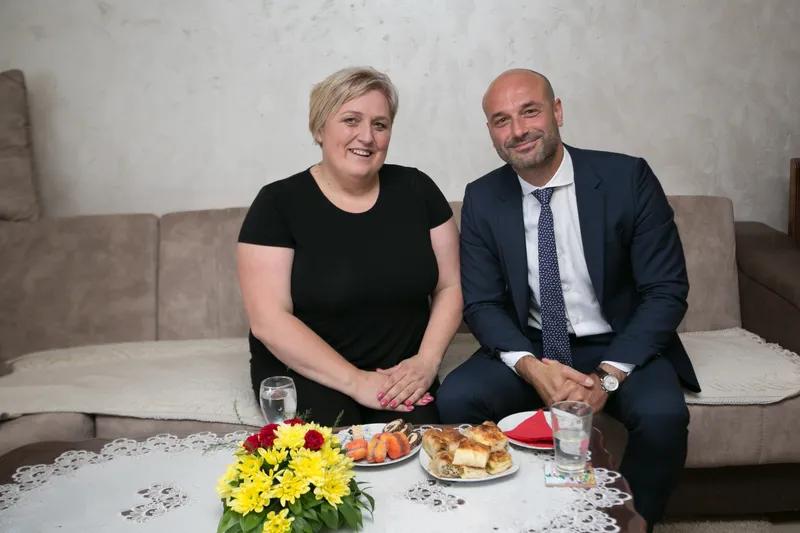
Moving into this RHP apartment not only provided Svetlana with stability and security in the form of housing, but also financial independence, as she kickstarted her home catering business in her new kitchen. With a complementary grant from the Government of Montenegro and Catholic Relief Services (CRS), Svetlana bought baking supplies and began catering for various events: ‘I have some fifteen to twenty women who order from me on various occasions such as children’s birthday parties etc. I offer quality to satisfy my customers,’ she smiles.
Svetlana's story illustrates the practical and social impact of investing in women. Complementary measures to the housing provided by the RHP have been implemented by organisations like the CRS, which have actively contributed to women’s economic independence, empowerment and entrepreneurship by providing crucial sources of income generation, aiding families to (re)settle.
Building on the housing support provided by the RHP, ‘Svetlana’s family was one of more than 700 who received income-generating support from CRS, dramatically transforming their lives for the better and leaving poverty behind them’ emphasises Marja Seppälä, former Head of the Regional Housing Programme Unit at the CEB.
The CEB is ‘immensely proud to have played a key role in the RHP, which provided secure homes and restored dignity to more than 11,300 most-vulnerable displaced and refugee families after years of conflict and inhumane living conditions’, adds Seppälä. Through the RHP, the CEB has supported most-vulnerable women, offering secure housing, and thereby fostering their potential for entrepreneurship and economic independence.
Beyond housing
For over a decade, by leveraging its extensive knowledge of social housing, the CEB has managed close to 300 million euros in RHP donor funds, facilitating the provision of durable housing to almost 36,000 most-vulnerable women, men and children across the Partner Countries. Meanwhile, UNHCR (the UN Refugee Agency) and the OSCE (Organisation for Security and Cooperation in Europe) monitored RHP beneficiary selection and socio-economic sustainability.
The RHP also benefitted from strong financial support from the international community, with the European Union as the largest donor, but also the USA, Germany, Norway, Italy and Switzerland, among others. The Programme ended in 2023.
Not only did the RHP play a key role in facilitating cohesion and cooperation amongst neighboring countries in the Western Balkans following years of persistent conflict, but it also spurred sustainable economic growth within local economies by stimulating job creation, as well as improved construction standards and maximised energy savings for families. The RHP has proven to be a successful initiative that should serve as a blueprint for future co-operation in other post-conflict or reconstruction contexts.