Making mobility sustainable in Nantes
With the 300,000 daily journeys into and out of the French metropolitan area of Nantes Métropole set to double by 2030, an efficient and attractive public transport system is a priority. A €150 million public sector financing facility from the CEB is helping to make this a reality.
 Nantes Métropole is one of the most dynamic metropolitan areas in France, with an annual employment growth rate of +1.24%. Around 30% of jobs in the region are held by people who do not live within the metropolitan area, which results in high volumes of daily commuter traffic.
The challenge of increasing traffic
Since 2002, the total number of daily journeys within the area has grown from 1,940,000 to 2,351,000, and some 300,000 journeys into and out of the metropolitan area are made every day. Around 90% of these are by car and around half are during rush hours. It’s thought that, by 2030, this daily figure will have doubled.
By 2030 the area is forecast to have a population of 680,000 residents; 60,000 new jobs will have been created. Each year some 6,000 new homes are built. Student numbers are expected to grow too. Providing efficient and attractive public transport is therefore a key priority for the authorities of Nantes Métropole.
Pioneering clean transport
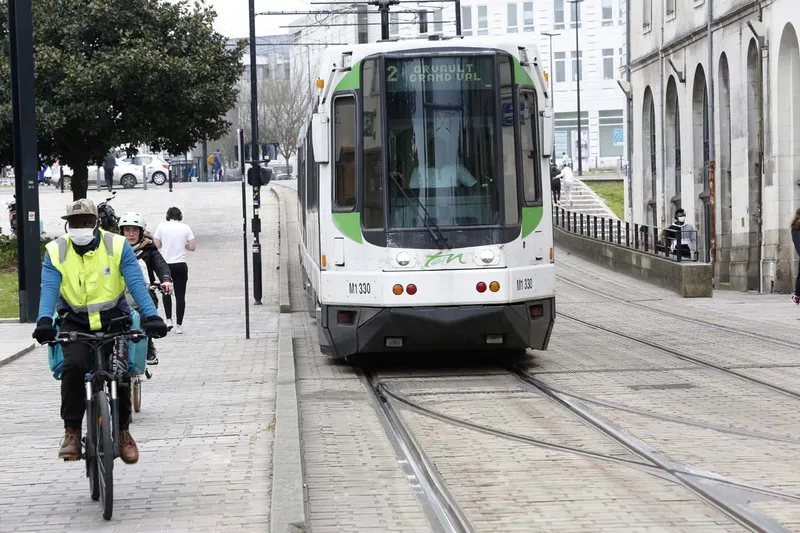
Nantes has an excellent reputation for implementing clean transport. In 1985 it reintroduced trams and created an extensive tram network. It has developed a bus rapid transit (BRT) system and worked hard to reduce car use and promote alternative means of transport, including bike rental schemes. It also makes extensive use of natural gas (NGV) hybrid buses and has implemented the Navibus, a hydrogenpowered river shuttle service. Despite the city continuing to expand, these efforts have led to a significant reduction in the use of private cars.
 Enhancing the tram and bus network
The CEB is playing a part in the latest chapter of the metropolitan area’s clean transport story. A new project will help to improve the capacity, frequency, comfort and accessibility of the region’s tram and bus network and this is being part financed by a €150 million public sector financing facility (PFF) from the CEB, approved in January 2020.
The project forms part of the Metropolitan Council’s Urban Travel Plan for 2018-2027 and Outlook for 2030. It will see major investment in new rolling stock (trams, busway e-buses, buses and minibuses) and extensive updates to the existing infrastructure.
 What will the project involve?
The aim is to strike a balance between accessibility for all with day-to-day mobility and environmental requirements. And all while improving quality of life for the metropolitan area’s residents. As well as catering for the expected doubling in daily journeys by the end of the decade, the project aims to make public transport a more attractive travel option for everyone in the area. It should also help to control the network’s operating and maintenance costs.
The total project cost is €317 million and has three components.
• New trams and updated infrastructure
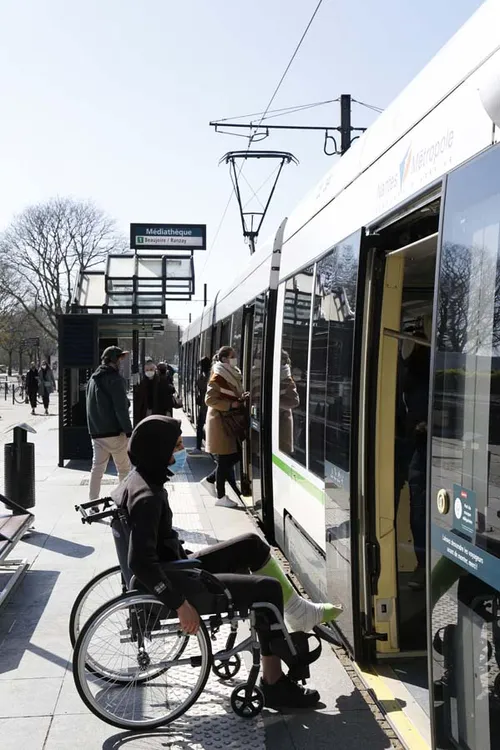
The project will see the purchase of 61 new, longer trams. This will cost an estimated €195 million and will increase tram capacity by 20%. The trams will be accessible and user-friendly for a variety of groups, from the elderly and people with reduced mobility or disabilities, to people on low-incomes or who work non-standard hours.
The new trams will provide better onboard information and will contribute to the authority’s low-energy policy.
Old trams will also be dismantled and decommissioned, and existing lines, stops and depots will be updated to enhance accessibility.
• New e-buses and infrastructure
Some 22 chargeable 24m busway e-buses will also be purchased, at an estimated cost of €38.5 million. Circulating along the line 4, these will serve a 7km route through three municipalities, Vertou, Saint Sébastien-sur-Loire and Nantes and will have the potential to be used by up to 55,000 passengers a day. The existing infrastructure along the route will also be upgraded to allow for the operation and charging of longer vehicles.
• Upgraded accessible minibus service
Nantes Métropole already runs a ProxiTan minibus service for people with reduced mobility. The new project will see a significant upgrade to this service, with the purchase of 32 new buses and minibuses at an estimated cost of €83.7 million.
A transport system for the future
Commenting on the project, Arnaud de Verdière, the CEB’s Senior Country Manager for France, says, “Easier travel between places of life, services, leisure and employment is essential for the quality of life of all citizens, especially the most economically and socially vulnerable. We are pleased to cooperate with Nantes Métropole on this project, which has multiple positive social and environmental effects.”
"The metropolis of Nantes has always been a pioneer in the development of public transport to meet the social and environmental challenges we face. The development of these infrastructures requires heavy investments and we are happy to have the partnership of the CEB to be able to finance them,” says Pascal Bolo, Vice-President of Nantes Métropole in charge of Financial Affairs.