A shared resolve
With Europe particularly hard hit by the COVID-19 pandemic, Info talks to the Secretary General of the Council of Europe, Marija Pejčinović Burić, and to the Governor of the CEB, Rolf Wenzel, about how the two organisations have supported European countries to cope with the crisis.
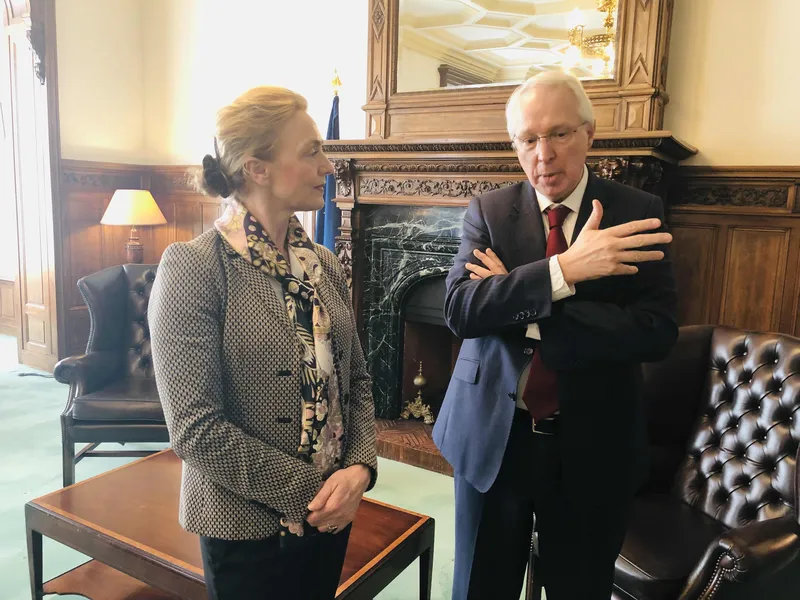
Info: Secretary General and Governor Wenzel, what steps have your organisations taken in response to the pandemic?
Secretary General: Our societies have been facing unprecedented medical, social and economic challenges due to the COVID-19 crisis. The Council of Europe's task is to assist member states to ensure that the measures they take to fight the pandemic do not risk the protection of our common European values of democracy, the rule of law and human rights.
That is why I issued a “toolkit” with guidance to governments to help ensure that the measures they take during the crisis remain proportional to the threat posed by the virus, and are time-limited.
The document covers four key areas:
- Derogation from the European Convention on Human Rights in times of emergency;
- Respect for the rule of law and democratic principles in times of emergency, including limits on the scope and duration of emergency measures;
- Fundamental human rights standards including freedom of expression, privacy and data protection, the protection of vulnerable groups from discrimination and the right to education;
- Protection from crime and the protection of victims of crime, in particular regarding gender-based violence.
We have been quick to adapt our working methods to ensure business continuity. Meetings of the Committee of Ministers have taken place by video conference. Our work has also remained visible through proactive communication.
As we move out of this crisis, I believe that our organisation will be a leading voice in the European debate on lessons to be learned for our governments and societies.
It is already clear that the crisis has exacerbated the inequalities faced by disadvantaged groups in society. We have gained substantial experience on the rule of law, domestic violence, the situation in prisons, counterfeit medicines, social rights and other key issues in 2020, the year that marks the 70th anniversary of the European Convention on Human Rights.
Governor: As lockdown conditions were imposed, the CEB moved swiftly to ensure that our critical banking operations continued uninterrupted. We adapted our loan policies and offered financing for crucial sectors such as health and MSMEs. Our aim was two-fold: first, to remain fully operational without compromising the welfare of our staff, which is a priority for the CEB, and, second, to support our member countries in the fastest and most efficient way possible.
The COVID-19 health crisis may be a major challenge in itself, but its social and economic effects are expected to be equally massive and lasting.
The CEB, as a social development bank, has an important role to play in supporting its members during the crisis and in the recovery period.
In just a couple of months, and with our staff remote working and making full use of videoconferencing, we managed to put together project proposals and approve by a fast-track procedure loans worth almost €3 billion for COVID-19 projects alone. These are to national governments, local authorities, national development banks, and institutions such as hospitals. They provide financing for health expenditures and MSMEs, since health and employment are the two areas where there are increased needs.
In April we also successfully issued a €1 billion COVID-19 Response Social Inclusion Bond, the proceeds of which are earmarked for projects in areas affected by the pandemic. Of course, the CEB has been successfully issuing social inclusion bonds since 2017, but this one is specifically aimed at mitigating the social and economic impact of the pandemic in member countries. I am pleased to say that investor interest exceeded our expectations many times over. The issuance was oversubscribed and we achieved favourable financing conditions, which, in turn, will benefit our member countries.
Info: Secretary General, how do you see the role of the CEB in these exceptional circumstances and in the future?
Secretary General: Our Bank has taken rapid action, providing financial assistance to member states facing extreme emergencies. As Governor Wenzel says, thanks to the special fast-track procedure introduced, specific loans have been approved to finance health projects to help cope with the pandemic. And the €1 billion COVID-19 Response Social Inclusion Bond is the largest social bond in the Bank's history!
Over the last decade, our Bank has become more efficient and more respected for its expertise and social mandate. It is now well-known internationally and has even been referred to as “Europe's Social Bank”.
The CEB’s support to vulnerable groups fits perfectly within the role of the Council of Europe’s mandate to promote human rights, democracy and the rule of law. I believe its role will continue to grow and benefit social cohesion and integration in Europe.
Info: Governor, how do you see the situation developing in the coming months?
Governor: The outlook for the European economies remains bleak despite the recovery expected in the second half of this year and despite the announcement of considerable financial support packages. So there will be an increased need to support small businesses, maintain jobs and create new ones, and cushion the impact of the crisis on social cohesion. At the same time, there will continue to be a need for social investments in areas such as social housing, education, migrant integration, and public infrastructure.
The CEB will continue to do its utmost to support its members, actively promoting the values of the Council of Europe, and working to build a better, stronger, more resilient Europe.
Related publications
-

INFO 03/2020
This issue of INFO magazine offers an overview of the Council of Europe Development Bank's response to the … Published: June 2020 Read