Supporting Nuremberg’s commitment to social integration
The Nuremberg city administration is wholeheartedly committed to actively realising human rights, and to the integration of all people living in Nuremberg. The CEB is supporting the City to solve substantial challenges.
 Nuremberg is Bavaria’s second-largest city after
Munich, with some 540,000 inhabitants. It’s a rapidly growing city, almost a
quarter of its inhabitants are foreign nationals and over 45% have migrant
backgrounds. In common with many European cities experiencing immigration and
rapid growth, Nuremberg has its challenges. Since 2019 the CEB has been
working with the city administration, and wbg Nürnberg GmbH
Immobilienunternehmen, Nuremberg’s leading public real estate company, and a
subsidiary of the City of Nuremberg, to meet the diverse needs of this
dynamic city.
Nuremberg is Bavaria’s second-largest city after
Munich, with some 540,000 inhabitants. It’s a rapidly growing city, almost a
quarter of its inhabitants are foreign nationals and over 45% have migrant
backgrounds. In common with many European cities experiencing immigration and
rapid growth, Nuremberg has its challenges. Since 2019 the CEB has been
working with the city administration, and wbg Nürnberg GmbH
Immobilienunternehmen, Nuremberg’s leading public real estate company, and a
subsidiary of the City of Nuremberg, to meet the diverse needs of this
dynamic city.
Meeting the affordable housing challenge
Affordable housing is a scarce commodity in Nuremberg. Policy changes in the 1980s and ’90s led to a huge drop in the social housing stock from 66,000 homes in 1980 to 18,000 in 2015. Plus, in the past decade rents have risen by 25% - affecting low income households – young families, single parent families, the elderly, students and migrants – the most.
The City and the CEB
About 6,200 dwellings of the social housing stock in Nuremberg are owned by wbg. Since 2019, it has been actively working to reverse the decline in social housing by modernising its ageing stock of homes and building new dwellings. This initiative has been supported by a €110 million loan from the CEB, which was approved in January 2019.
Around 58% of the homes wbg is building under the CEB Programme Loan will be social housing, while the remaining 42% will be rented out unrestricted, but at lower-than-average rents. This mixing of subsidised and market-based housing is a deliberate policy to preserve socially stable neighbourhoods and guarantee the peaceful integration of different population groups.
Construction of social housing in the city’s south east
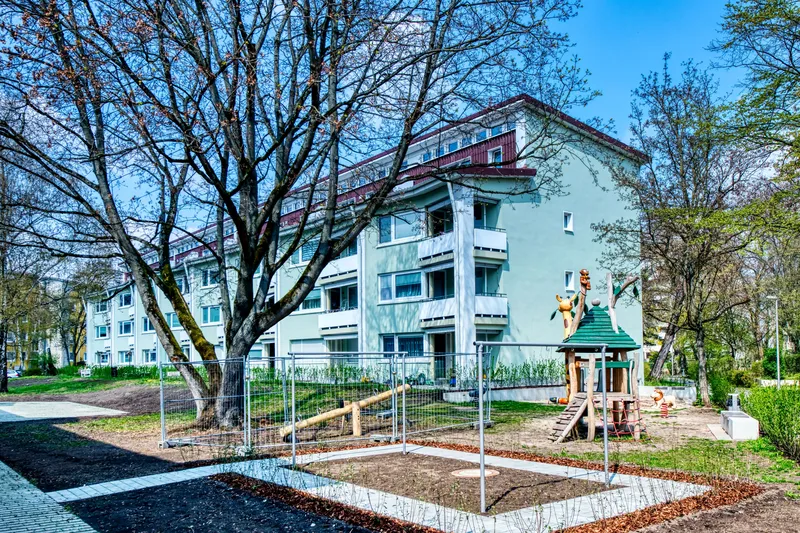
 On Neusalzer Strasse in the Langwasser district,
south east of the centre of the city, 36 rental flats now occupy a former
garage and commercial site. This development, built with CEB financing as
well as €9.6 million from wbg and other finance partners, has involved the
modernisation of wbg properties that date from the 1960s. The result is high
quality social housing that integrates the latest technical, energy and
social requirements – a new neighbourhood centre, providing advice and
support for local people, forms part of the development.
On Neusalzer Strasse in the Langwasser district,
south east of the centre of the city, 36 rental flats now occupy a former
garage and commercial site. This development, built with CEB financing as
well as €9.6 million from wbg and other finance partners, has involved the
modernisation of wbg properties that date from the 1960s. The result is high
quality social housing that integrates the latest technical, energy and
social requirements – a new neighbourhood centre, providing advice and
support for local people, forms part of the development.
Commenting on the new development, Frank Thyroff, Managing Director of wbg Nürnberg, says, “The loan agreement with the CEB is a central milestone for the economic and social challenges of providing Nuremberg’s population with sufficient affordable housing.
Favourable financing conditions enable wbg and its shareholder, the City of Nuremberg, to realise socially sustainable housing construction.”
How else does the CEB support Nuremberg?
The City of Nuremberg was the first German municipality to work directly with the CEB – a relationship initiated via an €80 million public sector financing facility (PFF) approved by the Bank in November 2018.
Investing in education
This loan is supporting the City’s 2018-2025 education investment programme which includes the construction or renovation of schools and early childhood care facilities throughout Nuremberg. The loan finances investment in:
- 21 early childhood education and care and after-school programmes (18% of total investment)
- 19 primary schools (31% of total investment)
- 6 secondary schools (34% of total investment)
- 4 middle schools (2% of total investment)
Many of Nuremberg’s inhabitants from migrant backgrounds are children and young people under 18. The PFF will help to part-finance additional classrooms in secondary schools, resulting from the demographic changes experienced by the city in recent years, as well as a recent extension in the number of school grades from eight to nine. New sport and library facilities, after-school activities and full-day schools are also included in the investment.
Practical support for migrants and refugees
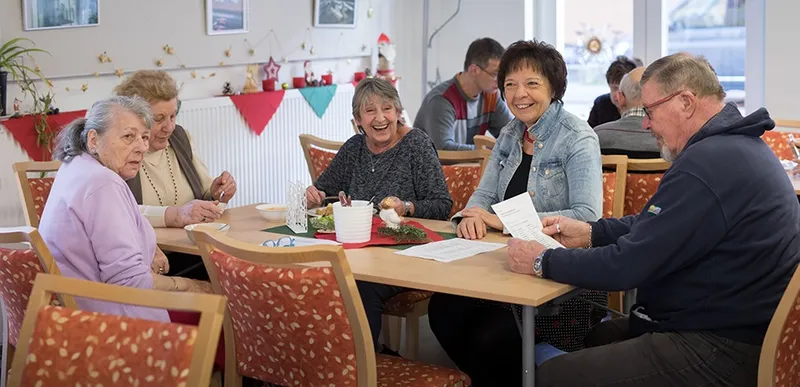
The “LeMi” learning café opened in the Südstadtforum on Siebenkeesstraße close to the city centre in 2019 with support from an investment grant from the Migrant and Refugee Fund. The grant funded the renovation of the café, as well as new equipment and staff costs.
A small team of teachers and social workers offer language and basic skills training plus help with everyday problems such as correspondence with authorities, professional orientation and job searches. While the café supports the social integration of migrants and refugees in Nuremberg, it also provides long-term unemployed people with skills training and is a welcoming place to make friends, contacts and connections. The project was implemented by municipal company, Noris-Arbeit (NOA).
Denis Petroy, responsible for the project’s development, says, “The CEB’s support has made this crucial project possible, including the funding of the team of teachers and social workers, who are all delivering an extremely important service.”
“Nuremberg is a showcase for the breadth of CEB’s instruments,” says Country Manager Philipp Voswinkel.
“Combining grants and loans to both the City and its subsidiaries allows Nuremberg to support meaningful social change more efficiently and effectively.”
This article is one of a series featuring emblematic projects to celebrate the CEB’s 65th anniversary.