A sweet success for women migrants
Through its work with Spain’s MicroBank, the CEB is supporting women migrants to build successful microbusinesses, fulfil their potential and fully integrate into Spanish society.
 Just over half of all migrants in OECD and EU
countries are women, yet they face persistent disadvantages in the labour
market due to their gender and migrant status. In fact, migrant women have
lower employment and higher unemployment rates than foreign-born men and
native-born women.
Just over half of all migrants in OECD and EU
countries are women, yet they face persistent disadvantages in the labour
market due to their gender and migrant status. In fact, migrant women have
lower employment and higher unemployment rates than foreign-born men and
native-born women.
Nevertheless, integrating migrant women into the labour market and society at large is vital if socio-economic gaps between men and women are to close, and if the children of migrant women are going to successfully integrate into their host country.
Accessing vital support
Spain’s MicroBank provides competitive microfinance to vulnerable population groups who aren’t sufficiently covered by the traditional banking system, enabling many people – including women migrants – to launch their own businesses. Since it started working with MicroBank in 2008 the CEB has provided six loans, totalling €480 million, to support its vital work.
MicroBank works in cooperation with social organisations and small business advisors who provide grassroots support for potential entrepreneurs from vulnerable groups to help them start their enterprises. One of these organisations is the Fundació de l’Esperança part of La Caixa Foundation, a centre for social action that empowers people from vulnerable groups to improve their quality of life.
Getting started
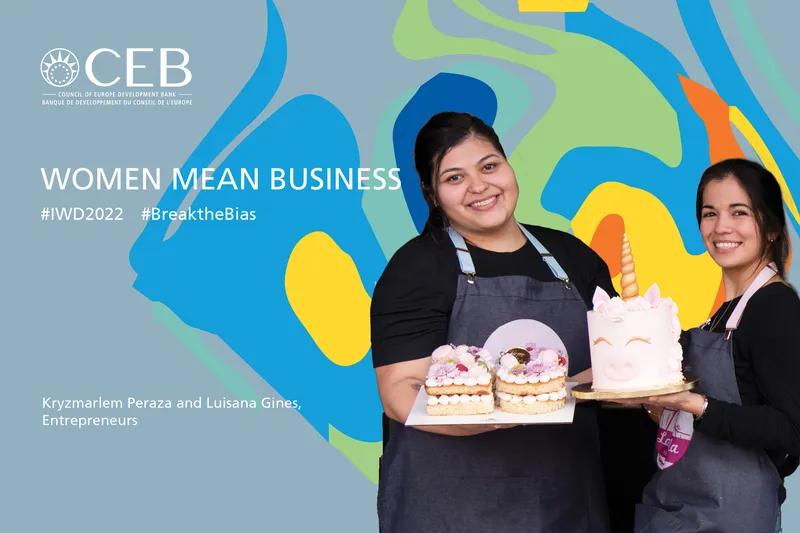
Kryzmarlem Peraza, 33, and Luisana Gines, 25, first approached Fundació de l’Esperança when they were looking to set up separate, but complementary, cake businesses in the same premises in Barcelona.
These two bakers from Venezuela became friends after moving to Barcelona. When they decided to set up their cake businesses in the city, despite speaking the language, they found navigating Spanish administration processes complex and time-consuming.
The Fundación’s business advisors supported Kryzmarlem and Luisana to prepare business plans and set up their microenterprises. Crucially, they also helped each of them through the process of applying for €25,000 microcredit from MicroBank to fund the purchase of vital equipment.
Success in the making
Despite the Covid-19 pandemic and the substantial decrease in demand for cakes when events and big celebrations came to a halt, theirs is a success story – and particularly for migrant women. During the pandemic, they simply adapted their output to suit smaller family gatherings, and when restrictions were lifted, they were ready to expand their businesses to offer small group baking classes and workshops. Indeed, they plan to take over a small cookware business when the owner retires.
They say, “Thanks to the support we have received from the Fundación, from MicroBank, and ultimately from the CEB, we have been able to carry out our project and we have plans for the future. We’re seeing new business opportunities which we hope to start soon.”
“A multidimensional support is the gold standard for fostering migrant entrepreneurship,” says Maria Sigüenza, Country Manager for Spain. “Thanks to MicroBank, the CEB can reach migrant women entrepreneurs and support them to turn their business ideas into reality.”