Warmer homes, greener future: Energy efficiency meets microfinance
In Bosnia and Herzegovina, winters can be long and harsh and, for many families, keeping warm comes at a high price. Across the country, older buildings with poor insulation and outdated heating systems make homes difficult to heat and energy bills unaffordable. Energy poverty is widespread, affecting in particular female-led households, retired people and families in rural areas.
Nearly half of all energy consumed in Bosnia and Herzegovina is spent on heating homes — almost twice as much as in most other European countries. Yet much of that energy is lost due to leaky windows, thin walls and inefficient heating systems.
“Most residents simply aren’t aware of how much energy they’re wasting,” says Oksana Davydovych, CEB Country Manager for Bosnia and Herzegovina. “And even when they are, many don’t have the means to invest in improvements. Long-term financing options that are accessible to low-income households are hard to find, so energy upgrades are often out of reach.”
Air pollution adds another layer of urgency. Cities like Sarajevo and Tuzla rank among the most polluted in Europe during winter, as families burn low-quality coal or wood to stay warm. This results in a vicious cycle — high energy bills, poor health environmental degradation — which traps the most vulnerable households in energy poverty.
A local solution with lasting benefits
To help break that cycle, the Council of Europe Development Bank (CEB) is supporting local partners such as Partner Microcredit Foundation — one of Bosnia and Herzegovina’s leading microfinance institutions — to make energy efficiency accessible to everyone.
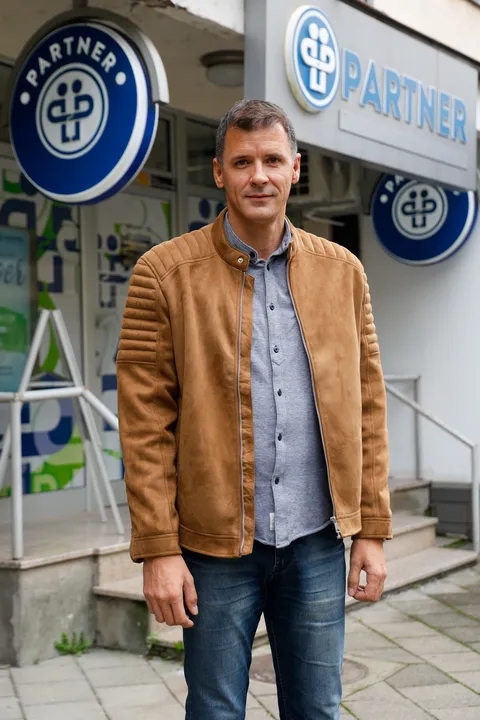
“Bosnia and Herzegovina is not a large country and does not have a large population either, but it has a significant number of energy-inefficient buildings,” says Momčilo Vukajlović, Branch Manager at Partner. “This means there is considerable potential for implementing energy-efficient measures.”
Partner’s mission is to provide financial services to people who have limited or no access to traditional commercial banks’ lending, helping them start or expand small business and improve their living conditions. In 2012, Partner developed a dedicated energy efficiency strategy, introducing products that support small-scale home improvements.
Through the CEB’s €2.5 million loan they are now expanding this offer, providing even lower interest rates for households that would otherwise be unable to afford such upgrades. Thanks to the CEB financing, Partner is able to provide small, affordable loans for insulation, double-glazed windows, or new heating systems — small changes that make a big difference for Bosnian families.
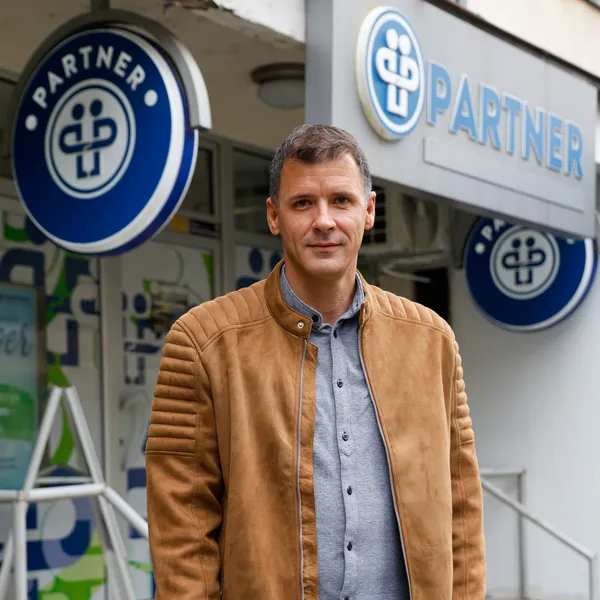
Beyond financing, Partner helps clients make the right choices for their homes. Vukajlović explains: “Before making any changes to heating or cooling systems, we recommend insulating the house or replacing windows and doors, because one without the other doesn’t work effectively.” Very often, he says, people are unaware of the benefits such measures bring — until they see and feel the results for themselves.
Microloans for macro impact
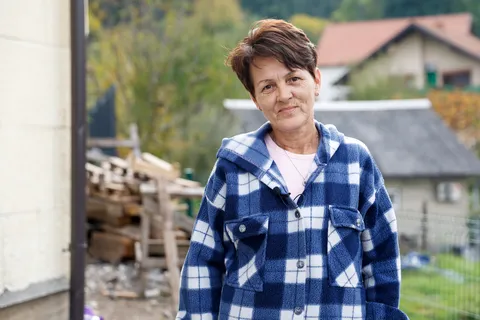
For Ćazija Poljaković, energy efficiency has been a step-by-step journey.
“I started building the house with Partner from the foundations, all the way up to the roof,” she says. “Bit by bit, little by little, slowly.”
Ćazija, a small-scale farmer, used a loan of BAM 6,500 (about €3,300), financed by the CEB, to replace her heating system and install a new pellet boiler. The investment has paid off: “For one thing, it’s healthier, the air is cleaner. And when we add it all up, we’ve cut our costs in half.”
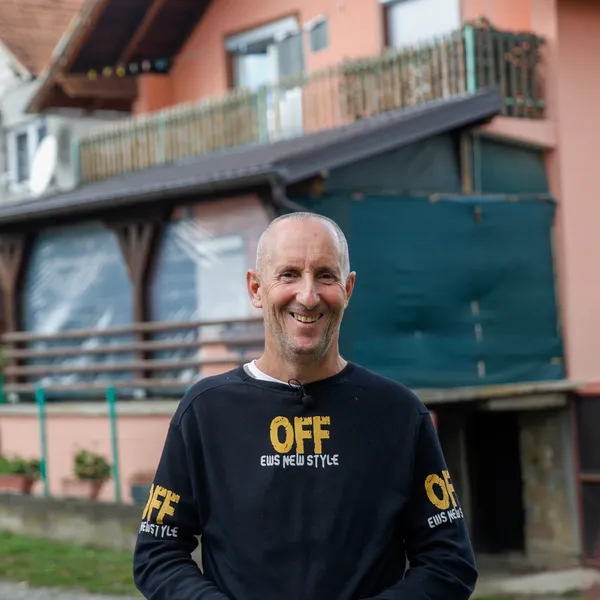
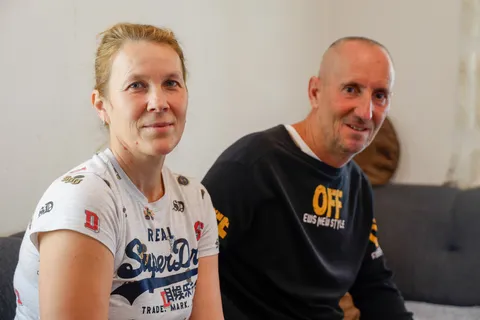
Almir Suljić and his family had lost their Zvornik home during the war in the former Yugoslavia. “When we returned here, our home was completely destroyed, levelled to the ground,” he recalls. “We received another house as a donation, but the carpentry wasn’t worth much, it was just a place to move into.”
Almir used a BAM 5,000 (€2,500) loan to replace windows and doors. Gesturing towards his newly fitted windows, he says: “Now it’s warmer since it’s been done. Especially with these blinds now, and we managed to insulate it with styrofoam — it’s different, we use less firewood. It’s warmer, it seals better."
Each small investment like these ones adds up to significant gains: lower emissions, cleaner air, and reduced energy waste.
“Our cooperation with the CEB allows us to increase our capacity to finance energy-efficiency measures under more favourable conditions than those available on the commercial market,” says Vukajlović. “This enables us to secure financing for ourselves on better terms, which in turn allows us to offer our clients loans with lower interest rates and simpler procedures.”
Climate action with a social purpose
For the CEB, such partnerships show that climate action and social inclusion can go hand in hand.
Across Europe, around 50 million families are estimated to live in energy poverty. Poor energy performance in housing hits low-income households the hardest, forcing them to cut back on heating and undermining their living standards, not to mention their health.
Improving the energy efficiency of existing buildings is not only essential for achieving the climate targets set by the Paris Agreement a decade ago, but also to relieve the burden of energy poverty. Helping families modernise their homes – even through small interventions - benefits the environment, living standards and public health.
The CEB’s Strategic Framework 2023-2027 recognises this connection explicitly: the climate crisis is also a social crisis. Supporting energy-efficient investments is central to the Bank’s climate action—cutting emissions while improving lives.
A green and just transition
As Bosnia and Herzegovina advances toward EU accession and a greener and more inclusive economy, improving energy efficiency is both a climate imperative and a social necessity. Cleaner, more comfortable homes help families save money and improve health, while helping the country cut emissions, energy poverty and converge toward EU countries’ living standards.
Or, as Almir Suljić puts it: “It’s nice, how could it not be? You saw it yourself — when you lower the blinds, how much warmer it is in the house and how much nicer it looks. That’s the difference, all of it.”
Related publications
-
Improving energy efficiency in housing: Why evaluation matters
Did you know that some 50 million households in the EU are estimated to live in energy poverty? … Published: October 2024 Read