Where academic excellence meets inclusion
At the SGH Warsaw School of Economics, a new Hub of Innovation – funded by the CEB has created inclusive spaces that foster collaboration and prepare students for the future.
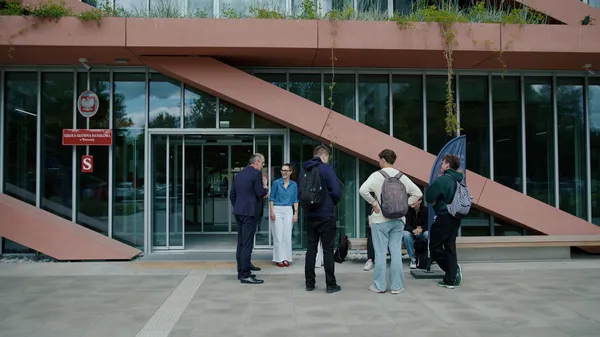
Towering green walls rise through the heart of the building, stretching from the underground teaching floor all the way to a rooftop overlooking Warsaw’s Pole Mokotowskie Park.
Sunlight pours through glass façades into modern lecture halls and open co-working spaces where students gather to study, exchange ideas and work on projects.

The Hub of Innovation at the SGH Warsaw School of Economics (SGH) is a striking addition to Poland’s oldest and one of the most prestigious universities. It reflects a broader transformation in higher education: one that places collaboration, inclusion, sustainability and innovation at the centre of the learning experience.
Responding to the needs of a modern university
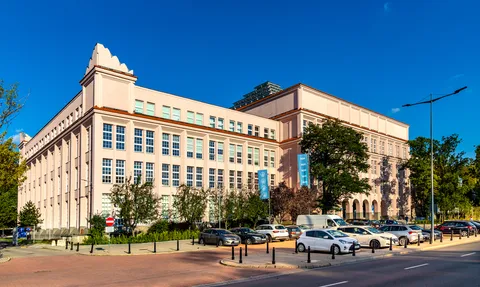
Founded in 1906, SGH educates 15,000 students and employs around 850 researchers and lecturers, including 70 full professors. Yet several of its historic buildings constitute protected heritage, limiting the scope for adaptation to contemporary educational needs.
While the university had undertaken efforts to improve existing facilities, its infrastructure increasingly struggled to support new ways of teaching, interdisciplinary collaboration and the needs and expectations of today’s students.
Supported by financing from the CEB, the new Hub of Innovation is helping SGH respond to these challenges. Since 2021, the Bank has provided financing worth PLN 178 million (equivalent to more than €40 million) to support the university’s development.
“Our new facility, financed by the CEB loan, has expanded our teaching capacity up to 18 percent,” says Dr Marcin Dąbrowski, Chancellor of SGH. “What’s more, it provides us with new, excellent co-working spaces and has become home to many academic departments, think tanks, and administrative units vital to the university’s operations.”

Spaces for inclusion and learning
The lecture halls have been designed to ensure the highest quality of teaching and to foster student interaction and deeper social relationships.
Importantly, everything – from the entrance to conducting teaching classes or participating in conferences – is accessible for persons with disabilities.
There are pictograms that help visitors navigate the space; there are no thresholds; and everything was built at a height accessible for wheelchair users.
“New facilities improve accessibility for all students and staff thanks to well-designed spaces,” says Mirosława Gajewska, lecturer and Accessibility Ambassador at SGH.
“Thanks to this building, I, as a lecturer, don’t feel excluded. I can get to any place, and that simply means I feel just like any able-bodied staff member.
“When I’m in this building, I don’t feel my disability.”
The impact is equally tangible for the students.
“The biggest difference in the SGH Hub of Innovation is the design and energy,” says Maja Todd, a student at SGH.
“Old facilities tend to feel quite rigid. Whereas the Hub of Innovation has these incredible glass walls that fill the rooms with natural light, greenery incorporated into spaces and co-working zones that bridge the gap between traditional university life and the modern world of work.”
The changing nature of the physical spaces is also transforming teaching.

The Hub has become a meeting point between academia, industry and startups.
“Students are sitting here thinking about their startups and we show them explicitly that the future has to be centered around sustainability and social responsibility,” adds Professor Woźny.
A space for civic engagement and social connections
Investing in more modern facilities is helping to ensure that the SGH can evolve while remaining true to its mission of academic excellence and social responsibility. The benefits of the new Hub of Innovation are expected to extend well beyond the student population.
At the Hub, the university provides professional education for adults and working professionals, while also offering lifelong learning opportunities for senior citizens.
The new facilities also support students involved in clubs and organisations that contribute to community initiatives, ranging from blood donation campaigns to charity runes and awareness raising events.
Local community organisations will also be able to use the Hub’s facilities, reinforcing its role not only as a place for learning, but also as a space for civic engagement and social connection.
Investing in future generations
“The CEB loan agreement is crucial for us in financing this investment,” says Dr Dąbrowski. “I am delighted that we share common social goals and a mutual understanding with CEB.”
For the Bank, investing in education infrastructure goes beyond financing brick and mortar.

The collaboration with SGH forms part of the CEB’s broader engagement in Poland. Since Poland joined the Bank in 1998, it has financed 80 projects totaling more than €8 billion, across the education, MSME financing, health and social care, regional development and natural disasters sectors.
“The projects developed with the SGH Warsaw School of Economics illustrate our strong commitment to Poland,” adds Krzewski.

Back in Warsaw, Maja Todd says that the Hub of Innovation has completely changed her daily routine: “It's the best place to meet up for group work.”.
According to Maya, the SGH is already highly recognised across Poland and Europe for its academic excellence, but the Hub of Innovation encourages the type of learning and collaborating that prepares the students for what comes next.