Donors in support of CEB social action
Highlights of 2022
Strong donor support in response to Ukraine
- €10 million in donor funds allocated for assistance to refugees fleeing Ukraine
- Ukraine Solidarity Fund established and endowed with €1 million by Ireland
EU provides substantial funding
- €35.7 million WBIF contribution to expand a paediatric hospital in Belgrade, Serbia
- €2.3 million contribution to extend the Regional Housing Programme until 2023
Enhancing social impact
Co-operation with donors is instrumental to achieving the CEB’s mission, as stated in the new Strategic Framework 2023-2027, approved in December. The CEB raises funds from donors to provide extra support to projects where needed and improve their social impact. This applies particularly to projects aimed at vulnerable persons and communities in disadvantaged areas, since the entities in charge of these projects generally have limited capacity to finance or implement them.
This extra support can take the form of technical assistance to help borrowers implement projects in line with best practice. It can also consist of investment grants or interest subsidies to reduce the financial burden of borrowers. Lastly, the Bank also uses donor funds to guarantee projects which would otherwise not be eligible for CEB loans due to their risk profile.
Assisting migrants and refugees, promoting social cohesion
The CEB allocates most of the funding provided by its donors to assisting migrants and refugees, for whom the Bank has mobilised almost €500 million so far. This effort, which is line with the Bank’s mandate, will continue to be important, in light of the Russian aggression against Ukraine as well as climate change. More broadly, donors provide crucial support to the Bank’s efforts to promote social cohesion in Europe.
The EU is the largest donor to the Bank, contributing €659 million or three quarters of total contributions received by the Bank so far. The CEB’s capability to manage EU funds in accordance with EU standards was reaffirmed in 2022 when it passed a new compliance test known as the pillar assessment (see Compliance page 51). Co-operation between the EU and the CEB delivers strong synergies: the EU has strong policy expertise and funding capacity, while the CEB is experienced in project design and implementation, and can reinforce EU grants with loans.
Main donors
The three largest donors among CEB member states are Germany, Norway and Italy, while the largest donor among non-members is the United States. To date, donor contributions stand at €883 million.
659 million euros donated to the Bank by its largest donor, the European Union, accounts for 75% of contributions received so far
Ukraine response
Russia’s aggression against Ukraine in 2022 caused widespread destruction and forced millions of people to flee their homes: at the end of 2022, close to 14 million people, or almost a third of the Ukrainian population, had been displaced.
As a first response, the CEB allocated €10 million in donor funds for assistance to refugees from Ukraine. These funds, of which €6.4 million were contracted in 2022, serve to provide transport, shelter, medical care and counselling. They are being channelled through the Migrant and Refugee Fund, a trust fund that was established by the CEB in 2015 in response to a surge in migration and displacement at that time.
Subsequently, the Bank established a dedicated trust fund, the Ukraine Solidarity Fund (USF), to aid displaced people from Ukraine and support the reconstruction of the country – Ukraine is expected to become a member of the CEB in 2023. Ireland, which championed the creation of this trust fund as host of the CEB’s annual joint meeting in July 2022, endowed it with €1 million in seed financing.
Housing displaced persons in the Balkans
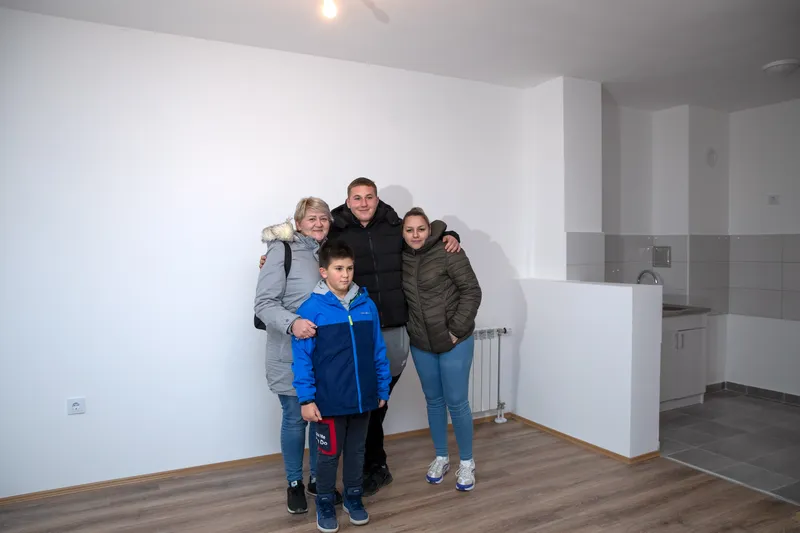
During the conflicts in the former Yugoslavia in the 1990s, millions of people had to flee their homes. Almost 30 years later, thousands of people continue to live in substandard accommodation. To provide these vulnerable people with decent housing, Bosnia and Herzegovina, Croatia, Montenegro, and Serbia have implemented a joint initiative, called the Regional Housing Programme (RHP). The programme, which is managed by the CEB, is delivering on a large scale: to date, it has enabled approximately 30 400 highly vulnerable persons to enjoy a decent home. That number is expected to rise to close to 34 000 by the time the programme ends in 2023.
The RHP benefits from strong support from the international community: donors have committed €294 million in favour of this initiative. The European Union is the largest donor, with €238 million, followed by the United States with €24 million. Other major donors are Germany, Norway, Switzerland and Italy.
Healthcare and refugees in Türkiye
According to the United Nations High Commissioner for Refugees (UNHCR), Türkiye hosts the world’s largest number of refugees, including 3.5 million Syrians, a fallout from the conflict that began over a decade ago. The EU and Türkiye established a coordination mechanism in 2015, called the EU Facility for Refugees in Türkiye (FRiT), to address the needs of refugees and their host communities in a comprehensive and coordinated manner. The CEB is managing two projects funded by FRiT, with the aim of improving healthcare for refugees and their host communities.
Kilis hospital, which benefited from an EU contribution worth €50 million, is expected to boost healthcare capacity by 300%
First, the Bank supervised the construction and equipping of a 400-bed public hospital in Kilis, near Türkiye’s border with Syria. Kilis province has seen a sharp rise in its population due to an influx of Syrian refugees. The hospital, which benefited from an EU contribution worth €50 million, is expected to boost healthcare capacity by 300%. Representatives of the Turkish Ministry of Health, the EU and the CEB attended the inauguration of the hospital in December 2022. The hospital withstood the February 2023 earthquake and remains fully operational. Second, the CEB has continued to oversee the establishment of a network of healthcare centres throughout Türkiye to serve both refugees and their host communities, under a €90 million project called “Strengthening Healthcare Infrastructure for All” (SHIFA). SHIFA began in 2021 and its scope is being revised to prioritise investments in health facilities in the area that was affected by the earthquake in February 2023.
Expanding a landmark paediatric hospital in the Balkans

The University Children’s Hospital Tiršova, in Belgrade has a reputation for excellence in providing paediatric care. To improve patient care even further, as well as staff working conditions, the Serbian authorities are constructing a new facility.
The project is supported by a CEB loan of €54 million and a contribution of nearly €36 million, approved in 2022 from the Western Balkans Investment Framework (WBIF), a joint initiative involving the EU, several finance institutions and bilateral donors. Serbia also received technical assistance to prepare the project, financed by the Slovak Inclusive Growth Account, set up to support CEB’s actions in favour of inclusive growth and environmental sustainability, and the Norway Trust Account.
A science and technology park for Bosnia and Herzegovina
Providing skilled employment, to fight youth unemployment and avoid a “brain drain” of talent abroad, is a major challenge for many countries, including Bosnia and Herzegovina. To create jobs and foster co-operation between the scientific community and the private sector, Bosnia and Herzegovina is setting up a science and technology park in Banja Luka, the country’s second-largest city.
To ensure that the project is implemented in line with international standards, the government of the Republic of Srpska entity has been receiving technical assistance from UNDP since 2022. This support, worth €550,000, is financed by the CEB’s Social Dividend Account (SDA) and the Italian Fund for Innovative Projects (IFIP). The SDA, which is used to support highly social projects, is financed mainly by contributions from the CEB member states, through allocations from the Bank’s annual profit. The IFIP was set up by Italy to help the Bank develop innovative social projects.
Improving living and working conditions in Serbia’s prisons
Overcrowding in prisons undermines the rights of detainees to healthy and secure conditions, and can affect their prospects of reintegrating into society later on. To address overcrowding, which also affects staff working conditions, and fulfil the accession requirements of the EU, Serbia is constructing a new prison in Kruševac and extending an existing one in Sremska Mitrovica (see page 23).
The CEB is supporting this highly social project with a €30 million loan approved in 2022. The Bank also approved technical assistance in 2022 to enable the Serbian authorities to improve the energy efficiency of the facilities. This support, worth €100 000, is financed from the Green Social Investment Fund, set up by the CEB in 2020 to help its member countries accelerate their transition towards low carbon and climate resilient economies. The resulting energy efficiency measures are expected to have environmental benefits, by reducing energy consumption, and social benefits, by improving the comfort of both inmates and prison staff.
Renovating schools in Georgia
Georgia is implementing an ambitious project to renovate public schools in the capital, Tbilisi, which is expected to have major social and environmental benefits. Prior to this project, only one school had been built in the previous ten years and many had been damaged by an earthquake in 2002. The renovation will improve the safety and comfort of pupils, while also increasing the energy efficiency of school buildings by 40%.
The project benefits from a €6 million grant from a multi-donor facility, the Eastern Europe Energy Efficiency and
Environment Partnership
The support from the international community has been key for the project. The project benefits from a €6 million grant from a multi-donor facility, the Eastern Europe Energy Efficiency and Environment Partnership (E5P), as well as €210 000 in technical assistance grants from the Slovak Inclusive Growth Account and the Spanish Social Cohesion Account, which was set up by Spain to finance technical assistance for CEB projects. The grants complement a €14 million loan from the CEB and help Georgian authorities finance the project and implement it in line with best practice.
©CEB Report of the Governor 2022
Related publications
-
Report of the Governor 2022
In 2022 the CEB demonstrated its key role in supporting social cohesion across Europe and as a first … Published: April 2023 Read -
Report on CEB and Donors 2022
In 2022 donors continued to play a key role in the Council of Europe Development Bank’s operations, enabling … Published: May 2023 Read