Europe’s social development bank in action
When the CEB issued its 2020-22 Development Plan at the end of 2019, the global outlook was already starting to look unstable. GDP growth had slid to around 3% per year, against a backdrop of sluggish trade and geopolitical tensions. The policy consensus among European countries was one of promoting sustainable and inclusive growth, spurred on by a digital transition backed by policies that would leave no one behind. At the CEB, this translated into three lines of concrete action on the social front to drive its strategy:
The COVID-19 surge in the first year of that plan, and the Russian aggression against Ukraine in February 2022, led to a sharp deterioration in the context and heightened the stakes. The lines of action could remain broadly the same, but the action would intensify: economic activity retracted sharply in 2020 as country borders closed to stop the spread of the coronavirus, and supply chains dried up. Massive government budgetary efforts together with enhanced use of communications technology helped keep people in business and in jobs, but inflationary pressures and other supply shortages emerged, which were worsened by the war in Ukraine. Inequalities were widening again too, particularly within individual countries.
In a context of overlapping crises, the CEB continued to mix agility with a strong focus on the policy relevance, quality and impact of its operations.
As Europe’s only international development bank with an exclusively social focus, the CEB’s mission would inevitably become more important than ever, both for social cohesion among its member countries, and for supporting people’s wellbeing, with a particular regard for the most vulnerable groups facing poverty, exclusion and ill-health. The CEB also did its utmost to ensure its activities would continue to contribute to progress on climate action and under the UN Sustainable Development Goals.
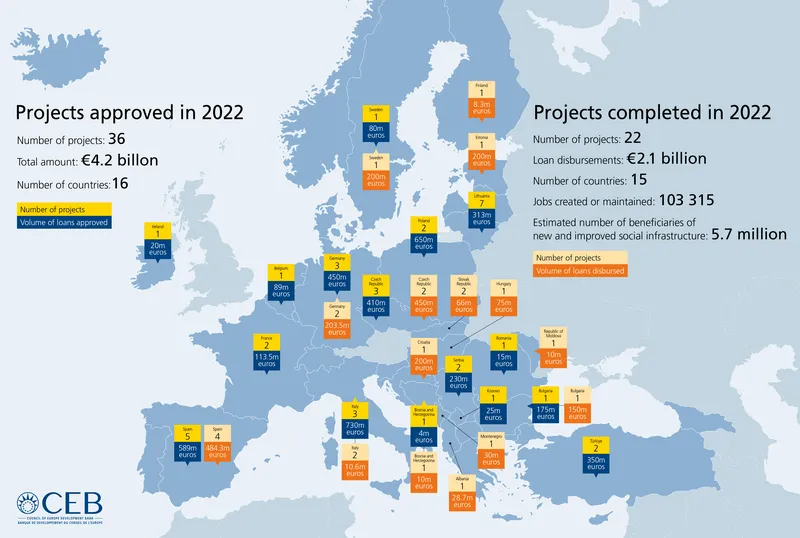
In a context of overlapping crises, the CEB continued to mix agility with a strong focus on the policy relevance, quality and impact of its operations. The Bank approved funding for 36 projects in 2022, of which 20 for Target Group Countries (see table page 58). It conducted robust due diligence of technical, economic, financial, environmental and social sustainability throughout each project cycle. In particular, it ensured that procurement processes follow CEB’s strict guidelines and that projects align with the CEB’s environmental and social safeguards and standards, and that any mitigating actions are implemented accordingly by clients or implementing entities. As well as the social impact, climate-related considerations were further mainstreamed within projects approval processes in 2022 (see page 14).
The CEB’s actions in response to Ukraine are described in the opening chapter. The following sections provide examples of other cross-cutting actions the Bank undertook in 2022, as represented by new projects approved. A complete list can be found in the project snapshots at the end of this report (from page 60).
 ©CEB 2023
Related publications
-

Report of the Governor 2022
In 2022 the CEB demonstrated its key role in supporting social cohesion across Europe and as a first … Published: April 2023 Read