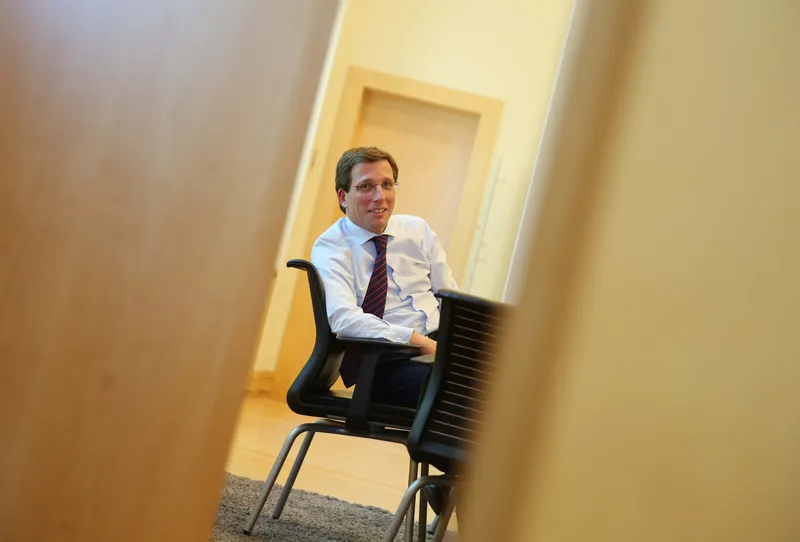
Interview with José Luis Martínez-Almeida, Mayor of Madrid
'It is obvious that an effort will also have to be made in terms of infrastructure for new spaces in the city, above all in terms of mobility and public transport.'
 Addressing urban inequalities is essential to ensuring that the COVID-19 response is inclusive. What measures is your city taking to mitigate the social and economic Impact of the pandemic, particularly on the most vulnerable?
The city of Madrid, its City Council, was the first Spanish public administration to take measures, both health and economic, before the state of emergency was even declared in our country. The local government team saw clearly that the health crisis was going to hit hard the economy of the city and the people of Madrid.
To take these measures it was essential to have a budget for this year. Thanks to its social dimension, Madrid’s 2020 budget for the first time in the recent history of the city was approved without any vote against.
Madrid has made significant tax cuts focused on the economic sectors most affected by the pandemic.
For example, we have reduced by 25% the Real Estate Tax on properties destined to leisure and hotel, commercial, cultural and entertainment activities affected by the state of emergency. The same reduction in the Tax on Economic Activities for Leisure and Catering, Travel Agencies, Commercial, Public Shows of all kinds, including sports, and Medical Research.
In the same way, we have made a 100% reduction in the fees of land occupation for terraces or markets and provided aid to SMEs and self-employed people (€24 million), to the hotel industry, markets, entrepreneurs, industrial factories...
The City Council has not forgotten the culture sector, with specific support measures to withstand the effects of the pandemic, such as the Plan Aplaude (€705 million) or the effort to maintain the programming of the Veranos de la Villa, the important cultural festival of Madrid summers.
But the one that is undoubtedly the hardest hit by the crisis is tourism. Consequently, it has been the source of our concern and the object of support and stimulus measures. Tourism is vital for Madrid, accounting for 13% of GDP and more than 200,000 jobs.
Our recovery strategy for the economic activity is based on four axes, the improvement of the governance of tourism management, with campaigns to recover, for example, international tourism and congresses; the management of health risks with the seal of the Institute for Spanish Tourism Quality, Safe Tourism Certified; communication; and finally the economic support, with an extraordinary plan for an additional allocation of six million euros.
Social assistance,
aids to families, a family emergency plan... the support of the City Council in
the social area reaches more than 155,000 people in Madrid. To give you an idea
of the social scope of the crisis, food aid to families in vulnerable
situations has so far amounted to €24.2 million. How is your city ensuring that the COVID-19 recovery is also a green one that meets climate change goals?
With the start of the pandemic, all the political groups represented in Madrid City Council have maintained a system of work and collaboration that I dare say has been exemplary. As a result of this climate of responsibility, for which I am grateful to the opposition, the possibility of reaching major political agreements to overcome the crisis and channel the immediate future of the city was born.
All the political groups held a month of negotiations and we reached more than 300 agreements unanimously, which were initialled in a solemn document that we called the Village Agreements.
These agreements reflect the spirit of the sustainability strategy of this government, which is called Madrid 360. A strategy based on the reduction of polluting emissions, the promotion of non-polluting public transport, pedestrianisation and a very powerful investment in renewing both the car fleet and polluting elements such as the city's heating systems with others that are much more sustainable.
It is called Madrid 360 because it focuses on all angles of sustainability. And also because unlike previous plans or strategies that were based on protecting the city centre, this one concerns the 21 districts of Madrid, it is global.
What long-term investments are required to increase your city’s preparedness to future pandemics and boost its resilience to shocks?
This crisis came without an instruction manual and with emergency plans adapted to other needs. Madrid has suffered intensely from the scourge of terrorism, aeroplane accidents or those typical of a city of our characteristics. But in recent times it had not faced a pandemic of these characteristics.
The first measure we have taken in this area has been to equip ourselves with the necessary infrastructure to maintain a stock and a strategic reserve of material essential to deal with a possible emergency of this nature.
It is obvious that an effort will also have to be made in terms of infrastructure for new spaces in the city, above all in terms of mobility and public transport.
We will also have to provide ourselves
with infrastructures to deal with social emergencies such as that born of a
pandemic of these characteristics.
Partnerships and collaborative efforts are critical to support local leaders in the COVID-19 recovery. What do you expect from the cooperation with national and European actors?
I am very hopeful about the political climate of collaboration and solidarity that I have felt among my fellow mayors around the world. Throughout the pandemic, I had the opportunity to hold different meetings with mayors from the five continents and it was an enriching experience from which we learned a lot.
From these conversations, different forums were born, in which Madrid participates and from which very interesting opportunities for collaboration are emerging and will continue in the future.
This pandemic is a global threat and needs global solutions adapted to the characteristics of each place.
Large cities, due to our characteristics of density and mobility, have been the propitious victims of this virus. Interesting lessons have emerged from this and from how we have each faced it, which will undoubtedly be useful in the future.