Healthcare in Western Balkans hurting people’s well-being and economic future
Weaknesses in health systems in the Western Balkans are in part contributing to the poor health outcomes of its citizens, which adds another challenge to the region’s economic development.
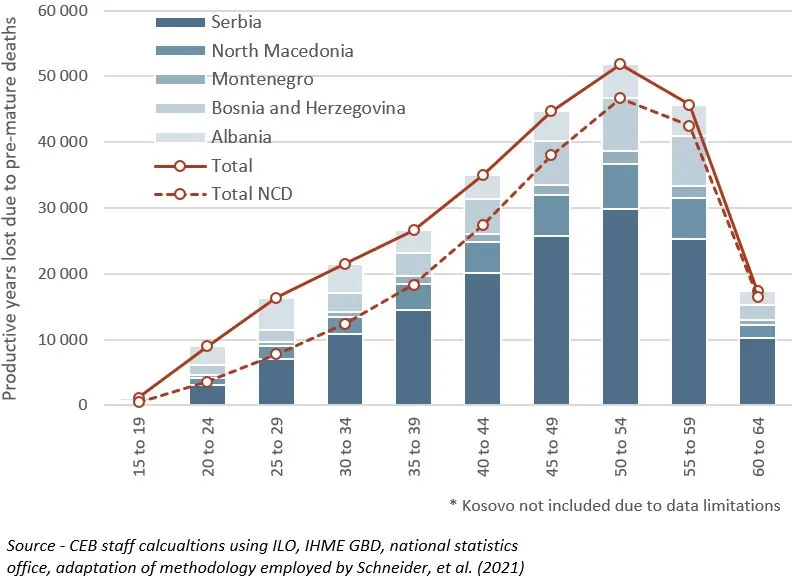
Poor health is creating economic and social costs
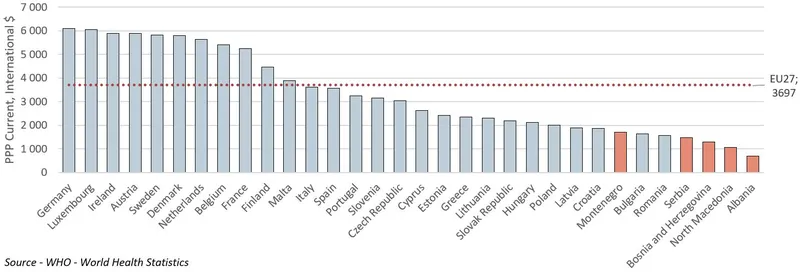
The most under-resourced healthcare systems in Europe
Lower-income individuals less likely to have access to quality health services
Despite the relatively low level of healthcare expenditure, healthcare costs impose a heavy financial burden on many people in the region – in particular those that are socioeconomically disadvantaged. In many Western Balkan countries, the share of out-of-pocket expenditure in current health expenditure is among the highest in Europe, with a regional average of 39% in 2018, compared to the EU average of 22%. High out-of-pocket expenditure disproportionally affects lower-income individuals, who already tend to have poorer health outcomes and less access to quality health services (and who may be forced to forgo paying for healthcare to not sacrifice the consumption of other necessary goods such as housing, food, and schooling). In most of the region’s countries, a clear dichotomy exists between private and public healthcare systems. The better-off are able to pay for private health care alternatives that have shorter waiting times, higher quality equipment, and overall better patient health outcomes[i]. Those in the bottom income quintile are more likely to report costs, distance, or waiting times as the reason for having unmet medical needs (Eurostat, 2020).
The need for more inclusive, comprehensive, and quality healthcare care
There is a clear need for increased investment in the region’s health systems to achieve a more effective, efficient and inclusive system that does not leave any group of the population behind. Healthcare is a central pillar of how social infrastructures can enhance the quality of life of individuals, precisely because it often deals with issues of life and death. Health systems in the region need to support citizens of the region’s countries throughout their lives: to ensure their health develops correctly in their youth, is maintained as adults, and is cared for in old age. Guaranteeing the physical human capital of individuals will allow them to productively contribute to the region’s development. Failure to do so will give one more reason for people to leave and choose to live their lives where their health is protected. Read more about social infrastructure and its role in building human capital and supporting economic resilience in the CEBs study: Social Infrastructure in the Western Balkans.
Post published: August 2022
Authors: Edo Omic, Economist (CEB) and Cecilia Handeland, Research Assistant (ex-CEB)
[i] Lai, T., Stachenko, S., Milevska-Kostova, N., Ristovska, G., & Spiroski, I. (2015). Better noncommunicable diseases outcomes: challenges and opportunities for health systems. Country assessment: the Former Yugoslav Republic of Macedonia. Copenhagen, Denmark: WHO Regional Office for Europe.
[1] Noncommunicable diseases (NCDs), based on the WHO definition, are “also known as chronic diseases, tend to be of long duration and are the result of a combination of genetic, physiological, environmental and behavioural factors. The main types of NCD are cardiovascular diseases (such as heart attacks and stroke), cancers, chronic respiratory diseases (such as chronic obstructive pulmonary disease and asthma) and diabetes.” (WHO, 2021; Schneider, Thiebaud, Abdul-Hamid, Arnhold, & Sondergaard, 2021)
Publications associées
-
Social Infrastructure in the Western Balkans
Renforcer la résilience économique de la région, valoriser le capital humain et contrer les effets de l'émigration sur … Publiée: novembre 2021 Lire