Supporting women in the Western Balkans through better social infrastructure
Women in the Western Balkans face a host of challenges limiting their capacity to fully contribute to the region’s economic and social development.
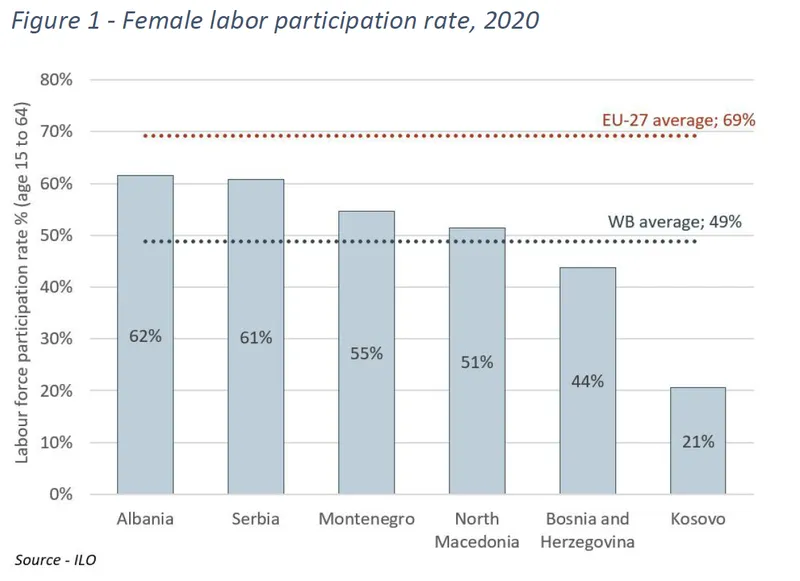 As a starting point, Western Balkan’s female labour force participation rates are considerably lower than the EU average (figure 1), and almost two-thirds of women in the Western Balkans are either outside the labour force or unemployed [i].
The low level of female labour participation and employment rates means the region is missing out on the support of a huge segment of the population to reinforce economic growth and convergence rates to the EU. Recent literature has established that raising the labour force participation of women to the level of men can significantly raise GDP levels [ii].
However, in some of the region’s countries, women continue to face large household work burdens and care responsibilities that are impeding their integration into the regular labour market.
Developing more inclusive social infrastructure, in particular in healthcare and education, could help alleviate many of these burdens and widen women’s opportunities in society. Moreover, investments to strengthen social infrastructure may support the physical and mental wellbeing of the region’s women.
Increasing accessibility of Early Childhood Development and education
 As in many regions in the world, the responsibility to provide childcare is overwhelmingly placed on women – the Western Balkans are no exception. These childcare responsibilities, combined with various cultural factors and public policies (for example regarding tax and family leave), can disincentivise women from working.
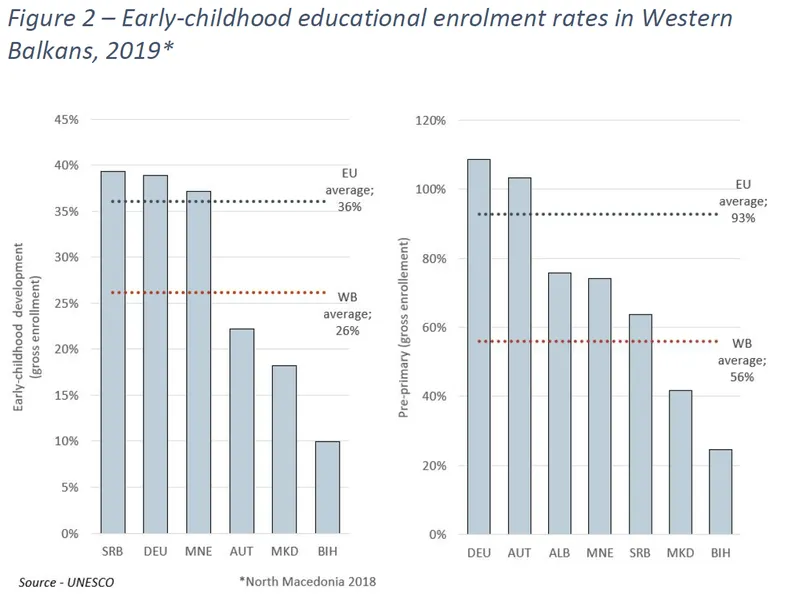
This is most clearly observed in the low female labour participation of the region [1]. By increasing access and availability of early childhood development and education options (see figure 2), women’s childcare-related pressures are reduced, and options to participate in the economy are increased.
Furthermore, increased early childhood development programmes also benefit the region’s children, as it helps them develop fundamental skills that prepare them for school and help combat educational and intergenerational mobility inequalities.
Improving healthcare to ease the burden on women
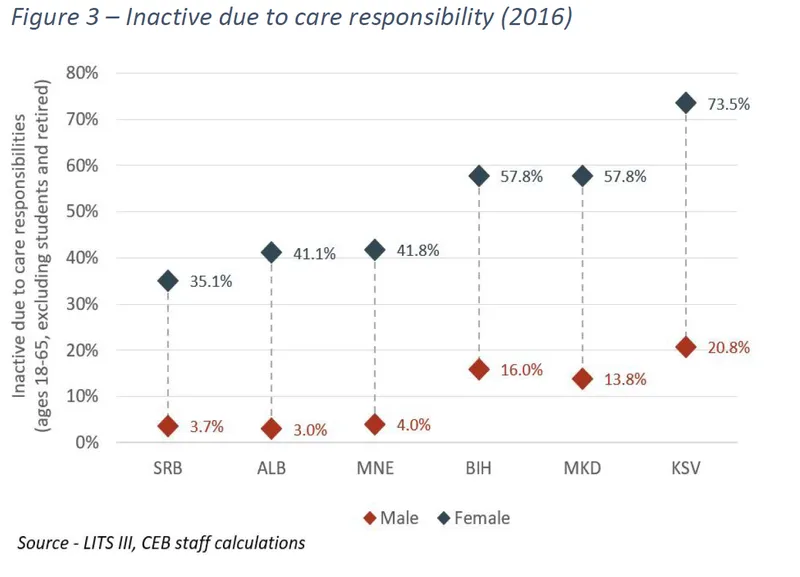 The inadequacies in health services access and availability disproportionally affect women, as they are often the ones that have to take on care responsibilities at home of elderly or sick family members. A large share of women who are not active in the labour market cites care responsibilities as a primary cause, ranging from 35% of women in Serbia and 74% in Kosovo (figure 3).
In part, this signals the need to further improve healthcare support arrangements and long-term care options. Moreover, in some countries, women are more likely than men to face problems accessing healthcare, for example, due to distance or affordability.
According to World Bank data women in the region also have lower access to prenatal care compared to women in the EU. Health care must become more inclusive and support the health and well-being of women, who suffer two folded from underfunded health systems in both their personal health and their increased responsibility to care for family members.
Women’s access to the housing market
The low female labour force participation means that some women are unable to achieve financial independence. In some of the region’s countries, the economic and social circumstances render many women dependent on their spouse or male family member for housing.
In Montenegro, women own 4% of all houses, 8% of land and 14% of holiday homes [iii]. In North Macedonia, women own on average 16% of land, whilst in Bosnia and Herzegovina women own 15% of homes [iv].
The lack of gender quality in the housing market can place women in more economically and socially vulnerable positions. Moreover, the limited access to the housing market for half of the population is an additional factor on an already long list of issues limiting women’s capabilities to enhance their professional and personal wellbeing.
More inclusive social infrastructure will support the region’s women
There is a need to develop more inclusive social infrastructure in the region that helps support women and provides them with increased choice and autonomy over their lives. The increased integration of women in the labour market would benefit the economic and social development of the Western Balkans, allowing them to augment human capital accumulation and better profit from structural transitions.
Read more about social infrastructure and its role in building human capital and supporting economic resilience in the CEBs study: Social infrastructure in the Western Balkans: Increasing the region’s economic resilience, enhancing human capital and counteracting the effects of brain drain.
Post published: March 2022
Authors: Edo Omic, Economist and Cecilia Handeland, Research Assistant
[1] Western Balkans Regional average female labour force participation was 50% in 2020, 19 percentage points lower than the corresponding EU average of 69%.
[i] IMF. (2017). Western Balkans: Increasing Women's Role in the Economy. Washington D.C.: International Monetary Fund.
[ii] Elborgh-Woytek, Katrin, et al. “Women, Work, and the Economy: Macroeconomic Gains from Gender Equity.” Staff Discussion Notes, vol. 13, no. 10, 2013, p. 1, www.imf.org/external/pubs/ft/sdn/2013/sdn1310.pdf, 10.5089/9781475566567.006.
[iii] World Bank. (2016). Montenegro: Achieving Sustainable and Inclusive Growth Amidst High Volatility, Systematic Country Diagnostic (Report No: 105019-ME). Washington D.C.: World Bank Group.
[iv] Duhacek, D., Brankovic, B., & Mirazic, M. (2019). Women's Rights in Western Balkans. Brussels: DG IPOL - European Parliament.
Publications associées
-
Social Infrastructure in the Western Balkans
Renforcer la résilience économique de la région, valoriser le capital humain et contrer les effets de l'émigration sur … Publiée: novembre 2021 Lire