News
€107 million for a new, more efficient and sustainable wastewater treatment plant in Wattrelos
08 June 2026
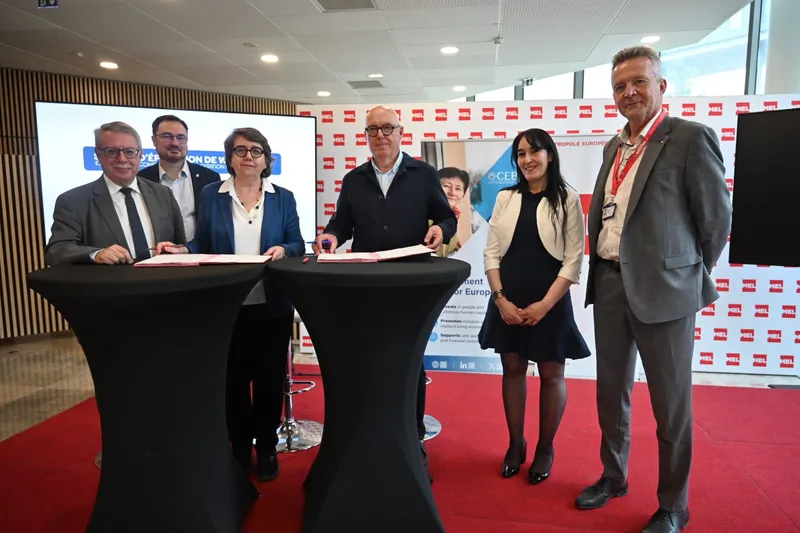
Lille – The Council of Europe Development Bank (CEB) and the Métropole Européenne de Lille (MEL) today signed a financing agreement for the modernisation and extension of the Wattrelos/Leers wastewater treatment plant. This project marks an important milestone for the MEL, supporting its strategy to diversify its funding sources and mobilise European financing to accelerate major infrastructure projects. Thanks to this support, the Metropolis will be able to modernise and extend a key facility serving nearly 275 000 residents. Beyond its environmental and energy benefits, this project will contribute in concrete terms to improving daily life, protecting natural resources, and strengthening support for the most vulnerable households.
As a cross-border facility, the Wattrelos wastewater treatment plant handles all the domestic and rainwater wastewater for the Roubaix conurbation, covering a catchment area of 14 municipalities with a total population of nearly 275 000 – including 15 000 in Belgium (municipality of Mouscron).
Built in the 1980s and partially renovated in 2005, the Wattrelos wastewater treatment plant now requires essential modernisation to ensure a high level of service and environmental performance. Running from 2025 to 2031, the project involves an ambitious transformation that will make the facility a model of excellence in energy transition and the circular economy.
The future plant will incorporate state-of-the-art equipment combining efficiency and energy savings. Thanks to the installation of 6 000 m² of photovoltaic panels and hydroelectric turbines harnessing the flow of treated water, over 10% of its electricity requirements will be generated on-site, whilst the remainder will be covered by certified green energy. Heat recovery from the equipment and treated water will also cover the plant’s entire heating requirements.
The project will also include a sludge energy recovery unit designed to produce biomethane equivalent to the consumption of a town of 2 800 inhabitants. The energy potential of the dried sludge, meanwhile, will be equivalent to the heating requirements of 1 500 homes. These developments will play a key role in reducing the facility’s carbon footprint, ensuring its compliance with the European Urban Waste Water Directive, and the sustainable preservation of this cross-border catchment area.
On a social level, the project will benefit all residents of the metropolitan area and the Escaut catchment area. As part of this approach to support and equity, the MEL is positioning itself as a pioneering local authority by introducing a social water tariff for the most vulnerable users. With its Public Service Concession (PSC), the first of its kind in Europe adopted in 2024 – the MEL is rolling out the water allowance, a genuine tariff shield designed to guarantee equitable access to water for low-income households in the area. This measure aims to ensure that no household spends more than 3% of its income on its water bill, within the framework of sensible consumption.
Key figures for the modernisation and extension of the Wattrelos wastewater treatment plant:
- 20% increase in the treatment plant’s capacity, bringing it to 511 500 population equivalents
- Creation of a 30 000 m² storage and return basin
- Production of over 2 GWh/year of renewable electricity for self-consumption and 11 GWh/year of biogas for reinjection
- Recovery of over 15 GWh/year of heat
- Dried sludge recoverable for energy production amounting to 14 GWh/year
“With the modernisation of the Wattrelos wastewater treatment plant, made possible by a €107 million loan from the Council of Europe Development Bank, the Metropolis is accelerating its ecological transition and preparing for the future. By increasing its capacity by 20%, this strategic infrastructure will support the region’s development whilst ensuring a high level of environmental performance. Water treatment, sludge recovery, recycling, positive energy: this project illustrates our ambition for a more sustainable, innovative and resilient metropolis in the face of climate challenges.”
Éric Skyronka, President of the European Metropolis of Lille
“This project exemplifies what the CEB does best: funding essential infrastructure where it has the greatest social impact. Supporting the MEL in modernising the Wattrelos plant means enabling 275 000 residents to benefit from higher-quality water and, for the most vulnerable among them, to access this right to water at an affordable price. The project thus aims to combine environmental, health and social challenges to give concrete form to an essential right guaranteed at European level: access to water.”
Sandrine Gaudin, Vice-Governor for Financial Strategy at the Council of Europe Development Bank
Press contacts:
CEB - Alice Vandenberghe
Communications Unit
alice.vandenberghe@coebank.org
MEL - Agnès Mazet
Press Office
amazet@lillemetropole.fr
About the CEB
The Council of Europe Development Bank (CEB) is a multilateral development bank with an exclusively social mandate from its 43 member countries. The CEB finances investment projects and provides technical assistance in social sectors such as education, health and affordable housing, while focusing on the needs of vulnerable people, as well as on the social dimensions of climate change and the environment. Borrowers include governments, local and regional authorities, public and private banks, non-profit organisations and others. The CEB, which has a triple-A credit rating, funds itself through international capital markets. In addition, the CEB receives funds from donors to complement its activities.
About the MEL
The Métropole Européenne de Lille (MEL), serving the 95 municipalities within its boundaries, works on a daily basis to support 1.2 million residents. The Metropolis Council, chaired by Eric Skyronka, comprises 188 members elected by direct universal suffrage. The MEL has responsibility for key areas, including: transport, housing, the economy, public spaces and roads, planning and urban development, urban policy, water, sanitation, household waste, nature and the living environment, culture, sport and tourism. As a key player in the wider water cycle, the MEL pays particular attention to issues relating to water and the environmental transition.