News
CEB and SID Banka strengthen partnership to expand affordable housing and improve local infrastructure in Slovenia
12 November 2026
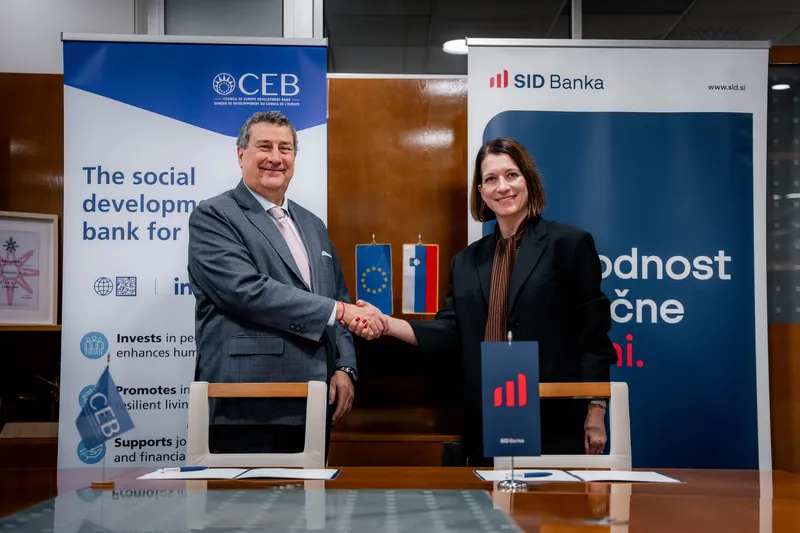
Ljubljana - The Council of Europe Development Bank (CEB) and SID Banka, Slovenia’s promotional, export, and development bank, are strengthening their cooperation with two loan agreements totalling €200 million, in support of affordable rental homes and essential municipal investments across Slovenia.
The larger of the two loans, worth €150 million, will help Slovenia tackle a growing shortage of affordable rental housing, a challenge particularly acute for young families, lower-income households and vulnerable groups. Channelled through SID Banka, the financing will support municipalities, public housing funds and non-profit providers in building and renovating social and affordable public rental homes across the country.
Together with an equal financing amount from the European Investment Bank (EIB), the CEB loan will contribute to a housing programme of €300 million, expected to deliver approximately 1 200 new or refurbished homes.
A second CEB loan of €50 million will help municipalities invest in the infrastructure and public services that communities rely on, from roads and water systems to schools, healthcare facilities, as well as investments that improve resilience to climate-related risks
“Across Europe, widespread high price of housing is placing an increasing financial strain on households and making it harder for young people to build independent lives,” said CEB Governor Carlo Monticelli. “By working with SID Banka and the EIB, we can bring together the financing and expertise needed to deliver more affordable homes, while helping municipalities invest in stronger, more resilient communities.”
“Affordable housing and strong local infrastructure are essential for Slovenia’s balanced and sustainable development. Through our partnership with the CEB and the EIB, SID Banka is bringing long-term international financing closer to municipalities, public housing funds and other organisations delivering projects that directly improve people’s quality of life,” said Stanka Šarc Majdič, member of the Management Board of SID Banka.
The new financing builds on the long-standing cooperation between the CEB and Slovenia to increase availability of affordable housing. The CEB has supported housing investments in Slovenia through various partners, including the Housing Fund of the Republic of Slovenia and SID Banka.
The two agreements with SID Banka mark a further step in this cooperation as Slovenia prepares to host the CEB’s 2027 Joint Meeting in Ljubljana, an opportunity to showcase the country’s experience in addressing housing needs and advancing social investment.
About SID Banka
SID Banka is Slovenia’s national development and export bank, fully owned by the Republic of Slovenia. Its role is to support economic and social development by providing financing where suitable commercial funding is limited or unavailable. By complementing commercial banks, SID Banka helps improve access to finance for businesses, particularly for investments in competitiveness, innovation, entrepreneurship, green transition, and regional development. Some SID Banka programmes offer financing at more favourable interest rates than those available on the market. The benefit resulting from these lower interest rates may constitute state aid and is therefore provided in accordance with applicable state aid rules.
About the CEB
The Council of Europe Development Bank (CEB) is a multilateral development bank with an exclusively social mandate from its 43 member countries. The CEB finances investment projects and provides technical assistance in social sectors such as education, health and affordable housing, while focusing on the needs of vulnerable people, as well as on the social dimensions of climate change and the environment. Borrowers include governments, local and regional authorities, public and private banks, non-profit organisations and others. The CEB, which has a triple-A credit rating, funds itself through international capital markets. In addition, the CEB receives funds from donors to complement its activities.