News
CEB approves 10 new loans totalling €821 million
20 November 2026
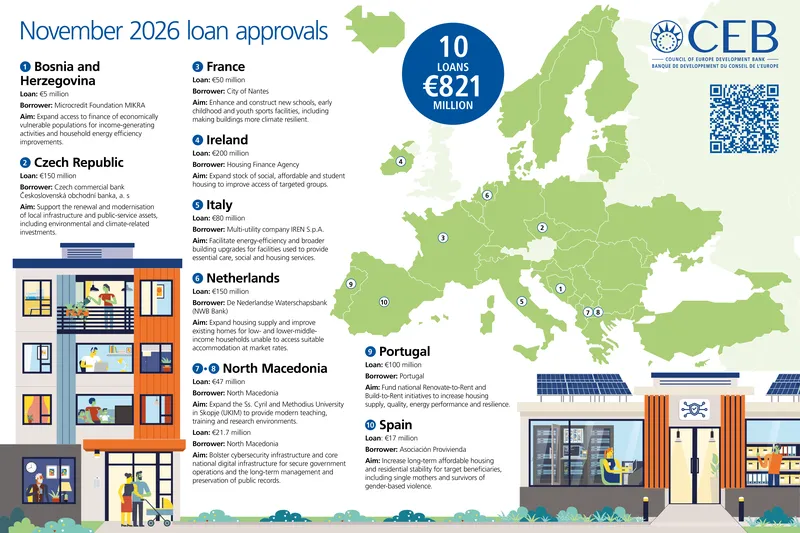
Paris – The CEB has approved 10 new loans totalling €821 million for socially focused investment projects across Europe. Almost half of the financing will go towards social and affordable housing, while the remainder will help improve local infrastructure, education, financial inclusion and digitalisation. Together, these projects will broaden access to essential services, benefit vulnerable and underserved groups, and build stronger, more resilient communities.
BOSNIA AND HERZEGOVINA: A €5 million loan to the Microcredit Foundation MIKRA will expand access to finance for economically vulnerable, low-income and financially excluded people across the country, particularly small-scale farmers and micro-entrepreneurs in rural communities. The loan will finance income-generating activities and energy efficiency improvements, to the benefit of around 3 000 microenterprises. At least 65% of the financing expected to benefit women and women-led businesses. This programme follows a CEB’s initial loan of €3 million to MIKRA in 2024.
CZECH REPUBLIC: A €150 million loan to commercial bank Československá obchodní banka (ČSOB CZ) will finance local infrastructure and public services throughout the country, including transport, schools, public buildings, utilities and community facilities. About 15% of CEB financing will target investments in the Czech Just Transition regions. Overall, the programme will improve the quality, safety, accessibility and resilience of essential local services. It builds on a previous loan of €60 million approved in 2022.
FRANCE: A €50 million loan to the City of Nantes will enable investments in schools, early childhood and sports facilities between 2026 and 2029, allowing the city to respond to population growth while reducing inequalities in access to quality public services. The loan will finance new and renovated infrastructure to improve learning, childcare and working conditions and strengthen climate resilience. More than 1 800 children will benefit from investment in schools and early childhood facilities, around half of them in areas with significant educational and social needs.
IRELAND: A €200 million loan to the Housing Finance Agency plc (HFA) will help deliver social, affordable and student housing, in response to Ireland’s significant housing shortage and affordability pressures. The financing will construct around 1 000 new dwellings and prioritise those with the greatest housing needs, including low-income households and people who are homeless or at risk of homelessness. This loan builds on the CEB’s long-standing partnership with the HFA, with €600 million in CEB financing approved since 2009.
ITALY: An €80 million loan to the multi-utility company IREN S.p.A. will finance the energy-efficient renovation of social care facilities and public housing in northern and central Italy. More than 125 projects will improve energy efficiency, accessibility and safety while providing better living and care conditions for around 8 550 beneficiaries, particularly older people, people with disabilities and low-income households. By lowering energy consumption and costs, the investments will also help tackle energy poverty and enhance the long-term sustainability of vital social services.
NETHERLANDS: A €150 million loan to De Nederlandse Waterschapsbank (NWB Bank) will support the construction and renovation of social housing, helping ease the Netherlands' significant housing shortage. The financing is expected to deliver more than 2 000 homes for over 4 000 people, primarily low- and lower-middle-income households unable to access housing on the private market. The investments will improve housing quality, accessibility and energy performance, while ensuring that homes remain affordable through regulated rents and allocation rules. This financing builds on the CEB’s prior collaboration with NWB Bank, following a €300 million CEB loan approved in 2018.
NORTH MACEDONIA: A €21.7 million loan to North Macedonia will strengthen the security, reliance and reliability of digital public services and official records nationwide. The loan will bolster the cybersecurity infrastructure of around 100 public institutions and establish a national electronic archive and records management system. It will help safeguard access to essential public services and official records for all the country’s residents and 72 000 businesses by reducing the risk of service disruptions and documentation loss.
A €47 million loan to North Macedonia for Ss. Cyril and Methodius University in Skopje (UKIM) will fund new facilities for its computer science and sports education faculties, providing modern teaching, training and research environments for more than 6 000 students and staff members each year. The project will strengthen higher education and skills development in fields with strong relevance to the labour market.
PORTUGAL: A €100 million loan to Portugal will support IFRRU 2030, a financial instrument providing favourable bank loans to expand the supply of affordable and moderate-rent housing and bring vacant or degraded properties back into use. By funding the national Renovate-to-Rent and Build-to-Rent initiatives, CEB financing will help increase the supply and quality of rental housing while improving its energy performance and resilience. The IFRRU 2030 instrument aims to mobilise around €1 billion in public and private investment to deliver approximately 6 200 rental homes overall between 2027 and 2030.
SPAIN: A €17 million loan to the national housing non-profit Asociación Provivienda, supported by a partial InvestEU guarantee, will finance the purchase and renovation of approximately 200 social and affordable rental properties, expanding access to secure, high-quality housing. The investment will benefit around 200 households, including low-income households and people at risk of homelessness. With a particular focus on women and vulnerable groups, around 38% of beneficiary households are expected to be for single-mother households and around 5% are expected to be for survivors of gender-based violence.
The Council of Europe Development Bank (CEB) is a multilateral development bank with an exclusively social mandate from its 43 member countries. The CEB finances investment projects and provides technical assistance in social sectors such as education, health and affordable housing, while focusing on the needs of vulnerable people, as well as on the social dimensions of climate change and the environment. Borrowers include governments, local and regional authorities, public and private banks, non-profit organisations and others. The CEB, which has a triple-A credit rating, funds itself through international capital markets. In addition, the CEB receives funds from donors to complement its activities.