News
CEB approves fourteen loans totalling €1.2 billion
19 June 2026
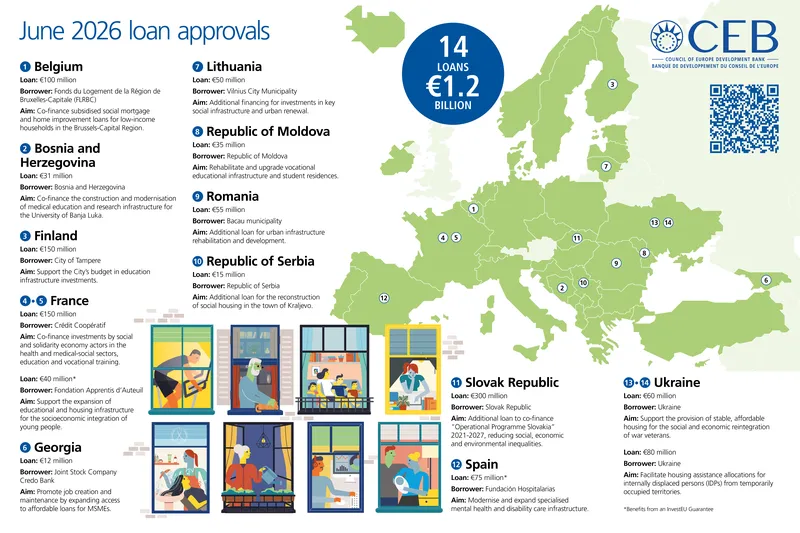
PARIS – The Council of Europe Development Bank (CEB) has approved 14 new loans totalling €1.2 billion for social investment across Europe. The financing targets key sectors including housing, education, healthcare and social inclusion, with significant support to Target Group Countries. Two additional loans for Ukraine bring total CEB approvals for the country to over €800 million since its accession to the Bank in June 2023.
BELGIUM: A €100 million loan to the Fonds du Logement de la Région de Bruxelles-Capitale (FLRBC) will increase access to affordable housing finance for households in the capital region with limited access to conventional long-term mortgages. The programme will support socially targeted mortgage lending for owner-occupied housing, as well as renovations and energy efficiency improvements. It is expected to deliver around 1 100 housing solutions, benefitting approximately 3 300 persons, including first-time buyers, single-parent families and individuals from migrant backgrounds as well as households with limited disposal income facing language and administrative barriers.
BOSNIA AND HERZEGOVINA: A €31 million loan will finance the development of an integrated medical education and research campus at the University of Banja Luka. The project will bring together clinical, academic and research functions, replace dispersed infrastructure, improve integration with the University Clinical Centre. It will deliver modern, energy-efficient facilities that benefit patients, healthcare professionals, students and teaching and research staff.
FINLAND: A €150 million loan to the City of Tampere will support the expansion and modernisation of its education infrastructure in response to rapid population growth and increasing diversity. By financing the construction, extension and renovation of daycare centres and schools, the project will improve access to inclusive, high-quality learning environments, particularly in socio-economically disadvantaged areas. The CEB loan is the fourth to the city of Tampere and will co-finance the city’s 2026-2030 Investment Programme. It will benefit children and teaching staff across all education levels by improving capacity, quality, and equity in education provision.
FRANCE: A €150 million loan to Crédit Coopératif will improve access to affordable healthcare, social services, education and professional development programmes for vulnerable groups across France. The financing will support the construction, renovation and modernisation of facilities, as well as the provision of essential equipment, with a particular focus on health and medical social infrastructure. It will benefit people with disabilities, those experiencing poverty, elderly people with reduced autonomy, protected minors, students and education professionals. Based on a well-established partnership that now includes seven loans since 2007, this initiative will deliver tangible social impact by improving access to services, the quality of care and inclusion.
A €40 million loan will fund the redevelopment of the Paris site of Fondation Apprentis d’Auteuil, expanding access to integrated social, educational and housing services for vulnerable young people and families. The project, which is co-financed with the European Investment Bank, and backed by an InvestEU guarantee, will strengthen child protection and family support, provide dedicated housing for unaccompanied minors and young adults, and improve education and vocational training opportunities. It will also deliver over 140 social housing units, improving living conditions and supporting individuals and families on their integration and social inclusion journey. This second loan to the Fondation, following one in 2023 to modernise their campus in Meudon, is expected to benefit a wide range of vulnerable groups, including children, adolescents, young adults and families facing poverty or social exclusion.
GEORGIA: A €12 million loan to Joint Stock Company Credo Bank will increase the availability of finance for approximately 400 micro-, small- and medium-sized enterprises, particularly in underserved rural areas. By supporting business growth, formalisation and resilience, the programme will help to create jobs, strengthen livelihoods and reduce regional disparities. At least 30% of the funding is earmarked for women-led enterprises to promote women’s entrepreneurship and inclusion. Overall, the operation will address critical financing gaps and contribute to more inclusive, balanced and sustainable economic development.
LITHUANIA: A €50 million additional loan to the City of Vilnius will support the municipality’s investment programme across education, mobility, environment and social infrastructure, improving service accessibility and urban sustainability for around
636 000 residents, including children, the elderly and persons with disabilities. The programme will support both EU‑funded and municipal investments in the delivery of inclusive, high‑quality public services. This additional financing to an initial €50 million loan brings total CEB lending for the programme to €100 million, building on a strong partnership with the municipality and a proven track record of tangible social impact.
REPUBLIC OF MOLDOVA: A €35 million loan will support the modernisation of 15 vocational education and training institutions across the country. This will improve learning conditions and skills development in key sectors such as agriculture, construction, energy and information and communication technology. The programme will upgrade infrastructure and provide modern equipment, while also improving energy efficiency, climate resilience and accessibility. It will also refurbish 10 student residences, enhancing living conditions. By creating safer, more inclusive and better-equipped environments, the project will benefit around 17 000 students, strengthen the labour market relevance of vocational education, and enhance broader economic and social resilience.
ROMANIA: A €55 million additional loan will support further investments in education, vocational training, urban regeneration and cultural heritage in the city of Bacău. The financing will improve school capacity and safety, expand green spaces and rehabilitate key heritage sites, while enhancing environmental quality and sustainability. It is expected to benefit the city’s 190 000 residents, with around 9 200 students, including children with disabilities, directly taking advantage from upgraded education facilities. By combining social infrastructure improvements with energy efficiency and inclusive design features, the project will strengthen quality of life and promote more resilient and inclusive urban development.
SERBIA: An additional loan of €15 million will support the completion of post-earthquake housing reconstruction in the city of Kraljevo, ensuring continued progress towards core technical and social objectives. The project will co-finance the construction of four residential buildings comprising 366 apartments, bringing the total project cost to around €29 million. The project will provide safe, modern, energy-efficient housing to replace damaged and inadequate dwellings. Around 366 families, representing around 1 000 people, are expected to benefit directly, while wider urban regeneration efforts will improve living conditions for the city’s broader population of approximately 55 000 residents.
SLOVAK REPUBLIC: An additional loan of €300 million will co-finance key state budget priorities under the Operational Programme Slovakia 2021-2027, which focuses on policy objectives “A More Social and Inclusive Europe”, “Europe Closer to Citizens” and “Just Transition Fund”. CEB financing will target investments that have high social value, such as inclusive education, community-based services, improved access to employment and support for vulnerable groups. The programme is expected to support over 500 infrastructure projects and improve access to services for over 1.5 million people, including vulnerable and marginalised groups.
SPAIN: A €75 million loan to Fundación Hospitalarias will finance the modernisation and expansion of social and healthcare infrastructure across Spain, with a particular focus on mental health services for people with mental health conditions and intellectual disabilities. The programme will improve access to care as well upgrade hospitals, residential facilities and community-based services, while reinforcing more inclusive, people-centred care models. The foundation already provides over one million residential, inpatient stays and around 1.3 million outpatient and support services each year. Backed by an InvestEU guarantee, the loan will support the foundation’s investment plan for the period 2025–2030.
UKRAINE: An €80 million loan will support the authorities’ plan to restore access to adequate housing for internally displaced persons (IDPs) from temporarily occupied territories. Given the extensive damage to and destruction of housing, the loan will provide one-off housing vouchers to eligible IDPs for home purchases. Complementing national budget resources, the programme is expected to finance around 2 000 housing allocations, prioritising those most affected by the war, including people with disabilities. By focusing on groups that are structurally excluded from existing support mechanisms, the programme will enhance access to housing assistance in a conflict-affected context.
A €60 million loan will provide adequate housing for war veterans by financing long-term mortgages on preferential terms. Implemented in cooperation with national authorities and administered by the State Fund for the Promotion of Youth Housing. In a context of acute housing needs and limited access to finance, the CEB loan will support a targeted concessional scheme enabling eligible veterans to purchase housing units available on the market. This scheme is expected to support around 1 100 beneficiaries initially, with potential to reach up to 1 500 over time, particularly among combat participants and persons with war-related disabilities.
The Council of Europe Development Bank (CEB) is a multilateral development bank with an exclusively social mandate from its 43 member countries. The CEB finances investment projects and provides technical assistance in social sectors such as education, health and affordable housing, while focusing on the needs of vulnerable people, as well as on the social dimensions of climate change and the environment. Borrowers include governments, local and regional authorities, public and private banks, non-profit organisations and others. The CEB, which has a triple-A credit rating, funds itself through international capital markets. In addition, the CEB receives funds from donors to complement its activities.