News
CEB approves 10 loans totalling €1.3 billion
02 October 2026
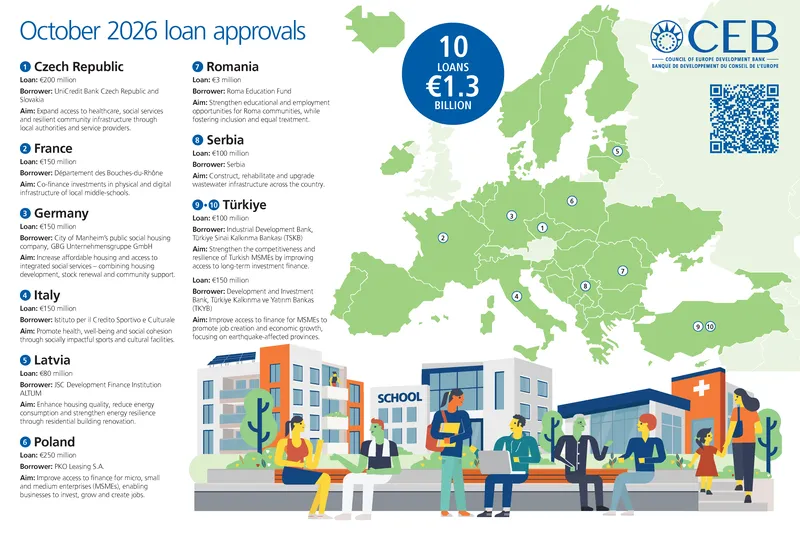
PARIS – The Council of Europe Development Bank (CEB) has approved 10 new loans totalling €1.3 billion to promote social cohesion and inclusive development in Europe. Two-thirds of this lending is directed at the CEB’s Target Group Countries to reduce social and economic disparities through investments in micro, small and medium-sized enterprises (MSMEs), affordable housing, education and regional development.
CZECH REPUBLIC: A €200 million loan to UniCredit Bank Czech Republic and Slovakia will increase investment in a pipeline of projects, including the construction, modernisation and rehabilitation of hospitals, clinics, social care facilities and essential municipal infrastructure throughout the Czech Republic. The programme will also finance energy efficiency improvements and facilities for older people and people with disabilities. Around 15% of allocations for municipal and regional infrastructure are expected to benefit Just Transition regions facing elevated social and economic challenges.
FRANCE: A €150 million loan to the Department of Bouches-du-Rhône will support the modernisation of public secondary schools under the Plan Charlemagne, a major programme to renovate, modernise and digitalise schools across the region. The financing will contribute to the construction, renovation and upgrading of 22 school facilities between 2026 and 2030, as well as the deployment of digital infrastructure and equipment. The project will enhance accessibility, energy performance, climate resilience and safety standards, benefitting over 13 000 students. Investments in nine schools, representing 40% of the total loan, will be in disadvantaged priority urban neighbourhoods in order to reinforce equal opportunities and improve learning environments.
GERMANY: A €150 million loan to the City of Mannheim’s municipal housing company, GBG Unternehmensgruppe GmbH, will expand affordable housing and social infrastructure in Mannheim. The investment will create, convert and modernise more than 1 900 housing units and provide essential social infrastructure, including childcare facilities, housing with care services for older people and a women’s shelter. More than half of the 815 new units will be reserved for social and supported housing. The project is expected to benefit over 4 000 residents, with a particular focus on vulnerable groups such as low-income families, refugees and migrants, older people, people with disabilities, and women and children affected by domestic violence.
ITALY: A €150 million loan to Istituto per il Credito Sportivo e Culturale will fund investments in sports and cultural infrastructure across Italy. By financing the projects of around 300 local authorities, the loan will contribute to the creation of more inclusive and resilient communities. Initiatives will include improving access to sports and cultural facilities, promoting health and well-being, strengthening youth engagement, enhancing accessibility for people with disabilities and supporting active ageing. The programme is expected to benefit over 8 million people across Italy, including vulnerable groups such as young people, older people and people with disabilities.
LATVIA: An €80 million loan to the state-owned \ JSC Development Finance Institution ALTUM, will support the renovation of multi-apartment residential buildings and improve living conditions across the country. The financing will enhance energy efficiency, reduce household energy costs and alleviate energy poverty. Works will include thermal insulation, the modernisation of heating and ventilation systems, the installation of renewable energy solutions and the refurbishment of communal areas. The programme is expected to renovate around 130 residential buildings, benefitting more than 5 000 households, prioritising low-income residents, older people and other vulnerable groups.
POLAND: A €250 million loan to PKO Leasing will improve access to finance for MSMEs across the country, enabling businesses to invest, grow and create jobs. The operation places a strong focus on inclusion, with 35% of the funding earmarked for economically disadvantaged regions, including eastern Poland and lower-income border areas, as well as 30% dedicated to women-owned or women-led businesses. The financing will be particularly valuable for micro and small enterprises, which face the greatest challenges in securing affordable funding. Around 6% of the loan is expected to support green assets, contributing to a more inclusive, resilient and sustainable economy.
ROMANIA: A €3 million loan to the Roma Education Fund (REF) will promote the educational and social inclusion of vulnerable Roma communities across the country. The financing will help sustain a wide range of initiatives in education, skills development, employability and anti-discrimination, ensuring the continuity of activities, while awaiting reimbursement from international grant funding sources. The programme will offer mentoring, vocational training, job placement, teacher training and remedial education to help beneficiaries progress from education to employment and long-term social participation. It is expected to reach at least 10 300 Roma people, including children and young people, unemployed adults, women and girls, people with disabilities and other vulnerable groups.
SERBIA: A €100 million loan will enable the construction and upgrading of wastewater infrastructure across the country. The financing will contribute to a broader national investment programme aimed at expanding sewerage networks and wastewater treatment capacity. This investment will help address long-standing infrastructure gaps and improve access to essential public services. The first phase is expected to benefit around 153 000 people in eight municipalities, while the wider programme could reach approximately 327 000 residents across 17 municipalities. By enhancing environmental protection, public health and living conditions, the project will promote more balanced territorial development and support Serbia’s progress towards EU environmental standards.
TÜRKIYE: A €150 million loan to the Development and Investment Bank of Türkiye, Türkiye Kalkınma ve Yatırım Bankasi (TKYB) will provide long-term financing to strengthen the recovery and resilience of MSMEs in the aftermath of the 2023 earthquakes. At least half of the financing will be directed towards businesses operating in the affected provinces, helping to restore economic activity, sustain employment and strengthen local resilience. The programme is expected to support around 150 to 200 enterprises by expanding their access to affordable long-term finance and include measures to encourage investments that enhance women’s participation in the workforce.
A €100 million loan to Türkiye’s Industrial Development Bank, Türkiye Sinai Kalkınma Bankası (TSKB), will improve access to long-term finance for MSMEs across the country. The financing will support investment, working capital and job creation in around 100 enterprises. At least 50% of the funding will be directed to enterprises operating in the earthquake-affected provinces, helping sustain economic recovery and strengthen business continuity in the region. The programme will includer investments that enhance climate and disaster resilience, while also promoting women’s employment and participation in management. In doing so, it will contribute to a more inclusive, resilient and sustainable economy.
The Council of Europe Development Bank (CEB) is a multilateral development bank with an exclusively social mandate from its 43 member countries. The CEB finances investment projects and provides technical assistance in social sectors such as education, health and affordable housing, while focusing on the needs of vulnerable people, as well as on the social dimensions of climate change and the environment. Borrowers include governments, local and regional authorities, public and private banks, non-profit organisations and others. The CEB, which has a triple-A credit rating, funds itself through international capital markets. In addition, the CEB receives funds from donors to complement its activities.