News
Ukraine participates in the CEB’s 56th annual Joint Meeting
09 June 2023
BREAKING NEWS : UKRAINE COMPLETES ACCESSION PROCESS TO BECOME THE CEB'S 43RD MEMBER STATE 15 JUNE.
Athens 9 June - Following the unanimous adoption by the Verkhovna Rada, Ukraine’s Parliament, of the law that allows the country to join the CEB, and its signature by President Zelenskyy, high-level representatives from the Government of Ukraine participated in the CEB Joint Meeting.
The annual Joint Meeting, hosted by Greece this year, took place in Athens today. It brought together the CEB’s governing bodies and management to discuss strategic and policy priorities for the Bank as well as to approve new projects.
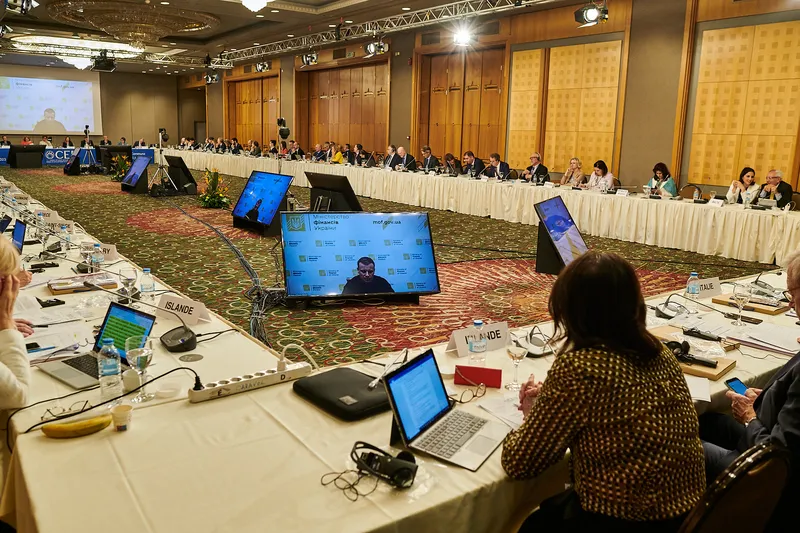
The Deputy Prime Minister for Restoration of Ukraine and Minister for Communities, Territories and Infrastructure Development, Oleksandr Kubrakov, and the Minister of Finance of Ukraine, Sergii Marchenko, participated virtually, while the Permanent Representative of Ukraine to the Council of Europe, Borys Tarasyuk, attended in person.
Deputy Prime Minister Kubrakov thanked the CEB for its support in making Ukraine’s membership in the Bank possible and for the help it has already provided to the Ukrainian people. “Today, it is important to lay a solid foundation for the restoration of social infrastructure, which is an area in which the CEB has extensive expertise. In particular, we are interested in the Bank’s participation in the restoration of housing, healthcare and education facilities, as well as the development of a network of rehabilitation centres for veterans. It is important for us to create conditions for the return of Ukrainians who were forced to leave their homes. The CEB’s experience is indispensable here”, said the Deputy Prime Minister.
Minister Marchenko stressed that: “The decision of Ukraine to join the CEB opens new horizons for development. It will contribute to the financial stability, recovery, and our aspirations to be a part of the EU. Without the help of international partners, it will be difficult to recover Ukraine. The Ukrainian Government looks forward to an active and important role of the CEB in this process.”
The Bank will operate in Ukraine, with a distinct focus on social sectors, such as healthcare and housing, deploying its long-standing expertise as Europe’s oldest multilateral development bank. This is especially important as needs have increased in these sectors due to recent attacks on critical infrastructure. The Bank’s Strategic Framework 2023-2027 envisages a volume of operations of around €200 million this year, increasing gradually to about €400 million per year by 2027.
Governor Monticelli emphasised: “Ukraine’s accession to the CEB will be a great honour. It is a testimony to the confidence that Ukraine places in the CEB’s capacity to deliver and its value-added to support the country’s recovery, reconstruction and long-term social development. The Bank will work hard to live up to this trust.”
Ukraine’s participation in the Joint Meeting happens less than a year after the country formally requested to become a member of the CEB in June 2022. At the Joint Meeting in July 2022, the CEB’s member states unanimously endorsed Ukraine’s request, and as a tangible sign of support in light of the exceptional circumstances that Ukraine is facing, agreed to exonerate the country of any payment requirement for accession.
About the CEB
The Council of Europe Development Bank (CEB) is a multilateral development bank whose unique mission is to promote social cohesion throughout Europe. The CEB finances investment in social sectors, including education, health and affordable housing, with a focus on the needs of vulnerable people. Borrowers include governments, local and regional authorities, public and private banks, non-profit organisations and others. As a multilateral bank with an excellent credit rating, the CEB funds itself on the international capital markets. It approves projects according to strict social, environmental and governance criteria, and provides technical assistance. In addition, the CEB receives funds from donors to complement its activities.
The CEB has 42 member states. It was established originally as a refugee fund in 1956 by eight of the 15 member states that made up the Council of Europe at the time. The CEB is Europe’s oldest multilateral development bank, and is legally and financially separate from the Council of Europe.