Strengthening Europe’s social fabric
For the CEB, 2025 proved to be another defining year, characterised by steadfast delivery on its commitment to strengthening social cohesion in Europe, while demonstrating leadership on the global stage by chairing the Heads of Multilateral Development Banks (MDBs) Group for the first time.
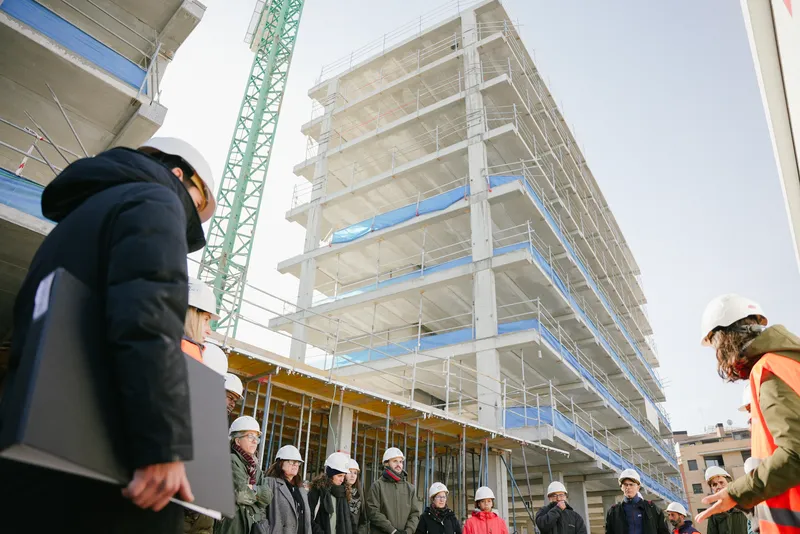
In particular, it was a year for taking stock of the CEB’s progress midway through the ambitious programme it set out under the Strategic Framework 2023-2027, assessing the way forward as it prepares to mark its 70th anniversary in 2026, and assuring the Bank’s ongoing relevance and impact in a shifting geopolitical and economic landscape.
By prioritising three lines of action – investing in people and enhancing human capital, promoting inclusive and resilient living environments, and supporting jobs and economic and financial inclusion – CEB has steadily advanced towards the Framework’s overarching goals: addressing social inclusion in a responsive manner, helping integrate displaced populations and migrants, and supporting the reconstruction of Ukraine’s vital social infrastructure. By rigorously applying its “vulnerability lens” (an operational tool that allows the Bank to better target its social investments where they are most needed and reaffirm its focus on assisting the most disadvantaged and marginalised members of society) to its lending operations, while advancing cross-cutting issues such as gender equality and climate action, the Bank actively endeavoured to promote inclusiveness and social cohesion as pillars of Europe’s resilience.
Guided by the Strategic Framework, the CEB has achieved solid results in three-years between 2023-2025: over €13.1 billion in loans approved for 146 projects across 34 countries, thereby meeting the indicative lending volume of €4.3 billion per year set out in the Strategic Framework. Over half of its loan projects were channelled to Target Group Countries, helping them address pressing social investment needs.
2025: a year of unflinching commitment
Buoyed by a robust financial position, the CEB again demonstrated its unflinching commitment to addressing the evolving social development needs of its member countries by approving 54 new loan projects worth €4.5 billion across 26 countries in 2025, with a particular focus on vulnerable populations.
Support for Ukraine continued strong as a strategic priority, with Russia’s brutal aggression showing no sign of abating during the year (see CEB and Ukraine web page).
Six loan projects bring CEB’s financial support to its newest member country to over €570 million in loans and grants since its accession in 2023, with other funding for approval through 2027 expected to bring the total to €1.2 billion overall.
Examples of such projects in 2025 include a €200 million loan agreement to support the Government of Ukraine’s assistance programme for internally displaced persons (IDPs). The loan, which was signed at the Ukraine Recovery Conference in Rome, represented the Bank’s largest loan to Ukraine, providing essential accommodation and subsistence to over 1.2 million displaced people. On the margins of the same conference, the CEB and Ukraine agreed a loan of €100 million for urgent rehousing of Ukrainians whose homes were destroyed by the war.
Donations to the Ukraine Solidarity Fund (USF) created in 2023 have provided welcome extra support, with Germany adding €1.5 million in 2025, its second contribution to the USF, which brings total contributions of all donors to the USF to €6.6 million at the end of the year (see Trust funds in support of CEB social action).
The CEB also furthered its financing to neighbouring countries coping with refugees, notably Poland with a new additional €175 million loan to support Poland’s Aid Fund for people from Ukraine under temporary protection. Since 2022, the Bank has provided around €1.5 billion in loans and grants to assist refugees from Ukraine and their host communities in CEB member countries.
More broadly, CEB loan projects contributed to strengthening social cohesion across Europe by delivering impact in key social sectors, such as health and social care, rural development, social housing, microenterprise and jobs, and culture and sports, notably in Target Group Countries (see selected examples in ‘The Strategic Framework in action’ section, and a full list of approved loan projects under Country snapshots at the end of this report and online at https://coebank.org/en/project-financing/projects-approved-administrative-council/).
Sound financial position
The CEB maintained a solid financial position throughout 2025 despite a challenging global economic and geopolitical environment. In this context, the Bank recorded a slight decline of 2.6% in core earnings, to €129.9 million, reflecting its prudent asset management approach. Volatility outside core earnings affected markets in the second half of the year. Nevertheless, the CEB delivered a stable net profit of €122.3 million as at 31 December 2025.
The Bank’s creditworthiness remained unimpeachable, with major rating agencies Moody’s, Standard & Poor’s, Fitch, and Scope Ratings, all reaffirming top-tier credit ratings with stable outlooks. Its financial solidity, buoyed by a stronger capital base following the successful closing of the subscription period for the CEB’s 7th capital increase in December 2024, underpinned successful capital market activities. The CEB kicked off the year by issuing its debut GBP 300 million Social Inclusion Bond (SIB) in January 2025, a transaction that further diversified the Bank’s funding sources, while underscoring investor confidence in social investments. SIBs represented more than 40% of the CEB’s borrowing volume in 2025, with issuances having surged to a total of around €13.5 billion since the CEB’s Social Inclusion Bond Framework was established in 2017 (see Financial market activities).
Heads of MDBs Group: Taking the helm

A highlight of the year was the CEB’s debut as chair of the Heads of MDBs Group, a forum for dialogue and coordination bringing together leaders from the 10 major multilateral development banks (MDBs) and the IMF Managing Director, which is committed to stronger system-wide collaboration to achieve greater impact and scale for member countries. This work has become increasingly important in light of pressing global challenges.
As chair, a role which rotates annually, the CEB steered the group to operate as a unified “system”, leveraging individual and collective strengths to tackle global challenges and accelerate progress towards sustainable development. It demonstrated leadership at high-level meetings throughout the year – in the margins of IMF-World Bank Group gatherings in Washington DC, at G20 Summits in South Africa and as the host of a first-ever Heads of MDB meeting in Paris – during which MDBs reaffirmed their commitment to advancing the G20 Roadmap towards Better, Bigger, and More Effective MDBs, endorsed by G20 Leaders in October 2024. On behalf of the Heads of MDBs Group, Governor Monticelli championed scaling up lending capacity and strengthening operational collaboration across MDBs, and brought a renewed, system-wide focus to social infrastructure as a strategic investment for inclusive growth, job creation and resilience in all countries and regions. The CEB also coordinated MDB inputs and represented the MDBs Group in UN system engagements ahead of and during the Fourth UN Financing for Development Conference in Sevilla, enhancing MDBs coherence as a group and the CEB’s visibility within the multilateral system.
With the CEB at the helm, the MDBs Group achieved significant milestones. First, the implementation of the G20 Roadmap was advanced, including by enhancing domestic and private sector resource mobilisation, improving impact measurement, effecting mutual reliance agreements (MRAs) to facilitate MDB co-financing, including the first two MRAs for the CEB with the EIB and the European Bank for Reconstruction and Development (EBRD), and contributing to the MDB co-financing portal, as well as supporting over 30 country platforms aimed at tailoring MDB efforts to national priorities.
Another achievement was under the Capital Adequacy Framework review, when the Group identified additional lending headroom totalling US$650 billion across all MDBs’ countries of operation for the next decade.
Coordinating and publishing the first-ever MDBs Comparison Report 2025 was a further breakthrough, providing transparency and comparability on financial positions and financial management across the MDB system, as called for by the G20. The CEB also coordinated Social Infrastructure in Focus: the Role of MDBs, a joint report highlighting the MDBs’ lynchpin contributions to supporting healthcare, education, housing, and water and sanitation, which are vital sectors for resilience and the Sustainable Development Goals (SDGs), accounting for around 22% of MDB commitments in 2019-23.
Chairing the Heads of MDBs Group strengthened CEB’s visibility and position within the global financial architecture, enhanced its engagement with other MDBs, the G20 and the UN system, and consolidated its position as an important international player in social investment.
Working together for impact
The CEB’s close collaboration with other MDBs reflects its strong commitment to strengthening partnerships more broadly, including with country donors, international organisations, civil society and the private sector, to boost its capacity and impact.
Working with the European Union (EU) has been key. For instance, the flagship InvestEU programme enabled the CEB to generate almost €620 million in new funding for social development (see the InvestEU highlight).
Other EU-related highlights include the conclusion of the Housing and Empowerment for Roma (HERO), a four-year pilot initiative implemented by the CEB with funding from the European Parliament and Spain, which promoted the inclusion of vulnerable Roma communities in Bulgaria, Romania, and the Slovak Republic through employment support and financial education (see Trust funds in support of CEB social action and Collaboration and partnerships for more detail).
Another is the CEB’s collaboration with the European Commission’s DG HOME under the Partnerships and Financing for Migrant Inclusion (PAFMI), which has provided training and microloans to over 3 000 migrants in Belgium, Finland, Italy and the Netherlands.
The CEB remains an active participant in the Finance in Common (FiCS), a strategic network of public development banks, and championed the importance of social investment at the 2025 FiCS summit in South Africa.
To advance the social dimensions of climate action, the Bank worked with peer institutions on developing metrics, and to issue a call to action on resilience and a just transition at COP30 in Brazil in November. In December, the CEB hosted a high-level seminar to mark the 10th anniversary of the Paris Agreement.
The CEB continued its participation in the Paris Dialogue to promote sustainable development alongside other Paris-based organisations, such as the OECD and UNESCO.
It also strengthened its technical influence within the International Capital Market Association (ICMA) by joining the Executive Committee that sets global standards for sustainable bond markets.
The Bank’s belief in community engagement and grassroots initiatives was demonstrated by the sixth annual CEB Award for Social Cohesion, which was won by Digital Twin from Türkiye for its work on disaster preparedness (see Disaster management project Digital Twin).
Making CEB future fit
The CEB’s social mission is more relevant than ever, and to meet the expectations of its member countries, it has continued to take steps to prepare and equip the institution for future challenges.
In 2025, it improved its accountability frameworks to strengthen compliance, independent evaluation and internal audit functions, and further sharpened its outreach and communications tools.
In pursuit of greater efficiency and future-readiness, in 2025, the CEB updated and digitised internal operations under the IT Masterplan approved in 2024, improved data management and collaborative tools, notably with the rollout of an integrated Enterprise Resource Planning (ERP) system, upgraded its core banking system and assessed AI opportunities. These advances will enhance the CEB’s ability to support its member countries and help them deliver tangible improvements for people and communities.
©CEB 2026